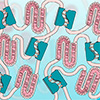
Mirror image crystals of poly(lactic acid) act as reversible crosslinks in a phase change material, delivering high latent heat, strong mechanics, and full recyclability at once.
(Nanowerk Spotlight) Poly(lactic acid) is the plastic behind most compostable coffee cups and cutlery. It is built from lactic acid, a small molecule that happens to exist in two forms that are mirror images of each other, the way a left hand mirrors a right. Chemists call them the L and D forms. Almost all commercial poly(lactic acid) is made from the L form alone. The D form exists but has to be synthesized deliberately in the lab, which is why you will not find it in a coffee cup.
Something unusual happens when a chemist deliberately combines chains of the two forms in equal parts in the lab. The oppositely handed chains interlock and pack into tiny crystals far more tightly than either form manages alone, held in place by a dense web of hydrogen bonds between them. These structures, called stereocomplex crystallites, are tough enough to act like structural rivets inside a softer material, yet they can be taken apart and reassembled with heat or the right solvent.
This behavior turns out to solve a stubborn problem in thermal energy storage. The problem centers on polyethylene glycol, a cheap polymer that stores impressive amounts of heat as it melts and releases that heat as it solidifies. It is a natural fit for phase change materials for thermal management in solar collectors, battery packs, and electronics, except that once it melts, it flows out of whatever is holding it.
The standard fix is to lock its chains inside a rigid polymer scaffold held together by permanent chemical bonds. That stops the leaking but blocks recycling and cuts the amount of heat the material can store, because the bonds interfere with how polyethylene glycol packs into its crystal form. Researchers call the result an impossible triangle, in which high energy capacity, mechanical toughness, and recyclability appear to be mutually exclusive.
Schematic of the synthetic olid-solid phase change material architecture featuring sc-PLA physical crosslinks. (Image: Reproduced with permission from Wiley-VCH Verlag)
The researchers built their material in a single chemical step. Polyethylene glycol is linked to chains of both the L and D forms of poly(lactic acid) using a short connecting molecule called hexamethylene diisocyanate, producing one continuous network.
As the mixture cures, the oppositely handed poly(lactic acid) chains pair up and lock into stereocomplex crystallites scattered throughout the polyethylene glycol matrix. The polyethylene glycol handles the heat storage. The crystallites hold everything together, strong enough to keep the material solid and shaped yet reversible enough to be melted down and remade.
The critical question was whether the crystallites were real, and whether they were genuinely stereocomplex rather than ordinary single-handed ones. A simple solvent test gave the first answer. A control sample containing only the L form dissolved completely in dichloromethane within 12 hours, behaving like an ordinary linear polymer with nothing holding it together. The version containing both forms merely swelled in the same solvent and kept its shape, which meant something was physically tying the chains together.
Diffraction measurements pinned down what that something was. As the D form was added, the signals characteristic of single-handed crystallites disappeared and were replaced by new signals at angles that match the tighter stereocomplex packing. A thermal test confirmed the interpretation, revealing a single melting transition at 204 °C, well above the temperature at which either form alone would melt. That is the unmistakable signature of interlocked L and D chains.
The mechanical numbers that follow from this architecture are unusual for a phase change material. The best-performing composition reached a tensile strength of 30.1 MPa while stretching to 1,427% of its original length before breaking, meaning a strip can be pulled to more than fourteen times its starting size without snapping. A thin sheet measuring 40 × 40 × 0.5 mm³ supported a 500 g weight without failing, more than 50,000 times the sheet’s own mass, and samples survived folding, knotting, and repeated deformation without visible damage.
At 80 °C, well above the polyethylene glycol melting point, the stereocomplex network held its shape under load while a control sample lacking the stereocomplex crosslinks sagged and flowed. The latent heat reached 122.4 J g⁻¹ in the formulation with the highest-molecular-weight polyethylene glycol, which the paper’s own comparison places among the highest values reported for flexible phase change materials. Two hundred thermal cycles produced no measurable change in storage capacity.
Recyclability was tested in two different ways. Fragments dissolved fully in hexafluoroisopropanol, a solvent strong enough to break up stereocomplex crystallites, within 10 minutes, and the resulting solution could be cast into a new homogeneous film after the solvent evaporated. Alternatively, pieces cut from a bulk sample were pressed back together at 120 °C under modest pressure, where the stereocomplex crystallites briefly came apart and reformed across the cut surfaces. Five rounds of solvent recycling or hot-pressing left the mechanical and thermal properties essentially unchanged.
A soil burial test underscored the contrast with conventional systems. After 60 days in a garden plot, the stereocomplex material had visibly disintegrated, while a chemically crosslinked control of the same dimensions remained fully intact. The poly(lactic acid) segments holding the stereocomplex network together are vulnerable to water and microbes under humid soil conditions, and once they break, the liberated polyethylene glycol chains disperse and degrade on their own.
To show the material could do useful work, the researchers blended 1 wt% carboxylated carbon nanotubes into it, which raised its solar absorptivity from about 40% to about 97%. Under simulated sunlight at the intensity of full noon sun, the composite reached 70 °C within 280 seconds and then held a distinct temperature plateau during cooling as the polyethylene glycol recrystallized and released its stored heat.
Coupled to a thermoelectric generator, a device that produces electricity from a temperature difference, the composite produced 50.7% more electrical energy during the cooling phase than an equivalent sample built around plain poly(lactic acid) and carbon nanotubes.
The result fits alongside other nanomaterial strategies for turning heat into storable electricity, with the stored latent heat keeping a useful temperature gradient alive long after the light source was switched off and extending the period over which the device could generate electricity from a single burst of sunlight.
The broader significance of the work lies in showing that the impossible triangle was never truly impossible, only poorly posed. Treating the crosslink itself as a reversible structure rather than a permanent one allows mechanical integrity and recyclability to coexist and choosing a crosslink that does not interfere with polyethylene glycol crystallization keeps energy density high.
The same design logic could extend to other phase change chemistries and to polymer composites well beyond thermal storage, pointing toward a generation of functional materials built from the outset to be taken apart and reused rather than discarded.
For authors and communications departmentsclick to open
Lay summary
Prefilled posts
ORCID information
Xinxin Sheng (Guangdong University of Technology)
, 0000-0001-7695-0430 corresponding author
Xiang Lu (Huazhong University of Science and Technology)
, 0009-0003-2576-8737 corresponding author
Nanowerk Newsletter
Get our Nanotechnology Spotlight updates to your inbox!
Thank you!
You have successfully joined our subscriber list.
Become a Spotlight guest author! Join our large and growing group of guest contributors. Have you just published a scientific paper or have other exciting developments to share with the nanotechnology community? Here is how to publish on nanowerk.com.