Living fungi weave conductive nanoparticles into their own growing networks, amplifying bioelectric signals 9-fold and opening a path to self-assembling functional materials.
(Nanowerk Spotlight) Most manufacturing works by imposing structure on passive raw materials: melting, molding, cutting, curing. Biology works differently. A growing organism builds itself, assembling complex architectures from whatever its environment provides. Fungi are especially adept at this. As their fine filaments push through soil or organic debris, they adsorb minerals, bind proteins, and shuttle nutrients across networks that can span meters.
The same scavenging instinct that lets a fungus extract iron from rock can, it turns out, be redirected to pick up engineered particles and wire them into its own living body.
Yet in nearly all of these systems, the fungal network acts as a passive scaffold. Manufacturers either kill the organism after growth to fix the material in place or keep it alive but assign it no functional role beyond holding a shape. Its ability to sense, respond, and transport materials through its network goes largely untapped.
A study published in Advanced Functional Materials (“Shaping of Biohybrid Functional Living Materials”) puts that ability to work. Researchers at the Shaping Matter Lab within the Faculty of Aerospace Engineering at Delft University of Technology demonstrate that active fungal growth can serve as a post-printing fabrication mechanism, one in which the organism itself recruits and organizes functional particles into its expanding network.
Carbon-particle incorporation, for instance, boosts the amplitude of the fungus’s faint native bioelectric signals 9-fold, transforming a barely detectable biological phenomenon into a measurable functional output.
Schematic overview of the growth, functionalization & shaping we perform to form functional biohybrid living materials. (a) Mycelium cultivated in a shaking flask forms into pellets, with morphologies dependent on shaking rate, nutrient concentration, and incubation time. (b) Mycelium cultivated in a medium with nano- and micro-particles (i) adsorbs suspended particles into the mycelium network, forming functional pellets. (ii) Active mycelium fragments embedded into a 3D-printable bioink grow into specific, architected designs. (c) By combining these techniques, biohybrid engineered living materials can have specific functionalization along an architected feature that could, for instance, enhance the bio-electrical interface between the materials and electrodes. (Image: Reproduced from DOI:10.1002/adfm.202530836, CC BY) (click on image to enlarge)
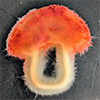
To understand how the fungus handles particles, the team first studied pellet formation. They cultured the fungal species Ganoderma lucidum in malt extract broth under agitation, where it naturally assembles into roughly spherical pellets. These pellets grow radially, with loose outer filaments, a metabolically active middle zone, and a nutrient-starved core.
Tracking pellet radii across three batches over seven days revealed that outward extension of filaments competes with shear-driven fragmentation from the agitated liquid. Adjusting the agitation rate shifts this balance, providing predictable control over pellet diameter.
The team then tested whether particles of different sizes enter these growing networks by different routes. They dispersed carbon particles of 30 nm and 45 µm in the growth medium at 1 wt%. Electron microscopy revealed two incorporation mechanisms. The nanoparticles coated individual filament walls, producing a tight armor-like shell. The larger particles became mechanically trapped within the filament mesh, with fine fibrous bridges often linking them to cell walls.
The researchers attribute these bridges to extracellular polysaccharides that the fungus naturally secretes. Electrostatic attraction could not explain the adsorption on its own, since both the particles and the pellet surfaces carried negative charges. Instead, the particles likely stick through a combination of weak molecular attractions, chemical binding at the cell surface, and physical trapping within the tangled filament network.
Controlling the timing of particle exposure enabled multi-material pellets with concentric functional layers. The team added three particle types sequentially, each for a four-day window: iron oxide nanoparticles first, then ceramic niobate-based particles, and finally carbon nanoparticles. Cross-sections of the mature pellets showed five distinct rings, each matching the particle type present during that growth phase. Elemental analysis confirmed sharp compositional boundaries, demonstrating that the fungus faithfully recorded its chemical exposure history in discrete layers.
Moving from free-floating pellets to designed structures required a printable bioink. The team formulated a cross-linkable hydrogel of κ-carrageenan, sodium alginate, agar, and a cellulose-based thickener, then mixed in active filament fragments of G. lucidum. After extrusion-based printing, calcium chloride cross-linking stabilized the geometry for submerged culture. As the fungus grew outward from the scaffold into the surrounding broth, the originally angular grids progressively rounded.
Fitting the evolving outlines to a superellipse, a mathematical curve that smoothly interpolates between a rectangle and an ellipse, allowed the team to quantify this rounding over eight days.
To restrict particles to specific regions of a printed structure, the researchers turned to a gelatin masking technique. They embedded mycelium-laden grids in gelatin and layered particle-containing media on top. The gelatin shielded covered regions while exposed surfaces accumulated particles. As the gelatin gradually swelled and dissolved, it revealed deeper areas and created a gradient of particle coverage.
Keeping the exposure window to two to four hours produced sharp boundaries between functionalized and bare zones. This spatial control matters because it determines which parts of a living structure carry functional properties, a prerequisite for building devices with distinct sensing or conductive regions.
That capability fed directly into the study’s central demonstration: amplifying the fungus’s native electrical activity. Mycelium networks generate weak bioelectric signals through ion channels in their cell membranes, but these fluctuations typically remain buried in noise. The team printed grid-based struts, grew them with or without 150 nm conductive carbon particles, and placed them across patterned electrodes inside a Faraday cage.
Sterilized controls produced no meaningful electrical activity. Living but particle-free struts showed bioelectric spiking after about 8 h, consistent with a metabolically active network reaching the electrode surface. Separate efforts to develop biodegradable electronic circuits from mushroom-based materials have explored dead mycelium as a substrate for conventional electronics, but this study takes a different approach by using living fungal tissue as both the circuit and the signal source.
The carbon-functionalized struts produced markedly stronger signals. Their average peak amplitude ran 9-fold larger, and the signal-to-noise ratio improved 2.7-fold, reaching 27.90 dB compared with 10.46 dB for unfunctionalized samples. Higher carbon loading also reduced the electrical resistance across the network, meaning the conductive particles helped signals propagate more efficiently through the living mesh.
The team also demonstrated that modular design could extend the useful life of these living devices. They fabricated tessellating pyramidal blocks, functionalized them individually, and assembled them across an electrode setup. When one block’s bioelectric output began to decay, swapping in a fresh unit immediately restored the signal across the network.
Rather than discarding a degraded system wholesale, individual components can be refreshed, an approach that exploits the fungus’s ability to regrow connections between newly joined pieces.
The study reframes the organism’s role in material fabrication. Instead of serving as a passive binder that gets killed once it has done its structural job, the fungus here stays alive and takes on an active manufacturing function. It recruits and organizes functional particles through natural growth, guided by the spatial constraints of a 3D-printed scaffold and the temporal sequence of particle exposure. Growth-driven assembly of this kind could eventually support adaptive, self-maintaining systems for environmental sensing, remediation, or bio-integrated electronics.
For authors and communications departmentsclick to open
Lay summary
Prefilled posts
Nanowerk Newsletter
Get our Nanotechnology Spotlight updates to your inbox!
Thank you!
You have successfully joined our subscriber list.
Become a Spotlight guest author! Join our large and growing group of guest contributors. Have you just published a scientific paper or have other exciting developments to share with the nanotechnology community? Here is how to publish on nanowerk.com.