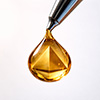
A volumetric 3D printing method forms objects inside hanging resin droplets that detach by gravity, eliminating manual steps between prints and enabling faster serial production.
(Nanowerk Spotlight) Most 3D printers that work with liquid resin need something to hold that liquid: a shallow tray, a glass vial, a sealed chamber. The container sits in the machine, light hardens the resin into the desired shape, and then someone removes the finished object, cleans or refills the vessel, and sets up the next run. This cycle of fill, print, extract, and reset is so basic to the process that it rarely gets questioned.
A newer class of 3D printing called volumetric additive manufacturing (VAM) made the printing step dramatically faster by curing an entire 3D shape at once rather than building it layer by layer. Light patterns, computed from a digital model, are projected into a rotating body of resin from many angles simultaneously. Where enough light accumulates, the resin solidifies. An object that would take hours to build conventionally can form in under a minute. The approach has already been adapted to volumetric 3D printing of silicone microfluidic devices and other functional structures.
But the container and its manual upkeep stayed. Each print still requires loading resin, positioning the vessel in a carefully matched optical bath, extracting the part, and resetting the system. Flow-based alternatives such as flow lithography and flow-enabled xolography, which uses intersecting light sheets to trigger curing, tried to sidestep these interruptions by pushing resin continuously through the print zone, but they consume large volumes of material and struggle with optical uniformity.
Holographic approaches to volumetric 3D printing have improved energy efficiency and resolution but still rely on conventional vial-based setups. For a process that prints in seconds, the minutes spent between prints remain the real constraint.
A study published in Advanced Functional Materials (“Dispensing Volumetric Additive Manufacturing”) discards the container altogether. Researchers at the Ulsan National Institute of Science and Technology feed resin through a glass pipette and let it collect at the tip as a hanging droplet, the way water gathers at the end of a faucet before it falls. Surface tension holds the droplet in place, suspended in open air with no vial or bath surrounding it. The light patterns project directly into this exposed bead of liquid as it rotates. Only the regions where enough light overlaps from multiple angles harden into a solid shape; the rest of the resin stays liquid.
When the droplet detaches under its own weight, the solid object drops with it onto a moving substrate below, still coated in uncured resin that the team later washes off, leaving only the finished part. A syringe immediately pushes fresh resin to the tip, and a new droplet forms in 1–3 seconds, beginning the next printing cycle. The container, the print volume, and the ejection mechanism are the same thing.
(a) Schematic of the droplet-based rapid serial printing approach of computed axial lithography. Photocurable resin is selectively polymerized by tomographic patterns. The laser-driven light pattern projected onto the DMD is optically corrected to ensure precise printing due to the refractive index-matching fluid. (b) Experimental setup for droplet-based VAM, using a laser diode (442 nm) for polymerization and a red (630 nm) LED source for CCD monitoring. (c) Schematic of droplet formation and printing sequence. Tomographic light patterns cure the target geometry, after which the printed object is dispensed onto the moving substrate. (Image: Reproduced from DOI:10.1002/adfm.202531982, CC BY)
The team calls the approach dispensing volumetric additive manufacturing, or DVAM. A blue-violet 442 nm laser diode illuminates the hanging droplet through a chip covered in hundreds of thousands of tiny individually tiltable mirrors, known as a digital micromirror device, that shapes the light into the computed patterns.
The resin, a mixture of two light-curable monomers, is roughly the consistency of honey (2000 cP), thick enough to keep the drop stable during rotation. A 4 mm glass pipette provides a maximum printable height of approximately 2.8 mm. Each object cures in 45–75 seconds, after which it detaches and the cycle repeats.
Removing the container, however, creates a new problem. A glass vial has flat, parallel walls; a hanging droplet has a curved surface that bends and focuses light like a lens. Without correction, the droplet’s curvature compresses the effective printing diameter to roughly 66% of the intended size, overcures the center, and washes out fine features.
The team set out to determine whether software could compensate for what the optics distorted. They built a real-time correction pipeline: a camera images each new droplet, an AI model extracts the curved contour frame by frame, and the system traces every projected ray through the air-resin boundary using the law of refraction. It then remaps the projector pattern so that light lands at the correct coordinates inside the resin. An additional intensity adjustment reduces brightness in regions where converging rays would otherwise overdose the material.
The correction restored geometric accuracy to near-ideal levels. When the team compared printed cubes and pyramids to their digital designs using a standard metric of shape overlap, uncorrected versions scored only about 56% and 52%. Corrected versions reached 92% and 89%, with height-to-width ratios closely matching the intended 1:1 design.
The improvement was most striking for internal voids. Uncorrected structures with holes scored below 41%, because converging light filled in empty spaces that should have remained open. After correction, the system recovered 96% of the dose coverage that an ideal setup using flat vial walls and an optical bath would deliver.
The team also investigated how fast the droplet must spin for the light dose to average evenly across all angles. At 6° per second, the rotation was too slow: local light accumulated faster than it could be spread, causing premature curing and distorted shapes. Small 1 × 1 mm² pyramids printed at that speed showed shape-overlap scores of only about 52%. At 24° per second, fidelity stabilized near 89% for 2 × 2 mm² pyramids, with little benefit from going faster.
Rapid serial fabrication process in dispensing-based VAM. After curing, the droplet is detached from the pipette, and the solidified 3D structure is deposited onto the substrate. A fresh pendant drop is subsequently generated for the next printing cycle.
The team demonstrated serial production in four sequences of 10 prints each. Geometries ranged from lattices, arches, and hollow pyramids to freeform models of the Eiffel Tower, the Thinker, and the Sphinx, as well as a letter sequence spelling “A B C D E U N I S T.” The smallest features measured approximately 150 µm, found in a triangular lattice with a 1.5 mm base.
Some limitations remain. A lateral wobble of about 25 µm during rotation can soften the finest features. The build volume is limited to what a hanging droplet can sustain. And mechanical alignment in the current laboratory setup introduces small misregistrations between the projected pattern and the spinning droplet. The authors expect that improved stabilization and tighter alignment will reduce these effects.
By replacing the container with a self-dispensing droplet, DVAM collapses the loading, aligning, and extraction steps of conventional volumetric printing into a gravity-driven transition lasting a few seconds. If the approach scales to larger droplets or parallel pipettes, it could bring volumetric manufacturing substantially closer to continuous, hands-free production.
For authors and communications departmentsclick to open
Lay summary
Prefilled posts
ORCID information
Im Doo Jung (Ulsan National Institute of Science and Technology (UNIST))
, 0000-0003-0883-1848 corresponding author
Nanowerk Newsletter
Get our Nanotechnology Spotlight updates to your inbox!
Thank you!
You have successfully joined our subscriber list.
Become a Spotlight guest author! Join our large and growing group of guest contributors. Have you just published a scientific paper or have other exciting developments to share with the nanotechnology community? Here is how to publish on nanowerk.com.