| Mar 23, 2026 |
Scientists developed a membrane that transports ions without chemical reactions or moving parts, advancing electrochemistry and enabling energy-efficient water treatment.
|
|
(Nanowerk News) Controlling the movement of ions through liquids is critical for many technological and biological processes. Conventional methods typically rely on energy-intensive electrochemical reactions.
|
|
The newly developed membrane offers an alternative: it features ultra-thin metal layers on both sides of a porous support. When a low electrical voltage is rapidly switched on and off, the metal interfaces undergo charging and discharging processes that, due to slight imbalances, produce a controlled flow of ions. This is the first time such an effect has been harnessed for ion transport.
|
 |
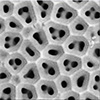
| Plan-view scanning electron microscopy image of the fabricated ion pump. (Image: Gideon Segev)
|
|
To demonstrate the technology’s practical potential, the research team integrated the membrane into a compact desalination system that operates entirely without moving parts or chemical reactions. In laboratory tests, the system was able to reduce the salt content of water by 50% using very low voltages. These results highlight the membrane’s promise for developing highly energy-efficient water purification and desalination solutions.
|
|
The researchers also expect that the technology can distinguish between ions with identical electrical charges based on subtle differences in their behavior within an electric field. This could enable new approaches in lithium recovery from seawater, removal of heavy metals from drinking water, advanced battery recycling, and next-generation diagnostic and sensor technologies.
|
|
The project brought together experts in chemistry, materials science, electrical engineering, and biotechnology from the University of California, Irvine, Tel Aviv University, the University of Massachusetts Boston, and Lawrence Berkeley National Laboratory. Prof Francesca Toma, head of the Hereon Institute of Functional Materials for Sustainability in Teltow and also affiliated with Berkeley Lab, was among the principal investigators who conceived the original concept of the study and played a key role in the study.
|
|
“This work introduces a new way to drive continuous ion transport in water by harnessing ratchet mechanisms in nanoporous materials. Beyond the fundamental insight, the concept may open new directions for more energy-efficient desalination and selective ion separations. It is especially meaningful to see an idea first developed years ago grow through international collaboration and perseverance into an impactful scientific contribution with technological potential”, said Toma about the research successes.
|
|
The findings are published in Nature Materials (“A nanoporous capacitive electrochemical ratchet for continuous ion separations”).
|