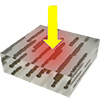
4D-printed microrobots with embedded gold-magnetite nanofillers use magnetic fields for navigation and near-infrared light for plasmonic heating to de-ice surfaces with programmable spatial and temporal precision.
(Nanowerk Spotlight) Aircraft that accumulate ice on their wings before departure must be sprayed with heated glycol to restore safe airflow, a procedure that delays flights and must be repeated if conditions persist. Wind turbines in cold climates lose up to 80% of their power output when ice builds on their blades. Ships navigating polar routes gain dangerous topside weight as ice coats decks and superstructures.
Yet the countermeasures available against icing remain blunt: resistive heaters that warm entire surfaces uniformly rather than targeting iced areas, chemical sprays that wash off and must be reapplied, and mechanical scrapers that risk damaging the structures they protect. Even passive approaches such as nanocoatings that prevent ice formation can only delay freezing, not remove ice once it has formed.
Photothermal materials work on a fundamentally different principle. Gold nanoparticles absorb light at specific wavelengths through surface plasmon resonance, a collective oscillation of electrons on the particle surface, and convert that energy into heat. This principle already underpins experimental cancer therapies and antifogging coatings. Plasmonic photothermal films for anti-icing have also shown promise, using light as a remote trigger for localized surface heating.
Separately, 4D printing has expanded the possibilities of additive manufacturing. The technique extends 3D printing by producing objects that change at least one property over time in response to an external stimulus. Among the material systems used in 4D printing, temperature-triggered shape change is the most common example, but magnetic fields, light, and pH have also been explored. Most 4D-printed devices, however, still respond to a single stimulus with a single behavior. Achieving multiple coupled functions within one printed architecture has remained difficult.
A study published in Advanced Functional Materials (“4D‐Printed Magneto‐Plasmonic Microrobots for Programmable Spatiotemporal De‐Icing”) now bridges that gap. The researchers created 4D-printed objects combining magnetic-field-driven movement with light-triggered photothermal heating and demonstrated the concept with a miniature icebreaker ship that navigates frozen surfaces while melting ice at millimeter-scale precision.
Example of a 4D printed photoheater used as an icebreaking ship. The 4D printed device presents a macroscopic functional shape (e.g., icebreaker ship) and embedded chain-like aligned magneto-plasmonic fillers. The magnetic field drives locomotion (spatial positioning) while the light irradiation enables a heat trigger (temporal control of the melting speed). (Image: Reproduced from DOI:10.1002/adfm.202530657, CC BY) (click on image to enlarge)
Each embedded nanofiller has a raspberry-like structure: a magnetite core roughly 75 nm across, coated with smaller gold nanoparticles about 18 nm in diameter. The magnetite provides the magnetic response. The gold provides plasmonic heating. A positively charged polymer coating on the magnetite draws in the negatively charged gold particles during ultrasonic mixing, binding the two through electrostatic attraction.
Printing these nanofillers into a functional object required a custom fabrication setup. The resin-filled vat of a digital light processing (DLP) printer sat inside a nested Halbach array, a configuration of permanent magnets that produces a strong, uniform field on one side while nearly canceling it on the other. This field caused dispersed nanofillers to self-assemble into aligned chains before the resin cured layer by layer. A 15-minute exposure proved optimal, with chains reaching about 75% of their final length by that point.
Once embedded, the chains enable two modes of magnetic actuation. A uniform external field generates a torque that rotates the printed object to align its chains with the field direction. A field gradient exerts a translational force, pulling the object toward stronger field regions. Orientation and movement can thus be controlled independently.
Does gold loading density actually determine the heating response? Two formulations provided a clear answer: a high-density variant with a gold-to-iron atomic ratio of about 28%, and a low-density variant at roughly 3%. Hyperspectral dark-field microscopy revealed that the high-density nanofillers produced broad, intense plasmonic scattering extending from visible wavelengths into the near infrared. The low-density version showed only faint features typical of isolated gold particles.
The difference traces to electromagnetic coupling. On high-density nanofillers, gold particles sit close enough to create hot spots, zones of amplified electric field that shift and broaden the collective resonance well beyond what individual nanoparticles produce. Spatially resolved spectra taken along individual chains confirmed pronounced local variation, evidence of disordered plasmonic coupling rather than a single resonance mode.
What controls how much heat a printed object generates in practice? Light wavelength and intensity dominate. Under near-infrared illumination at 852 nm, a 0.2 mm thick piece loaded with high-density nanofillers reached above 80 °C, far outperforming the same piece under green light at 532 nm. The system achieved a photothermal conversion efficiency of approximately 40% in the near infrared. Crucially, the gold nanoparticles are responsible for most of the heating: samples containing bare magnetite without gold produced significantly lower temperatures under the same conditions.
Geometry plays a secondary role. Thinner samples heated more effectively because absorption is confined to a shallow surface layer with an estimated optical penetration depth of only about 61 µm. Thicker pieces spread generated heat into a larger cool volume, diluting the temperature rise. Doubling the nanoparticle loading gave only modest improvement, since extra particles increased opacity and further shrank the absorption zone.
To test real de-icing capability, the team printed a miniature icebreaker ship loaded with 1% nanofillers and placed it on ice maintained at around −5 °C. Under near-infrared light, the ship’s surface reached 18 °C. Within five minutes it melted through the ice beneath its hull, dropped to the water below, and began responding to a nearby permanent magnet.
Over the next 12 minutes, the ship carved a channel through the ice. Its embedded chains aligned the vessel with the magnetic field while the field gradient pulled it forward. A second, unilluminated ship remained frozen in place, confirming that both stimuli are required. Displacement speed depended not on magnetic force but on melting kinetics: the ship advanced only as fast as it could liquefy the ice ahead.
Photothermal and magnetic models reproduced the observed behavior. Colder ice slowed motion by acting as a stronger thermal sink, while higher laser power compensated. Reducing the ship’s floating thickness increased speed by shrinking the ice volume requiring melting. Thermal cycling at −20 °C left photothermal performance unchanged, and even at that temperature, the ship’s surface stayed above freezing under illumination.
This platform coordinates mechanical motion with localized energy delivery in a single untethered object. Rather than blanketing a surface with uniform heat, it targets only iced areas, guided by magnetic fields and activated by light. The underlying architecture, magneto-plasmonic chains printed into arbitrary three-dimensional shapes, extends beyond ice removal to any application pairing precise positioning with controlled local heating, from soft robotics in extreme environments to adaptive thermal management.
For authors and communications departmentsclick to open
Lay summary
Prefilled posts
Nanowerk Newsletter
Get our Nanotechnology Spotlight updates to your inbox!
Thank you!
You have successfully joined our subscriber list.
Become a Spotlight guest author! Join our large and growing group of guest contributors. Have you just published a scientific paper or have other exciting developments to share with the nanotechnology community? Here is how to publish on nanowerk.com.