| Mar 16, 2026 |
Chemists grew the longest conductive polymer chains ever made on a surface, nearly one micrometer long, using a clean process that enables precise nanoribbons.
(Nanowerk News) Chemists have grown the longest conductive polymer chains ever produced on a surface, reaching nearly one micrometer, and shown that these chains provide direct access to atomically precise carbon nanoribbons. The team, led by J. Michael Gottfried at Philipps-Universität Marburg, used a halogen-free ring-opening polymerization on copper that grows poly(p-phenylene) (PPP) through genuine chain growth rather than random fragment coupling.
|
|
Their results appear in Nature Chemistry (“On-surface radical ring-opening polymerization produces ultralong poly(para-phenylene) for access to non-benzenoid carbon nanoribbons”).
|
Key Findings
- The most frequently measured PPP chain length was around 170 nanometers, with one chain reaching nearly 1,000 nanometers, almost an order of magnitude longer than previous surface-synthesized PPP.
- The ring-opening mechanism proceeds as true chain growth, where each reactive chain end opens a strained ring molecule and incorporates it, avoiding the random coupling of short fragments typical of earlier surface methods.
- Because the process is halogen-free, it produces no by-products that would block the catalytic surface and limit further chain extension.
|
Controlled chain growth on surfaces
|
|
Conventional approaches to building conjugated polymers on metal surfaces rely on coupling reactions in which short molecular fragments link together in an uncontrolled fashion. Halogen-containing precursors used in those methods release by-products that contaminate the catalytic surface and cap the achievable chain lengths. The new strategy bypasses both limitations by starting from strained cyclic molecules that contain no halogens.
|
|
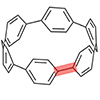
When deposited on a copper surface, these ring-shaped precursors are attacked by the reactive end of a growing polymer chain. Each ring that is opened extends the chain by one unit, and the process repeats exclusively at the chain ends. Growth is therefore directional and produces no surface-blocking waste. “This mechanism prevents by-products that would otherwise block the surface for further reactions,” Gottfried said.
|
Atomic-scale characterization
|
|
To verify the structure of the resulting chains, the team employed high-resolution scanning tunneling microscopy (STM) and non-contact atomic force microscopy (nc-AFM) with a functionalized tip. These techniques allowed direct visualization of individual bonds within the polymer backbone. X-ray photoelectron spectroscopy (XPS) and near-edge X-ray absorption fine structure (NEXAFS) measurements provided additional confirmation of the chemical transformations occurring during the reaction.
|
|
Density functional theory calculations performed at the University of Leipzig supported the proposed reaction pathway and clarified the energetic factors that favor chain growth over competing processes. Together, the experimental and computational evidence confirmed that the polymerization follows a radical ring-opening mechanism rather than the step-growth coupling seen in earlier surface reactions.
|
From long chains to carbon nanoribbons
|
|
The statistical peak of the chain length distribution fell at approximately 170 nanometers, but individual chains extended to nearly one micrometer. At these lengths, PPP chains become viable precursors for carbon nanoribbons with well-defined widths and edge structures, including nonbenzenoid configurations that are difficult to access through other synthetic routes.
|
|
PPP belongs to the family of conjugated polymers, materials in which alternating single and double bonds along the backbone allow electrons to delocalize along the chain. This gives conjugated polymers semiconductor-like behavior, but their electronic properties depend strongly on both chain length and structural regularity. “PPP is one of the conjugated polymers whose electronic properties depend heavily on chain length and structural perfection,” Gottfried noted. The ultra-long chains now accessible could serve as starting materials for nanoribbons tailored for molecular electronics or organic transistors.
|
Interdisciplinary collaboration
|
|
The work emerged from the LOEWE research focus “Principles of On-Surface Synthesis” (PriOSS), a joint initiative of the Universities of Marburg and Giessen that combines expertise in chemical design, surface physics, high-resolution microscopy, and computational theory. The interdisciplinary team also included researchers from the University of Leipzig and collaborators in China.
|
|
“The work of Michael Gottfried and his team impressively demonstrates the potential of the close cooperation between the Universities of Marburg and Giessen at the Research Campus of Central Hessen,” said Gert Bange, Vice-President for Research at Philipps-Universität Marburg. “The pooling of complementary expertise is leading to scientific breakthroughs and new perspectives for atomically precise materials and future semiconductor technologies.”
|
|
By making true chain-growth polymerization of PPP possible on clean metal surfaces, the method provides synthetic access to conjugated chains long enough and structurally regular enough to serve as templates for atomically precise carbon nanoribbons with engineered electronic properties.
|