| Feb 25, 2026 |
Charged helium nanodroplets stored in an ion trap for a full minute, 10,000x longer than before, open breakthrough possibilities in nanocalorimetry and nanoscale research.
(Nanowerk News) A team of researchers from the University of Innsbruck, supported by Prof. Dr. Lutz Schweikhard from the Institute of Physics at the University of Greifswald, has set a milestone in physics: the team succeeded for the first time in storing electrically charged helium droplets in an ion trap for up to one minute (Physical Review Letters, “Extending the Observation Time of Charged Helium Droplets to the Minute Timescale”).
|
|
The new time span, which is four orders of magnitude longer than previous methods, opens up completely new possibilities for the investigation of processes in physics and chemistry. The results were published recently in the renowned journal Physical Review Letters (PRL).
|
|
Helium nanodroplets are tiny, extremely cold accumulations of helium atoms that almost identically imitate the conditions of outer space. As “micro cryolaboratories”, they are particularly suitable for the spectroscopic investigation of atoms and molecules in the laboratory under conditions similar to those found in space. Until now, only a very short time slot of a few milliseconds was available whilst the droplets flew from the source to the detector.
|
|
A research team from the Department of Ion Physics and Applied Physics at the University of Innsbruck, in collaboration with Prof. Dr. Lutz Schweikhard, head of the Atomic and Molecular Physics working group at the University of Greifswald, has now made a decisive breakthrough: using a new type of ion trap, they succeeded for the first time in storing the charged droplets in isolation in a vacuum for a full minute.
|
 |
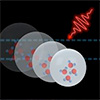
| The image shows the new experimental setup that will allow helium droplets to be observed 10,000 times longer in the future. (Image: Reproduced from DOI:10.1103/yr98-h791, CC BY)
|
|
The University of Greifswald provided decisive support for the experiments in Innsbruck. Professor Schweikhard is an expert in the field of ion trap technology and used his many years of expertise to support the team as an advisor.
|
|
“The Innsbruck experiments incorporate a great deal of experience gathered by my working group during decades of development and application of this type of ion trap in the measurement of the mass of exotic atomic nuclei at the CERN research centre near Geneva, and in investigations of the properties of atomic clusters in the Greifswald laboratory,” says Professor Schweikhard.
|
|
“The prolonged storage of helium nanodroplets that has resulted from the project is a big step towards more precise investigations that are not only relevant for the field of physics,” adds Matthias Veternik, first author of the publication.
|
|
The longer period of storage that has now been achieved for the first time also enables more detailed investigations of processes inside the droplets.
|
|
“To demonstrate this, we embedded water molecules in the helium nanodroplets and investigated their absorption of thermal radiation from the surrounding vacuum apparatus at room temperature. These measurements show the enormous potential of the new method,” says Dr. Elisabeth Gruber, a researcher in the Innsbruck team.
|
|
The next step is already planned: the scientists aim to install detection cylinders in the ion trap in order to measure the helium droplets with regard to their mass, charge and ratio to each other. This technique opens up new paths in nanocalorimetry.
|