| Dec 09, 2025 |
Scientists have found a way to use light to control and read tiny quantum states inside atom-thin materials. The simple technique could pave the way for computers that are dramatically faster and consume far less power than today’s electronics.
(Nanowerk News) A team of researchers from Indian Institute of Technology Bombay has demonstrated a remarkably simple optical method to control quantum states inside ultrathin materials using a linearly polarised light. This breakthrough could one day help build computers and electronic devices that are dramatically faster and more energy-efficient than what we use today.
|
|
The materials studied are just one atom thick — far thinner than a human hair — and are known as two-dimensional (2D) semiconductors. Inside these materials, electrons can sit in one of two distinct quantum states, called valleys. These valleys, named K and K′, can be thought of as two different “locations” that an electron can choose between. Because there are two options, researchers have long imagined using them like the 0 and 1 of digital computing, but on a quantum level. This idea is the foundation of a rapidly growing research field called valleytronics.
|
|
However, being able to reliably control which valley electrons occupy — and to switch between them quickly and on demand — has been a major challenge. “Previous methods required complicated experimental setups with carefully tuned circularly polarized laser and often multiple laser pulses, and they only worked under specific conditions” said Prof. Gopal Dixit. In many cases, they could not fully switch between the two valley states or directly measure which state the electrons ended up in. As a result, fully reversible and quantifiable valley control has remained elusive under major realistic laboratory conditions.
|
|
The findings, reported in Advanced Optical Materials (“Harnessing Light for Valley Control in 2d Semiconductors”), reveal a new method that removes the need for complicated laser schemes by using just one linearly polarized pulse The researchers found that a subtle asymmetry in the laser’s skewed polarization waveform — introduced as a controlled delay between its polarization components — is enough to push electrons into either the K or K′ valley. By inverting the temporal skew, the induced valley polarization can be switched between the two states, making the process fully reversible. In other words, the direction of the skew determines whether the system is set to “0” or “1.”
|
|
Prof. Dixit emphasises that even more impressively, the same pulse that switches the valley state also creates a tiny electric current, which acts as a built-in signal telling researchers which state was chosen. This means the system can be controlled and read out at the same time — no second laser or additional instrument is needed.
|
|
The method works across a wide range of laser wavelengths and does not depend on matching the frequency to the material, which has been a major limitation of earlier approaches. Because the effect relies on the shape of the laser pulse rather than the material’s exact energy structure, it is expected to work for different 2D semiconductors, even at room temperature.
|
 |
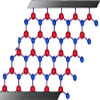
| Schematic of an atom-thin semiconductor driven by a laser pulse with skewed polarization. The laser selectively drives electron to one of quantum states: K or K′ valley and produces a measurable current that can be measured by attached electrodes. Adjusting the laser parameters switches the dominant valley between (a) K and (b) K′. (Figure is adopted from https://doi.org/10.1002/adom.202501593)
|
|
Beyond the scientific elegance of the result, the work has practical implications. A perfectly symmetric pulse populates both valleys equally, corresponding to an OFF state in a logic device. A slightly skewed pulse populates only one valley, corresponding to either 0 or 1. Since the resulting valley current immediately tells which state was selected, this forms the basis for all-optical logic operations — computing controlled entirely by light rather than electric circuits. Thus, the process offers a technologically straightforward route to integrate valleytronic logical device into compact optical platforms.
|
|
This finding significantly simplify the experimental landscape of valleytronics. The use of a single, non-resonant, linearly polarized pulse eliminates the need for carrier-envelope-phase stabilization, circular polarization control, and multi-pulse pump-probe configurations. Perhaps most exciting is the speed. Because the switching mechanism occurs on timescales shorter than a single cycle of the laser, it opens a route toward information processing at petahertz frequencies — about one million times faster than the fastest commercial processors today.
|
|
By reducing valley control to a single, easy-to-generate laser pulse, this finding simplifies experimental requirements while unlocking ultrafast, low-power quantum-state control. It represents a major step toward future devices that use light to control information in 2D materials, potentially transforming technologies in both classical computing and quantum computing.
|