| Dec 24, 2025 |
A precise synthesis tunes platinum skin thickness on PtCu nanospheres and shows two atomic layers give the best oxygen reduction performance and durability.
(Nanowerk News) Fuel cells still depend on platinum to speed up the oxygen reduction reaction, or ORR, a notoriously slow step that drags down efficiency and drives up cost. Engineers have boosted performance by alloying platinum with transition metals and by building porous nanostructures.
|
|
But one stubborn problem remains: researchers rarely get fine control over the Pt skin, the outermost atomic layers that directly set catalytic behavior. Those layers govern surface strain, how strongly oxygen related intermediates stick, and how electrons rearrange at the surface.
|
|
Yet experiments struggle to isolate their effects because conventional deposition methods seldom place atoms with true layer by layer precision. That leaves a basic question unresolved: how does Pt skin thickness shape ORR activity?
|
|
A research team from Shanghai University and Wuhan University tackled that question with a synthesis designed to control the Pt skin with atomic precision on dendritic PtCu nanospheres.
|
|
Reporting in eScience (“Precise Pt-skin manipulation of strain and ligand effects for oxygen reduction”), the team adjusted reduction conditions to build catalysts with zero to five Pt layers and then tracked how strain, electron transfer, and d band energetics shift as the shell thickens.
|
 |
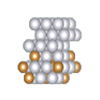
| This figure illustrates the volcano-type trend between Pt-skin layer thickness and oxygen-reduction reaction performance. Mass activity peaks at two Pt layers, where the optimal interplay of strain and ligand effects lowers the d-band center and maximizes catalytic efficiency. Structural models show how varying Pt-skin thickness reshapes electronic properties across the PtCu@PtnL series. (Image: eScience)
|
|
The central result pointed to a sweet spot. A two layer Pt skin produced the most favorable electronic configuration and delivered top tier ORR performance in both half cell measurements and full H₂ O₂ proton exchange membrane fuel cells.
|
|
To make the full series, the researchers used sodium citrate and citrate as reduction modulators, creating a library of PtCu@PtnL nanospheres with Pt skins ranging from 0 to 5 layers. High resolution microscopy and spectroscopy showed uniform, porous, dendritic particles about 30 nm across, with Pt layers wrapped precisely around a PtCu alloy core.
|
|
X ray diffraction indicated the samples shared the same alloy phase, while X ray photoelectron spectroscopy revealed systematic shifts in Pt 4f binding energies, consistent with layer by layer changes in electron transfer.
|
|
Theory and electronic measurements explained why thickness mattered. Density functional theory, combined with Pt valence band data, showed the d band center changed in a concave, parabolic way across the series. That pattern signaled a nonlinear interplay between geometric compressive strain and electron redistribution as the Pt skin grew.
|
|
The two layer Pt skin pushed the d band center to its lowest value, which in turn tuned the binding strength of ORR intermediates toward the known optimum. Free energy calculations supported the same conclusion, indicating that this configuration minimized overpotential and accelerated reaction kinetics.
|
|
Electrochemical tests matched the mechanistic picture. PtCu@Pt₂L led the series with a mass activity of 1.22 A mgPt⁻¹ and a specific activity of 2.14 mA cm⁻², well above commercial Pt C. In durability testing, the catalyst held onto its structure and performance after 30,000 cycles. In single cell fuel cell tests, it reached a peak power density of 1.61 W cm⁻², outperforming Pt C by 39 percent.
|
|
The work also drew outside attention. An independent expert in electrocatalysis said the study “offers one of the clearest mechanistic maps yet for designing Pt based catalysts with atomic precision.” The expert highlighted the volcano type relationship between Pt skin thickness and ORR performance as a key advance that addresses a long running gap in fuel cell science.
|
|
“This work doesn’t just find a better catalyst it explains why it is better,” the expert said. “The ability to disentangle strain and electronic effects at the atomic level will accelerate the rational design of high performance low platinum systems across the clean energy sector.”
|
|
Beyond a single material, the results propose a practical rule for catalyst design: tune the Pt skin to two atomic layers to balance strain and electronic structure for ORR. The team argues that PtCu@Pt₂L nanostructures could cut platinum demand while maintaining high power density and strong durability, which matters for electric vehicles, portable power, and stationary systems.
|
|
They also report the synthesis scales to gram level and can adapt to other Pt based alloys, a step toward industrial relevance. More broadly, the mechanistic framework offers a way to tune atomic interfaces in many electrocatalysts, with the aim of making clean energy technologies more efficient and affordable.
|