| Dec 10, 2025 |
3D printing creates hydrophobic barriers in hydrophilic paper, guiding liquids along precise paths for controlled mixing, gradients, and two-phase separation.
|
|
(Nanowerk News) Filter paper plays important roles in everyday laboratory work, from simple solid-liquid separation to chromatography, thanks to its microstructural properties. It is composed of small paper fibers, forming network with different densities throughout the sheet, allowing different grades to be manufactured for different uses. A denser fiber distribution produces smaller pores, which affects the hydrophilicity and overall performance of the filter paper.
|
|
Despite being one of the most common consumables in laboratories worldwide, most uses of filter paper rely on its hydrophilicity. If filter paper could have both hydrophilic and hydrophobic at the same time, it might serve broader purposes, even replacing more expensive membrane materials in certain applications.
|
|
Researchers typically make filter paper hydrophobic by adding wax, resin, or other materials to form water-repelling barriers. These patterns can be produced through simple methods like screen printing or high-resolution inkjet printing, as well as more advanced fabrication techniques.
|
|
A team led by Dr. Pai-Shan Chen, Professor from the Institute of Toxicology of College of Medicine, National Taiwan University (NTU), and Dr. Pin-Chuan Chen, Distinguished Professor in Mechanical Engineering at National Taiwan University of Science and Technology (NTUST), developed a digital light processing (DLP) 3D-printing strategy that creates high-resolution hydrophobic structures inside filter paper and integrates them with polymer microchannels for diverse fluidic operations (Chemical Engineering Journal, “Paper meets polymer: Efficiently manufacturing hybrid microfluidics for membrane-based applications”).
|
 |
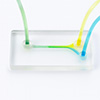
| Digital light processing selectively cures resin to form hydrophobic barriers on filter paper, creating different geometries for various applications. (Image: National Taiwan University)
|
|
A DLP system essentially functions as a projector that displays grayscale digital images in ultraviolet light, curing photosensitive resin only where needed. Using this principle, the team forms hydrophobic resin barriers directly within the hydrophilic filter paper matrix. By designing customized digital masks, they can arrange hydrophilic and hydrophobic zones in any desired pattern and then chemically bond the patterned paper to polymer microchannels.
|
|
This allows the creation of compact, easy-to-fabricate devices capable of handling complex liquid–liquid and liquid–solid interactions under controlled flow. In effect, ordinary filter paper is transformed into a fluid-handling platform with new capabilities.
|
|
By restricting hydrophilic regions to specific zones, the design leverages the paper’s natural fiber network. These randomly arranged microstructures act as flow obstacles, increasing resistance and altering fluid motion. The team showed that this structure can generate passive mixing under low-Reynolds-number conditions due to chaotic advection.
|
|
Adjusting the geometry of the hydrophobic barriers also allows controlled diffusion between channels, enabling predefined concentration gradients. The researchers further demonstrated liquid–liquid phase separation using alternating hydrophilic and hydrophobic stripes.
|
|
This approach makes it possible to perform tasks that normally rely on intricate microfluidic devices and complex manufacturing steps—using nothing more than patterned filter paper.
|
|
“We turned a useful tool into a powerful one—almost like giving ordinary filter paper a brand-new superpower. With this strategy, complex fluid manipulation becomes as simple as projecting a digital pattern, making advanced experimentation accessible to far more researchers and expanding the creative possibilities in this field,” says Prof. Pai-Shan Chen.
|
|
“Embedding DLP-printed hydrophobic structures directly into paper creates a simple yet powerful platform that allows researchers, students, and even small labs to perform experiments that once required expensive, specialized equipment—opening the door to applications that were previously out of reach,” says Distinguished Prof. Pin-Chuan Chen.
|