| Mar 26, 2026 |
Researchers developed an air-breakdown triboelectric nanogenerator that harvests skin static electricity to power ultrathin keyboards and remote controls without batteries.
(Nanowerk News) A team of engineers has developed a triboelectric nanogenerator that harvests the static electricity naturally present on human skin, producing enough power to operate keyboards, remote controls, and other everyday input devices without batteries.
|
|
The device, called an air-breakdown triboelectric nanogenerator (AB-TENG), borrows its layered architecture from conventional transistors and turns a long-standing technical obstacle — the uncontrolled discharge of skin electrons through air — into a deliberate energy source.
|
Key Findings
- The AB-TENG produces up to 290 V and 22 mW of peak power at 24 N of contact force, outperforming conventional tactile triboelectric nanogenerators by a factor of 22.
- A fully functional self-powered keyboard measuring just 600 µm thick was demonstrated with 30 keys and both wired and wireless communication.
- The device can also generate electricity without physical contact, producing 6–16 V across air gaps of 0.5–2 mm through arc discharge.
|
|
The research was carried out at the MEMS and Nanotechnology Laboratory at Chonnam National University under the direction of Professor Dong-Weon Lee, with collaborators at Kyungpook National University. Their findings were published in Nano-Micro Letters (“Air-Breakdown Triboelectric Nanogenerator Inspired by Transistor Architecture for Low-Force Human–Machine Interfaces”).
|
 |
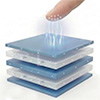
| The air-breakdown triboelectric nanogenerator (AB-TENG) uses a transistor-inspired five-layer architecture to harvest electrostatic discharge from human skin at low contact force. The design enables self-powered thin-film devices such as ultrathin keyboards, remote controls, mice, and calculators for everyday human–machine interfaces. (Image: Karthikeyan Munirathinam, Longlong Li, Arunkumar Shanmugasundaram, Jongsung Park, Dong-Weon Lee)
|
Why air breakdown matters
|
|
Conventional tactile triboelectric nanogenerators collect charge by pressing two materials together and separating them, but they have always struggled with low surface charge density and erratic output. Much of the problem stems from air breakdown — the spontaneous discharge of accumulated electrons into the surrounding air before they can be captured.
|
|
The AB-TENG addresses this directly by incorporating a base terminal that collects electrons escaping from human skin through an ionized air channel, converting what was previously wasted energy into usable current.
|
Design and operation
|
|
The device is built from five functional layers: a base, an emitter, a charge-inducing layer, a dielectric layer, and a collector. This stack mirrors the terminal arrangement of a transistor, with each layer serving a distinct role in directing electron flow.
|
|
Two operating modes are available. In the indirect mode, charge accumulates over multiple contact cycles and generates output through electrostatic induction. In the direct mode, electrons flow immediately from the skin through the air channel to the base terminal, producing a large instantaneous voltage — 165 V at just 2 N of applied force, rising to 290 V at 24 N.
|
Applications and demonstrations
|
|
To validate the concept in a practical setting, the team built a self-powered infrared remote control system using four AB-TENG units. Each unit converted finger presses into signals that wirelessly operated LEDs, achieving a success rate above 80 percent at a contact force of 15 N. No external battery or power supply was needed.
|
|
A second demonstration pushed the design further. The researchers fabricated an ultrathin keyboard with 30 keys arranged in four rows and eight columns, all within a total thickness of 600 µm. Each keystroke served a dual purpose: it registered a data signal for the connected device while simultaneously generating the electrical energy required to transmit that signal. The keyboard operated in both wired and wireless configurations.
|
|
Environmental testing showed that the AB-TENG maintained stable output across temperatures ranging from 20 to 80 °C. Performance at low humidity remained strong, though output declined at elevated humidity levels because moisture in the air accelerated charge dissipation before electrons could reach the base terminal.
|
|
The device also demonstrated a non-contact mode in which arc discharge across air gaps of 0.5 to 2 mm generated voltages between 6 and 16 V, enabling touchless sensing applications.
|
|
The authors note that scaling the technology toward large-area, flexible, and wearable formats remains an open challenge. Future work will focus on extending the AB-TENG architecture to Internet of Things devices and improving resilience in humid conditions. By converting a fundamental physical limitation into a functional advantage, the study establishes a design framework for self-sustaining human-machine interfaces that eliminate the need for external power.
|