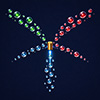
A new chip sorts individual living cells through open air along adjustable paths, offering a gentler and more flexible alternative to conventional methods.
(Nanowerk Spotlight) Sorting individual cells from a mixed population is one of the most important and technically demanding tasks in modern biology. Researchers studying cancer, the immune system, or drug responses often need to isolate specific cell types, one by one, from samples containing millions of cells of many different kinds.
The dominant technology for this job, fluorescence-activated cell sorting (FACS), has been used in biology labs since the late 1960s. FACS works by firing a stream of cells through a laser beam, reading their fluorescent labels, and then using electrical charges to deflect individual droplets into collection tubes. It is fast, but it comes with well-known drawbacks: the high fluid pressure can damage or kill fragile cells, and its single-cell sorting efficiency typically falls in the range of 70–90%.
Another established method, magnetic-activated cell sorting (MACS), requires tagging cells with magnetic particles and offers relatively low recovery rates and poor manipulation precision. Microfluidic chips, which manipulate tiny volumes of fluid through channels etched into small devices, emerged as an alternative in the early 2000s.
Among the most successful microfluidic sorting techniques is dielectrophoresis (DEP), which uses non-uniform electric fields to push or pull cells and droplets. DEP-based sorters can operate at throughputs up to 30 kHz with high precision and are relatively simple to fabricate.
But they share a fundamental limitation: sorted cells travel through fixed, solid channels filled with oil. Once a chip is built, the number and direction of sorting paths are locked in, usually to just one or two. And because the droplets are suspended in oil, retrieving the cells afterward requires breaking the emulsion, a chemical step that can further harm delicate cells.
A research team at Beihang University in Beijing has now developed a microfluidic device that avoids both problems by sorting single cells not inside oil-filled channels but through open air. Their work, published in Microsystems & Nanoengineering (“In-air microfluidic sorting of single cells on multiple paths”), describes a chip that ejects droplets containing individual cells into the air, steers them along adjustable paths, and sorts them with an accuracy exceeding 99% on every path tested.
a Schematic of a microfluidic device and its operation. Cell suspension is injected into the microfluidic device in which single cells are encapsulated in droplets formed by the co-flow of two air flows and an aqueous phase. Droplets are interrogated by a laser-activated fluorescence sorting system. The sorting of the electrical signal delivered by the control system is amplified and applied to the cylindrical electrode, such that single cells are selectively sorted. b Ejection direction of droplets in air can be adjusted through regulating the asymmetry of air pressures. c Sorting is activated through selectively applying DEP force with a constant DEP force for waste droplets collection and no DEP force for sorted droplets. (Image: Reproduced from DOI:10.1038/s41378-025-01024-z, CC BY) (click on image to enlarge)
The device combines two design innovations. The first is a co-flow geometry that uses two independently controlled air streams flanking a liquid channel carrying the cell suspension. Where these three flows meet at a nozzle, the shearing force of the air streams pinches off tiny droplets, each ideally containing a single cell, and launches them into the air.
Adjusting the pressures of the two air streams relative to each other tilts the ejection direction of the droplets in real time. When both air streams are set to equal pressure, 5 psi each, the droplets fly straight ahead. Increasing one stream to 7 psi while decreasing the other to 3 psi angles the droplets to one side, and reversing those values angles them to the other. Over the usable pressure range of 2 psi to 8 psi, the device achieves a total angular range of roughly 32.8°, enough to define three or more distinct sorting paths.
The ejected droplets are monodisperse, meaning highly uniform in size, a critical feature for consistent sorting. Droplet diameter varies with total air pressure, ranging from about 36 µm to 76 µm, but remains tightly distributed for any given pressure combination. The ejection direction also proves stable: after approximately 5 × 10⁵ switching cycles, the deflection angles showed no significant drift.
The second innovation is a cylindrical DEP electrode. Conventional DEP electrodes have flat or curved tips designed to deflect droplets arriving from a single direction inside a fixed channel. That geometry fails when droplets approach from varying angles. The cylindrical electrode, made from a 0.6 mm diameter solder wire inserted into the chip, generates a radially symmetric electric field. Any droplet flying over it, regardless of approach angle, experiences a similar deflecting force. Simulations and experiments confirmed that droplets on all three tested paths were deflected by comparable distances when the electrode was energized.
The sorting logic works in reverse compared to many conventional systems. A constant high voltage of approximately 2 kV is applied to the electrode so that, by default, every droplet is deflected into a waste collection tube. When the laser-based fluorescence detection system identifies a droplet carrying a desired cell, the voltage is momentarily switched off, allowing that droplet to fly undeflected along its intended path.
Testing the device with Calcein Green-stained NIH 3T3 cells, the team measured sorting accuracy above 99% independently on each of the three paths. Cell viability after sorting exceeded 92% across all paths, assessed by staining with live/dead fluorescent dyes. The researchers attribute this high survival rate to the gentle shear forces from the low-pressure air flows, an improvement over the mechanical stress that FACS imposes and the limited precision of MACS.
To demonstrate the practical value of multi-path sorting, the team ran a proof-of-concept experiment using a mixed suspension of three cell populations labeled with green, red, and pink fluorescent dyes at roughly equal proportions. In a single sorting run, the device directed only green cells to path one, only red cells to path three, and a defined 1:1 mixture of green and red cells to path two.
After sorting 1 000 cells per path, fluorescence imaging confirmed sorting accuracies of approximately 95.6% for green cells on path one and 94.7% for red cells on path three. Path two yielded the intended mixed ratio of about 50.1% green to 46.8% red. The slightly lower accuracy compared with single-type sorting likely reflects optical limitations in distinguishing dim cells or cell doublets, issues the authors say improved optics and sorting algorithms could address.
The current device uses a three-color laser system, limiting it to distinguishing three cell types at once. But because the underlying detection principle mirrors that of FACS, the authors note it could expand to handle signals across as many as 18 channels, as commercial flow cytometers already do. The cylindrical electrode imposes no inherent limit on the number of sorting paths; any direction within the tunable ejection range can serve as a collection route.
The authors highlight specific applications this flexibility could unlock, such as simultaneously isolating tumor cells and immune cells from a cancer patient’s blood. They also suggest that integrating image-based detection could enable sorting of unprocessed clinical samples.
The device remains at the proof-of-concept stage, but its demonstrated performance, above 99% accuracy, above 92% viability, and stable operation across more than 500 000 switching cycles, establishes a clear foundation for multi-path single-cell sorting outside the constraints of solid channels.
For authors and communications departmentsclick to open
Lay summary
Prefilled posts
Nanowerk Newsletter
Get our Nanotechnology Spotlight updates to your inbox!
Thank you!
You have successfully joined our subscriber list.
Become a Spotlight guest author! Join our large and growing group of guest contributors. Have you just published a scientific paper or have other exciting developments to share with the nanotechnology community? Here is how to publish on nanowerk.com.