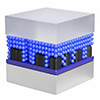
A semiconductor device generates unforgeable watermarks from chaotic electron behavior, embedding invisible markers in images that expose AI manipulation at the pixel level while also enabling stronger encryption.
(Nanowerk Spotlight) Digital photographs can no longer be trusted as evidence. Generative artificial intelligence now swaps faces, alters expressions, and fabricates entire scenes with results that fool both casual viewers and trained analysts. Courts weighing photographic evidence, journalists verifying sources, and ordinary people assessing what they see online all face the same problem: how can anyone confirm that an image has not been manipulated? Software-based detection methods struggle to keep pace with rapidly improving forgery tools.
This collapse of visual trust reflects a deeper vulnerability in digital security. Modern cryptography depends on random numbers to generate encryption keys, authenticate users, and protect sensitive communications. Yet most systems rely on pseudo-random number generators, algorithms that produce sequences appearing random but actually derived deterministically from an initial seed value.
Given sufficient computational resources or knowledge of that seed, an attacker can reconstruct the entire sequence and compromise the system. If encryption keys could instead originate from genuinely unpredictable physical processes, and if those same processes could watermark images at capture, both vulnerabilities might be addressed simultaneously.
The search for genuine physical randomness has produced creative solutions. Cloudflare, a major cybersecurity firm, films a wall of lava lamps and uses the chaotic motion of wax to seed its encryption systems. Quantum random number generators exploit the probabilistic behavior of individual photons. Yet these approaches require bulky optical components or specialized laboratory equipment, limiting integration into compact consumer devices.
A study published in Advanced Materials (“Light‐Induced Entropy for Secure Vision”) presents a device that tackles both challenges. The researchers built a photospike-based true random number generator, or PS-TRNG, that harnesses unpredictable interactions between light and semiconductor nanostructures. The randomness emerges from the physics of the device itself, making it virtually impossible to replicate or predict.
Schematic of a ternary random number generation system based on a photospike-based true random number generator device and its application to the pixel tampering diagnosis system. (Image: Adapted with permission from Wiley-VCH Verlag) (click on image to enlarge)
The device employs an oxide heterostructure, layering copper vanadate (CuV₂O₆) nanostructures and tin dioxide (SnO₂) quantum dots on an n-type silicon substrate, topped with a PEDOT:PSS conductive polymer electrode. Notably, it operates under zero external bias, drawing energy solely from light excitation rather than an external power source. This makes the system highly energy-efficient and well-suited for low-power applications.
When pulsed red light at 660 nm and 0.53 mW·cm⁻² strikes this stack at 50 Hz, electrons excited by the light move through the quantum dot layer and encounter randomly distributed surface defects. These defects trap and release electrons unpredictably, producing transient spikes in the photocurrent that vary chaotically in intensity and timing from pulse to pulse.
These spike currents become the source of entropy. By sampling the photocurrent at random intervals, the researchers convert intensity variations into discrete logic states. Rather than binary zeros and ones, the system produces ternary values: zero, one, or two. Currents below −187.5 nA register as zero, those above 91.8 nA as two, and intermediate values as one.
This three-valued output increases both information density and security. A four-digit binary PIN has a 6.25% chance of being guessed correctly; a ternary PIN of the same length drops that probability to 1.2%.
The researchers subjected their system to exhaustive statistical validation, analyzing over 10,000 ternary outputs. Each state appeared with approximately 33.3% frequency, matching the ideal distribution. Inter-Hamming distance, which quantifies how different each output string is from others in a dataset, also matched the theoretical target of about 33.3%.
Entropy reached 1.552 bits per trit out of a theoretical maximum of 1.585. The team converted their ternary outputs into binary subsets and ran all 15 tests in the NIST Statistical Test Suite, a standard benchmark for cryptographic random number generators. Every test passed with p-values exceeding the 0.01 threshold. The pseudo-random sampling controller alone, by contrast, failed four of those tests.
To confirm that randomness originates from the device rather than the light source, the researchers operated two independent PS-TRNG units under identical illumination. The devices produced entirely uncorrelated outputs, demonstrating that each unit’s unique internal defect structure drives the entropy. Scaling experiments with eight parallel devices achieved 156.15 trits per second while maintaining statistical independence between channels. A single device produces 11.89 bits per second.
The team pushed the device through more than 2 million measurement cycles and 460 days of continuous operation without degradation. Performance held steady across varying temperatures, humidity levels, mechanical vibrations, and wavelengths from visible red to ultraviolet.
The researchers then integrated their PS-TRNG with a custom circuit board and mobile phone application. Random outputs served as encryption keys for AES-based image encryption, successfully obfuscating facial photographs and restoring them without loss upon decryption.
They also built a pixel tampering diagnosis system using steganography, a technique for concealing data within other data. The system embeds random numbers in the two least significant bits of each image pixel, creating a hidden watermark that remains cryptographically verifiable but invisible to the eye. Because the watermark originates from physically unclonable hardware, forgers cannot reproduce it.
When the researchers used generative AI tools to alter hairstyles in watermarked portraits, the system detected tampering at the pixel level, even for modifications visually indistinguishable from authentic images. It caught changes as subtle as adding small objects to a scene.
The technology’s compatibility with imaging sensors could enable embedding random number generation directly into cameras, authenticating images at the moment of capture. Hardware-rooted entropy could also provide secure key generation for Internet-of-Things devices and physically unclonable authentication functions.
The bit rate remains modest compared to some alternatives, though parallelization offers a clear scaling pathway. The steganographic watermarking does not survive lossy compression, though lossless formats preserve functionality. The authors suggest that frequency-domain embedding could improve robustness in future work.
This research demonstrates a practical bridge between nanoscale physics and real-world security. The same unpredictable electron behavior that generates cryptographic keys can also certify that an image has not been altered, offering a unified hardware defense against both code-breaking and visual deception.
For authors and communications departmentsclick to open
Lay summary
Prefilled posts
Nanowerk Newsletter
Get our Nanotechnology Spotlight updates to your inbox!
Thank you!
You have successfully joined our subscriber list.
Become a Spotlight guest author! Join our large and growing group of guest contributors. Have you just published a scientific paper or have other exciting developments to share with the nanotechnology community? Here is how to publish on nanowerk.com.