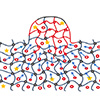
Researchers create ‘living’ polymers that grow, degrow, and reprogram their properties after fabrication using reversible chemistry and light-activated catalysts.
(Nanowerk Spotlight) A salamander can regrow a severed limb in a matter of weeks. The process is astonishing in its completeness: cells at the wound site dedifferentiate, proliferate, and rebuild bone, muscle, nerve, and skin in the correct arrangement, restoring full function.
This kind of adaptive self-remodeling pervades biology. Bones deposit mineral along lines of mechanical stress. Skin thickens where friction is chronic. Muscles add mass when loaded repeatedly. In every case, the living material senses its environment, imports raw molecular ingredients, runs chemical reactions that reshape its internal architecture, and adjusts its mechanical properties accordingly.
Synthetic materials do none of this. A polymer part rolling off a production line is, in a meaningful sense, finished. Its molecular network, its stiffness, its shape, and its composition are all fixed at the point of manufacture. Researchers have chipped away at this rigidity through a series of incremental advances.
Stimuli-responsive hydrogels swell or shrink in response to temperature or pH. Shape-memory polymers snap between two or three preprogrammed configurations. Vitrimers, introduced in 2011, showed that permanently crosslinked networks could be rearranged by heating, enabling reprocessing. In 2019, a team in Japan demonstrated hydrogels that stiffened under repeated mechanical loading, mimicking muscle training. And in 2023, a cyclosiloxane-based system achieved partial polymer growth after fabrication but was hampered by sluggish reactions, poor spatial control, and narrow mechanical range.
Each advance solved part of the puzzle while leaving the rest untouched. No one had built a synthetic material that could simultaneously absorb chemical building blocks, polymerize them into its own network, relieve the mechanical stresses that accumulate during the process, and reverse the whole sequence on demand.
A study now published in Advanced Materials (“Rewriting Polymer Fate via Chemomechanical Coupling”) reports a polymer platform that accomplishes this. A team at the Georgia Institute of Technology, with collaborators at North Carolina State University, created what they call a “living” polymer: a material that can grow, shrink, heal, change its stiffness by roughly 100-fold, and be recycled back to raw monomers, all post-fabrication.
Design mechanism of the dynamic “living” polymer. (a) Computational illustration comparing the different growth behaviors and limitations of dynamic polymer systems governed by different reaction mechanisms. The time is normalized by diffusion time scale with D being the diffusivity and L the size of the sample. (b) Chemical structures of the monomers, crosslinker, and catalysts used in this work, along with the associated mechanisms for polymerization, depolymerization, catalyst activation, and chain exchange reactions. (c) Schematic representation of how concurrent processes—including catalyst activation/deactivation, polymerization/depolymerization, chain exchange, molecular transport, and mechanical deformation—collectively drive the macroscopic phenomena of growth, degrowth, and regrowth in the “living” polymer system. The pictures show a “living” polymer growing from a seed-like structure into a tree-like form within a confined environment, supported by a continuous nutrient supply. The scale bar is 1 cm. (Image: Reproduced from DOI:10.1002/adma.202518567, CC BY) (click on image to enlarge)
The chemistry at the core is ring-opening metathesis polymerization (ROMP), a reaction in which strained, ring-shaped molecules open up and link into long polymer chains. ROMP is reversible: under the right conditions, chains break back down into monomers. The same catalytic mechanism also enables chain exchange, where segments of different polymer chains swap with one another, relieving internal stresses that would otherwise halt further growth.
The researchers’ computational model confirmed that without chain exchange keeping pace with polymerization, tension accumulates in the original network and blocks monomer uptake, consistent with limitations seen in earlier work.
The starting material is a crosslinked polymer film made from a cyclopentene-based monomer called CP-ester. After initial synthesis, the catalyst is deactivated and the material is dried into a stable solid. To trigger growth, the polymer is exposed to a “nutrient” solution containing fresh monomer, crosslinker, and a ruthenium catalyst. The catalyst anchors onto existing chains, polymerizes incoming monomers, and facilitates chain exchange simultaneously. Once growth reaches the target, the catalyst is quenched and the material is dried, locking in the new structure.
Whether growth is uniform or spatially uneven depends on the balance between diffusion speed and reaction speed. Thin films in a slow-reacting solution reached swelling equilibrium in about 5 min while the reaction needed roughly 80 min to convert 10 % of the monomer, producing homogeneous expansion.
Thicker cubes in a fast-reacting solution showed the opposite: monomers were consumed at the surface before penetrating deeper, generating exaggerated growth at corners. Finite element simulations matched both outcomes.
Degrowth exploits ROMP’s reversibility. Because the CP-ester monomer evaporates at room temperature, exposing the active polymer to air shifts the equilibrium toward depolymerization. At 22 °C this produced controlled, uniform shrinkage. At 35 °C, faster kinetics outpaced the network’s reorganization, causing structural collapse.
Spatial control at the microscale relied on cis-Ru-1, a photo-activated catalyst that remains inert until exposed to 405 nm light. A focused beam on a nutrient-swollen sample triggered polymerization only in the illuminated spot, drawing monomers inward from surrounding regions and producing micro-pillars a few hundred micrometers across. Six successive irradiation cycles built the pillars progressively taller with no plateau.
Applied to a dry sample without monomers, the same catalyst carved micro-holes whose diameter tracked the light-spot size to within 5 %. Surface temperature at the highest intensity reached only about 27 °C, preserving the material’s capacity to regrow at the same location.
Mechanical reprogramming was equally notable. Varying the crosslinker-to-monomer ratio in the nutrient solution stiffened or softened the same starting polymer. Switching monomer identity amplified the effect: a poly(cyclopentene) film grown in cis-cyclooctene solution saw its shear modulus, a measure of rigidity, jump from 0.36 MPa to 21.7 MPa as the new polymer crystallized. Degrowth achieved similar stiffening through a different route.
A copolymer of CP-ester and cyclooctene rose from 0.34 MPa to 42.7 MPa over five days as the softer component selectively evaporated, concentrating the stiffer fraction. That stiffened material could then regrow in CP-ester solution at 60 °C to become soft again.
Three demonstrations illustrate practical potential. A flexible antenna with a liquid-metal foam conductor shifted its resonant frequency from 1.6 GHz to 1.06 GHz after two growth cycles extended it from 8 cm to 12 cm. A magnetically actuated soft robot grew larger while retaining the integrity to handle a bigger object. And a gecko-shaped polymer had a limb severed, then regrew a foot sole and toes through sequential light exposures.
Both the antenna and robot could be fully recycled: dissolving them in solvent with catalyst recovered the monomers by distillation and reclaimed the embedded functional materials.
The platform operates within clear boundaries. Growth and degrowth rates hinge on a delicate balance of catalyst loading, temperature, and crosslink density. Photo-degradation showed limited effectiveness below a 200 µm light-spot diameter.
The system currently requires ruthenium catalysts and specific cyclopentene-derived monomers, though the authors argue the design principles should transfer to other reversible chemistries. If that proves true, it would open a path toward synthetic materials whose properties need never be final: polymers that can be repurposed, repaired, and eventually returned to their molecular starting ingredients.
For authors and communications departmentsclick to open
Lay summary
Prefilled posts
Nanowerk Newsletter
Get our Nanotechnology Spotlight updates to your inbox!
Thank you!
You have successfully joined our subscriber list.
Become a Spotlight guest author! Join our large and growing group of guest contributors. Have you just published a scientific paper or have other exciting developments to share with the nanotechnology community? Here is how to publish on nanowerk.com.