| Apr 12, 2026 |
A new synthesis of astronomical measurements confirms a persistent mismatch that could point to physics beyond current models.
|
|
(Nanowerk News) An international collaboration of astronomers has produced one of the most precise measurements yet of how fast the local Universe is expanding. The result deepens one of the most significant challenges in modern cosmology. John Blakeslee, astronomer at NSF NOIRLab, funded by the U.S. National Science Foundation, is a member of the collaboration, and telescopes across two NSF NOIRLab Programs contributed data.
|
|
Astronomers have sought to measure the expansion rate of the Universe using two fundamentally different approaches. One method relies on measuring distances to stars and galaxies in the nearby Universe. The other uses measurements of the cosmic microwave background to predict what the expansion rate would be today under the standard model of cosmology.
|
|
These two approaches are expected to yield the same result, but they don’t. Measurements based on the nearby Universe consistently indicate a higher expansion rate — around 73 kilometers per second per megaparsec — while predictions derived from the early Universe yield a lower value, closer to 67 or 68. Although the numerical difference is modest, it is far larger than can be explained by statistical uncertainty. This persistent disagreement, known as the Hubble tension, has now been observed across multiple independent studies and techniques.
|
 |
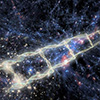
| Artist’s interpretation of the cosmic distance ladder — a succession of overlapping methods used to measure distances across the Universe, where each rung of the ladder provides information that can be used to determine the distances at the next higher rung. Methods include observations of pulsating Cepheid variable stars, red giant stars that shine with a known brightness, Type Ia supernovae, and certain types of galaxies. In this illustration, the distance ladder begins at the Coma Cluster, which is the nearest extremely rich galaxy cluster to us. The distance to the Coma Cluster can be measured directly using observations of Type Ia supernovae within the cluster. Type Ia supernovae have a predictable luminosity that makes them reliable objects for distance calculations. (Image: CTIO/NOIRLab/DOE/NSF/AURA/J. Pollard Image Processing: D. de Martin & M. Zamani (NSF NOIRLab))
|
|
By bringing together decades of independent observations into a single, unified framework, an international collaboration of astronomers has achieved the most precise direct measurement to date of the expansion rate of the nearby Universe. In a paper published in Astronomy & Astrophysics (“The Local Distance Network: A community consensus report on the measurement of the Hubble constant at ∼1% precision”), the H0 Distance Network (H0DN) Collaboration reports a value of the Hubble constant of 73.50 ± 0.81 kilometers per second per megaparsec, corresponding to a precision of just over 1%.
|
|
The study, “The Local Distance Network: a community consensus report on the measurement of the Hubble constant at ∼1% precision,” is the outcome of a broad community effort launched at the International Space Science Institute (ISSI) Breakthrough Workshop, “What’s under the H0od?”, held at ISSI in Bern, Switzerland, in March 2025.
|
|
“This isn’t just a new value of the Hubble constant,” the collaboration notes, “it’s a community-built framework that brings decades of independent distance measurements together, transparently and accessibly.”
|
|
NSF NOIRLab contributed both expertise and observational data to this effort. John Blakeslee, astronomer and Director of Research and Science Services at NSF NOIRLab, is a member of the collaboration. The study includes data from telescopes at NSF Cerro Tololo Inter-American Observatory (CTIO) in Chile and NSF Kitt Peak National Observatory (KPNO) in Arizona, both Programs of NSF NOIRLab. Those data were incorporated into a broader, collaborative framework spanning both ground and space-based observatories, helping to strengthen the overall result.
|
|
Rather than relying on a single method, the team constructed a “distance network” that links many overlapping techniques for measuring distances across the local Universe. These include observations of pulsating Cepheid variable stars, red giant stars that shine with a known brightness, Type Ia supernovae, and certain types of galaxies. This approach enables multiple independent paths to the same final result, and allows for a critical test: is the discrepancy caused by an error within a single method? The results indicate that this is unlikely. Even when individual techniques are removed from the analysis, the overall result changes only minimally. Independent measurements remain consistent with one another, reinforcing the robustness of the locally measured expansion rate.
|
|
“This work effectively rules out explanations of the Hubble tension that rely on a single overlooked error in local distance measurements,” the authors conclude. “If the tension is real, as the growing body of evidence suggests, it may point to new physics beyond the standard cosmological model.”
|
 |
| This graphic represents the tension that exists between measurements of the expansion rate of the late, nearby Universe, versus what would be expected based on measurements of the early Universe, specifically the cosmic microwave background (CMB). Under the standard model of cosmology, these two approaches are expected to yield the same result, but they don’t. This discrepancy is known as the Hubble tension, and is represented in this graphic by the misalignment between the Early Route and Late Route “bridges.” Currently, the best estimate for the Hubble constant based on measurements of the CMB is about 67.2 kilometers per second per megaparsec. In 2026, the H0 Distance Network (H0DN) Collaboration delivered the most precise direct measurement of the local Hubble constant to-date, reporting a value of 73.50 ± 0.81 kilometers per second per megaparsec, corresponding to a precision of just over 1%. (Image: NOIRLab/NSF/AURA/J. da Silva/J. Pollard)
|
|
The implications are significant. The lower expansion rate inferred from the early Universe depends on the standard model of cosmology, which describes how the Universe has evolved since the Big Bang. If that model is incomplete — for example, if it does not fully account for the behavior of dark energy, new particles, or modifications to gravity — its predictions for the present-day expansion rate would be affected.
|
|
In that case, the Hubble tension may not be the result of measurement error, but rather evidence that the current model of the Universe is missing a key component. The local distance network also establishes a framework for future investigations. By making its methods and data openly available, the collaboration has created a foundation that can be expanded with new observations. With next-generation observatories expected to provide even more precise measurements, astronomers aim to determine whether this discrepancy will ultimately be resolved or continue to point toward new physics.
|