| Apr 07, 2026 |
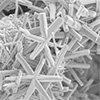
Star-shaped vanadium hydroxide nanoparticles show that changing a material’s shape from sheets to stars shifts its energy storage from battery-like to capacitor-like behavior.
(Nanowerk News) When created at the nanoscale, materials can resemble shapes like stars, rods or even pyramids.
|
|
These particle shapes, also known as the morphologies of a solid, make for more than just interesting images under a microscope — they can determine how the material behaves, sometimes in dramatic ways.
|
|
University at Buffalo researchers have demonstrated this phenomenon by creating the first-ever star-shaped vanadyl hydroxide (VOOH) and shown that this shape can fundamentally alter how the material stores energy.
|
|
When this metal-based chemical initially formed as flat, sheet-like layers, it stored energy internally like a battery. But as it evolved into clustered rods and eventually star-shaped structures, its behavior shifted toward that of a pseudocapacitor, storing energy at or near its surface.
|
 |
| A scanning electron microscope image reveals particles of vanadyl hydroxide (VOOH) shaped like stars. The team of Luis De Jesús Báez found that these particles behaved more like a pseudocapacitor than a battery. (Image: Luis De Jesús Báez, University at Buffalo)
|
|
“By simply changing a material’s morphology, you can change its electrochemical behavior and thereby change what you can do with it,” says Luis De Jesús Báez, PhD, assistant professor in the UB Department of Chemistry and corresponding author of a study published in Nanoscale (“On the crystal growth of vanadyl hydroxide (VOOH) with six-fold arms morphology”).
|
|
The study and its accompanying microscope images, which served as the cover art for Nanoscale’s 2026 Emerging Investigators collection, could provide insights for designing hybrid energy storage systems that deliver energy quickly like a capacitor while also storing it for longer like a battery. They also suggest that controlling a material’s shape could influence how its electrons behave, a key factor in emerging technologies such as quantum and neuromorphic computing.
|
|
“We are learning more and more that a material’s properties are not just determined by chemical composition or atomic crystal structure — morphology also needs to be taken into account,” De Jesús Báez says.
|
From seed to star
|
|
Creating a material starts with a seed — a cluster of a few atoms that can grow into a solid under the right conditions and over time.
|
|
De Jesús Báez’s team synthesized VOOH and observed how its structure evolved over the course of three and a half days. They used both transmission electron microscopy and scanning electron microscopy, which rely on electrons rather than light to image materials at extremely small scales.
|
|
After 36 hours, the VOOH formed as flat, sheet-like structures and stored energy internally like a conventional battery. By 48 hours, the material began forming as rod-like clusters — and its energy storage behavior began to change.
|
|
After 84 hours, the VOOH had taken on a six-armed, star-shaped form and was storing some of its energy at or near its surface.
|
 |
| As the VOOH shape transitioned from sheets to stars, it took on the shape of clustered rods. (Image: Luis De Jesús Báez, University at Buffalo)
|
|
“Growing a solid shaped like a star is much more complex than growing it as a sheet. A star shape allows for more edges with high density of defects and increased overall surface area. The increased defects and surface area is what then leads to a change in electrochemical behavior and teaches us about the role that nucleation and growth have on properties,” says first author Jayanti Sharma, a PhD student in De Jesús Báez’s lab.
|
Where AI meets materials science
|
|
Increasingly, scientists are using artificial intelligence models to simulate a material’s behavior, but De Jesús Báez says this research showcases why time-intensive lab work remains essential.
|
|
AI models rely on materials science databases, which often include information on a material’s properties but not always the specific conditions needed to produce them.
|
|
“What good is a model that tells you that VOOH is a good pseudocapacitor if it doesn’t also tell you that it requires a star-shaped structure and explains how to create that?” De Jesús Báez says. “This is where AI needs to meet material scientists where we are. With better data from the lab, these models could really help us catapult new discoveries.”
|
|
Plus, the resulting electron microscope images alone are worth the time in the lab.
|
|
“Whenever I see images like this, it’s almost like being a kid and discovering something new again,” De Jesús Báez says. “In 2026, it can sometimes feel like everything that could be discovered has been discovered, but these images remind us there’s so much more left to explore.”
|