| Mar 25, 2026 |
A molybdenum-based spin-flip emitter harvested singlet fission excitons at 130% quantum yield, demonstrating a new path beyond the Shockley-Queisser solar cell efficiency limit.
|
|
(Nanowerk News) Solar cells built from standard semiconductors can convert only about one-third of incoming sunlight into electricity. High-energy photons waste their excess as heat, while low-energy infrared photons lack the energy to excite electrons at all. This ceiling, described by the Shockley-Queisser limit, has constrained photovoltaic performance since it was first calculated in 1961.
|
|
A research team led by Kyushu University in Japan, working with collaborators at Johannes Gutenberg University (JGU) Mainz in Germany, has now demonstrated a way around this barrier using a molybdenum-based metal complex that harvests multiplied excitons from singlet fission at a quantum yield of roughly 130%. The results were published in the Journal of the American Chemical Society (“Exploring Spin-State Selective Harvesting Pathways from Singlet Fission Dimers to a Near-Infrared-Emissive Spin-Flip Emitter”).
|
Key Findings
- A molybdenum-based spin-flip emitter selectively captured triplet excitons produced by singlet fission, reaching a quantum yield of approximately 130%.
- The design suppressed a competing energy loss pathway called Förster resonance energy transfer (FRET), which typically drains excitons before they can be harvested.
- The work establishes a new strategy for exciton amplification that could eventually be integrated into higher-efficiency solar cells, LEDs, and quantum technologies.
|
|
Singlet fission offers one of the most promising routes past the Shockley-Queisser limit. In this process, a single high-energy exciton splits into two lower-energy triplet excitons, theoretically doubling the number of energy carriers available from one absorbed photon. Certain organic semiconductors such as tetracene can undergo singlet fission, but extracting the resulting triplet excitons before they dissipate has remained an obstacle.
|
 |
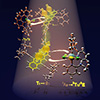
| A molybdenum-based spin-flip emitter (bottom) selectively harvests triplet excitons produced when a tetracene-based singlet fission dimer (top) splits one high-energy exciton into two. The process achieved a quantum yield of approximately 130%, meaning more energy carriers were generated than photons absorbed. (Image: Percy Gonzalo Sifuentes-Samanamud, Tokyo University)
|
|
“We have two main strategies to break through this limit,” says Yoichi Sasaki, Associate Professor at Kyushu University’s Faculty of Engineering. “One is to convert lower-energy infrared photons into higher energy visible photons. The other, what we explore here, is to use SF to generate two excitons from a single exciton photon.”
|
|
The core difficulty is a competing process called Förster resonance energy transfer (FRET). Before singlet fission can multiply excitons, FRET tends to siphon off the energy, funneling it to a nearby acceptor molecule in its original, undoubled form.
|
|
“The energy can be easily ‘stolen’ by a mechanism called Förster resonance energy transfer (FRET) before multiplication occurs,” Sasaki explains. “We therefore needed an energy acceptor that selectively captures the multiplied triplet excitons after fission.”
|
|
To solve this, the team turned to metal complexes, molecules whose electronic structures can be precisely tailored. They identified a molybdenum-based compound classified as a spin-flip emitter. In these molecules, an electron reverses its spin state during absorption or emission of near-infrared light. That spin reversal allows the complex to accept specifically the triplet-state energy produced by singlet fission rather than the pre-fission singlet energy that FRET would otherwise drain. By tuning the energy levels of the system, the researchers shut down the wasteful FRET pathway and channeled the multiplied triplet excitons into the molybdenum acceptor.
|
|
The collaboration with JGU Mainz was instrumental. Adrian Sauer, a graduate student from the Heinze group visiting Kyushu University on exchange and the paper’s second author, introduced the team to a material that had been studied extensively at Mainz, sparking the joint project.
|
|
“We could not have reached this point without the Heinze group from JGU Mainz,” Sasaki says.
|
|
When the researchers paired the molybdenum complex with tetracene-based singlet fission materials in solution, they measured quantum yields of approximately 130%. In practical terms, for every photon absorbed, roughly 1.3 molybdenum complexes were excited. Exceeding the conventional 100% ceiling confirmed that the system generated and harvested more energy carriers than photons it received.
|
|
The team notes that these experiments remain at the proof-of-concept stage, conducted in solution rather than in a solid-state device. Their next step is to bring the singlet fission material and the spin-flip emitter together in a solid film, where efficient energy transfer could be engineered into a functioning solar cell architecture. Beyond photovoltaics, the researchers point to LEDs and next-generation quantum technologies as areas where selective triplet harvesting from singlet fission could prove valuable.
|
|
By pairing a precisely tuned metal complex with an organic singlet fission material, the study opens a design space that previous approaches, limited to all-organic systems, had not explored. Whether this strategy can deliver practical efficiency gains will depend on translating the solution-phase results into solid-state devices, but the 130% quantum yield establishes a clear proof of principle for metal-complex-based exciton amplification.
|