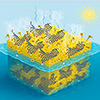
A graphene membrane uses sunlight to separate lithium from magnesium-rich brine, achieving 28-fold enrichment without electricity or pumps.
(Nanowerk Spotlight) Beneath the salt flats of Chile and Bolivia sits a vast reserve of dissolved lithium. These deposits account for roughly 60% of the world’s known supply of a metal now indispensable to battery manufacturing. The problem is getting it out. Dissolved in underground brines alongside overwhelming concentrations of magnesium, sodium, and calcium, lithium makes up only a tiny fraction of this mineral soup.
Magnesium is the main obstacle: it outnumbers lithium by ratios of 20 to 1 or more, and its chemical behavior overlaps just enough to fool most separation technologies. Researchers have searched for a physical property that cleanly separates the two in solution, where both exist as electrically charged particles called ions.
The most promising candidate is hydration energy, the strength with which each ion holds onto its surrounding water molecules. Magnesium grips its water shell roughly four times more tightly than lithium does. A sufficiently precise filter should be able to exploit that gap, letting loosely hydrated lithium slip through while blocking the stubbornly water-wrapped magnesium.
Nanofiltration membranes attempt exactly this, sorting ions by size and charge under low pressure. In practice, though, most conventional versions achieve lithium-to-magnesium selectivity below 25 and degrade within 50 hours in brines above 200 g/L. Corrosive salts, membrane swelling, and the chemical similarity of the target ions have kept large-scale brine extraction dependent on slow evaporation ponds that take months and waste enormous volumes of water.
Schematic of the solar-driven lithium separation system. A melamine sponge rod (MSR) draws brine upward from the feed solution. The graphene nanoribbon/reduced graphene oxide nanofiltration membrane (PrGO/GNRs membrane) selectively allows lithium ions to pass while blocking magnesium and other competing ions. A protective polyacrylonitrile layer (PL) shields the membrane, and a solar-absorbing photothermal substrate (PS) on top converts sunlight into heat, accelerating the separation process. Evaporated water exits as steam from the surface. (Image: Reproduced with permission from Wiley-VCH Verlag)
The membrane pairs edge-functionalized graphene nanoribbons (GNRs) with graphene oxide that has been reduced using light-generated heat, a material known as photothermally reduced graphene oxide (PrGO). GNRs are flat, ribbon-shaped carbon sheets produced by chemically splitting open multi-walled carbon nanotubes along their length.
The process exposes dense rows of oxygen and nitrogen groups along the ribbon edges. These act as docking stations where lithium ions briefly land, shed part of their water shell, and hop forward to the next site.
Negatively charged groups along those same edges repel magnesium and calcium ions, pushing them away before they can enter the channels. PrGO partially restores the electrically conductive carbon lattice while keeping the material compatible with water. It stiffens the membrane and prevents the swelling that degrades other graphene-based filters in salty solutions.
Quantum-mechanical simulations provided a molecular-level view of how the membrane sorts ions. The calculations revealed strong electronic coupling between the GNR and PrGO layers, with charge transfer that reshapes the chemistry of the edge groups. Lithium ions face very low energy barriers when hopping between neighboring sites on the composite. Without the PrGO scaffold, those barriers rise roughly fivefold, confirming that the two materials must work in tandem.
Magnesium, by contrast, binds far more strongly to the same chemical groups and finds no energetically favorable hopping route. It effectively stalls at the surface, unable to pass through.
The best-performing membrane, containing 15 wt% PrGO, delivered a lithium permeation rate of 0.253 mol m⁻² h⁻¹, roughly three times faster than pristine PrGO alone, and a lithium-to-magnesium selectivity of 21 under passive diffusion. Lower PrGO content left the membrane vulnerable to swelling, while higher content buried too many active edge sites, restricting ion access.
Activating the solar component pushed performance further. The substrate, a porous polymer sponge whose surface carries sulfur-containing anchoring groups and a coating of GNRs, absorbs roughly 97% of incoming solar radiation and converts it into surface heat. Under two-sun illumination the sponge surface reached 48 °C in brine. That localized heating reduces brine viscosity, making it flow more easily, strips water molecules from lithium ions more aggressively, and widens the gap between lithium and magnesium transport rates.
The researchers tested the full system against a simulated brine modeled on Bolivia’s Uyuni salt flat, with total salinity above 350 g/L and an initial magnesium-to-lithium ratio of 19.8. Under two-sun irradiation the system drove that ratio down to 0.7, a 28-fold enrichment. The recovered lithium carbonate reached approximately 97% purity, meeting battery-grade specifications.
Over 48 hours of repeated wash-and-dry cycles under two-sun irradiation, evaporation rates held steady and infrared imaging confirmed uniform heat distribution with no localized degradation. Salt buildup on the sponge surface did slow evaporation during extended runs, but the membrane itself retained its structure and selectivity throughout.
The approach points toward a class of lithium extraction systems that run entirely on sunlight, requiring neither high-pressure pumps nor electrical input. If the design can scale from laboratory demonstrations to larger formats, it could offer a faster, less water-intensive alternative to the evaporation ponds that currently dominate brine-based lithium production.
For authors and communications departmentsclick to open
Lay summary
Prefilled posts
ORCID information
Sang Joon Lee (Pohang University of Science and Technology)
, 0009-0005-8759-6496 corresponding author
Nanowerk Newsletter
Get our Nanotechnology Spotlight updates to your inbox!
Thank you!
You have successfully joined our subscriber list.
Become a Spotlight guest author! Join our large and growing group of guest contributors. Have you just published a scientific paper or have other exciting developments to share with the nanotechnology community? Here is how to publish on nanowerk.com.