| Dec 16, 2025 |
A research team has developed an enzyme that robustly and efficiently reduces formate to formaldehyde. This synthetic metabolic pathway is an important route for the sustainable conversion of CO2 into raw materials.
|
|
(Nanowerk News) For a carbon-neutral bioeconomy, processes are needed that can efficiently capture CO2 and convert it into valuable products. Formic acid, or more specifically its salt, formate, is considered a promising candidate as it can be produced from CO₂ using renewable electricity. It is also easy to transport, non-toxic and versatile. Research is focusing, among other things, on microorganisms that are ‘fed’ formic acid made from CO₂ and use it to produce basic chemicals or fuels.
|
|
A team led by Maren Nattermann at the Max Planck Institute for Terrestrial Microbiology has developed a synthetic enzyme designed to perform the central conversion step with precision and stability in a single enzymatic process (ACS Catalysis, “Engineering a Formic Acid Reductase”). This builds on previous research in which the team established a fully synthetic formyl phosphate pathway was established in bacteria.
|
 |
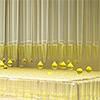
| High-throughput devices can dramatically accelerate research. Here, 96 samples are tested at once for the enzymatic conversion of formate to formaldehyde—recognizable by the yellow color change. (Image: MPI f. Terrestrial Microbiology, Franka Eiche)
|
Synthetic metabolic pathway
|
|
Until now, only certain bacteria have been able to utilize formic acid. Natural metabolic pathways bypass the intermediate product formaldehyde, which is an important starting point for integrating CO₂ into cellular metabolism. The researchers constructed an artificial bridge in the form of a synthetic formyl phosphate metabolic pathway, which they incorporated into living E. coli bacteria.
|
|
Cooperation partner Sebastian Wenk (Project leader, University of Groningen) explains: ‘Our work showed that a synthetic metabolic pathway for processing formate works in living organisms — a significant step towards developing biotechnologically useful microorganisms that can use formate obtained from CO₂ to produce food, fuels and materials.’ The formaldehyde is immediately processed by the cell and does not accumulate.
|
|
However, the connection to cellular metabolism must be robust — after all, it is competing with well-established natural metabolism that has evolved over millions of years. Until now, researchers have only been able to develop complex, fragile, multi-step enzymatic cascades that release sensitive intermediate products, such as formyl phosphate or formyl-CoA, which are prone to breaking down or entering undesirable side reactions. From a biotechnological perspective, the goal is a ‘full formate diet’ in which bacteria grow exclusively on formic acid, without the need for costly additives.
|
Tailor-made enzyme
|
|
Recently, the group achieved a decisive breakthrough with a tailor-made formate reductase enzyme that can convert formic acid to formaldehyde precisely and robustly. This enzyme, known as FAR (formate reductase), is based on a carboxylic acid reductase (CAR) found in the bacterium Mycobacteroides abscessus. This enzyme was modified through targeted mutagenesis and high-throughput screening to preferentially select small molecules such as formate.
|
|
“With FAR, we now have a single, robust enzyme that reliably reduces formate to formaldehyde — exactly where many biotechnological pathways begin,” explains Nattermann. ‘This provides us with a missing building block for future bioconversions based directly on CO₂-based raw materials.’
|
|
‘The most important thing is that our enzyme tolerates high concentrations of formate, whereas previous systems failed completely under these conditions,’ adds Philipp Wichmann, the study’s first author. It is precisely this stability that makes FAR attractive for industrial processes in which formate is produced electrochemically in very high concentrations. Without the use of high-throughput methods, this result would not have been achievable in such a short time. ‘After screening around 4,000 variants, we achieved a fivefold increase in formaldehyde production,’ explains Nattermann.
|
|
FAR is now an enzyme that can be used in both living cells and cell-free systems, as well as in electrobiochemical production lines. In the future, basic chemicals, bioplastics or fuels could be produced from CO₂-based formate. The researchers are already planning to combine FAR with other synthetic metabolic pathways, for example, to produce energy-rich molecules.
|