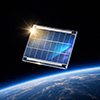
Perovskite solar cells operated for months in low Earth orbit and tolerated radiation equivalent to decades in space, marking the most comprehensive orbital test of the technology.
(Nanowerk Spotlight) Thousands of new satellites enter orbit every year, each one carrying solar panels that rank among the most expensive components onboard. The gallium arsenide cells that dominate space power are grown atom by atom in high-vacuum chambers from scarce materials, and even after recent cost reductions driven by mega-constellation demand, space-grade cells still run between $50 and $150 per watt. Terrestrial silicon panels, by contrast, now sell for under 30 cents per watt.
That gap of two to three orders of magnitude persists because space cells must deliver 28–34% efficiency under extreme radiation and thermal stress, then pass months of qualification testing before they are cleared to fly. When only governments and defense contractors were launching satellites, the expense was manageable. Now, with broadband mega-constellations and commercial Earth-observation networks driving a surge in launch demand, the industry needs alternatives. A cheaper, lighter solar technology that works well in space would change the economics of spaceflight.
Metal halide perovskites present a promising option. These crystalline semiconductors can be deposited from liquid solutions at low temperatures onto thin, flexible films, a fabrication process far simpler than the high-vacuum crystal growth required for III-V cells.
Perovskites absorb light efficiently, their optical properties are tunable, and when built on ultrathin polymer substrates they deliver outstanding ratios of power output to device weight, meaning more electricity per gram launched. On Earth, perovskite solar cells have staged one of the fastest efficiency climbs in photovoltaic history.
But laboratory records set in climate-controlled rooms mean little 540 kilometers above the planet’s surface, where temperatures swing by 60 degrees every 95 minutes and high-energy protons penetrate any material in their path. Whether perovskites can endure those conditions has remained an open question.
Brief rocket flights, passive film exposures on the International Space Station, and small-scale CubeSat tests have offered partial answers, but no study has delivered comprehensive data from functioning perovskite devices operating under sustained orbital conditions.
A study published in Advanced Materials (“Beyond Earth: Resilience of Quasi‐2D Perovskite Solar Cells in Space”) now fills that gap. An international collaboration across Johannes Kepler University Linz, Helmholtz-Zentrum Berlin, the California Institute of Technology, and the University of Potsdam flew quasi-two-dimensional perovskite solar cells on the Space Solar Power Demonstrator One (SSPD-1) satellite, launched aboard SpaceX’s Transporter-6 mission in January 2023. The SSPD-1 mission was designed to investigate technologies for cost-effective space-based solar power, and a dedicated payload called ALBA carried the perovskite cells alongside other novel photovoltaic technologies.
SSPD-1 mission overview and design of quasi-2D perovskite solar cells tested in orbit. A) Schematic illustration of the Space Solar Power Demonstrator 1 (SSPD-1) mission and its insertion into low Earth orbit (LEO) about 540 km above sea level. B) Mission timeline showing days stored in the lab at California Institute of Technology (Caltech), and the launch facility in Cape Canaveral Florida Space Force Station, the launch on the 3rd of January 2023, and the SSPD-1 boom extension (part of the self-deployable space structure, with the deployed booms occasionally casting partial shade on the PSCs for certain elevation and azimuth angles), during the data acquisition phase. C) View of Earth from the SSPD-1 avionics platform during orbital operations (reproduced with permission from Sergio Pellegrino at Caltech), D) Schematic structure of the quasi-2D perovskite absorber and molecular structure of PEDOT and PSS., E) Device architecture of the perovskite solar cell (PSC) in both ultrathin flexible (PET-based) and rigid (glass-based) formats., F) Photographs of the encapsulated ultrathin flexible PSC (left) on a thin PMMA support frame, and the glass-based rigid PSC (right), both used for space and ground testing. Scale bar: 10 mm. (Image: Reproduced from DOI:10.1002/adma.202520433, CC BY) (click on image to enlarge)
Over nine months at an altitude of approximately 540 km, ALBA recorded more than 3 million individual measurements of electrical output, along with over 200,000 current-voltage sweeps. Combined with extensive ground-based testing, the data set offers a detailed before-and-after picture that earlier experiments could not provide.
The term “quasi-two-dimensional” describes the crystal structure of the light-absorbing layer. In a standard three-dimensional perovskite, metal and halide atoms form a continuous cubic lattice. In the quasi-2D variant used here, large organic molecules called alpha-methylbenzylammonium (MBA) are inserted as spacers between thin slabs of the perovskite crystal. These spacers block the movement of charged atoms through the lattice and repel water molecules, addressing two persistent failure modes in conventional perovskites. The specific absorber composition was MBA₂(Cs₀.₁₂MA₀.₈₈)₆Pb₇I₂₂.
The team fabricated two device types from the same production batch: rigid cells on glass with indium tin oxide electrodes, and ultrathin flexible cells less than 3 µm thick built on polymer film using the conductive polymer PEDOT:PSS as the transparent electrode. Both used PCBM, an organic semiconductor, as the electron-transport layer.
In laboratory testing under vacuum, spanning temperatures from −80 to +80 °C and simulated space-spectrum light at 1,350 W/m², the rigid cells reached 16.5% stabilized power conversion efficiency, and the flexible cells reached 16.7% at room temperature. Both showed similar thermal behavior. Open-circuit voltage climbed as temperature fell, because cooling suppresses recombination, the loss of charge carriers before they can be collected as current. At subzero temperatures, current output dropped as the organic transport layers lost electrical conductivity. That decline was sharper in the flexible cells, where PEDOT:PSS served as the only transparent conductor.
Radiation hardness was tested with 68 MeV protons at a cumulative dose of 2 × 10¹² protons per cm², equivalent to about 50 years of exposure in low Earth orbit. The flexible cells held above 92% of their initial efficiency throughout. Their voltage and fill factor, a measure of how close a cell operates to its theoretical maximum, showed no measurable decline.
The rigid cells lost more current, but the researchers traced the primary cause not to perovskite damage but to radiation-induced darkening of the glass substrate, which filtered out incoming light before it reached the active layers. Once that optical loss was accounted for, the perovskite absorber itself proved similarly resilient in both formats.
In orbit, the flexible and polymer-electrode devices never had a chance to demonstrate their potential. A launch delay forced the early removal of a sealed protective cover, leaving the payload exposed to humid air at Cape Canaveral, Florida, for roughly 43 days before liftoff. Moisture and oxygen penetrated the thin polymer layers and degraded the PEDOT:PSS electrode and its contact with the perovskite. By the time the satellite began collecting data, those cells had either failed outright or lost most of their output.
The glass-encapsulated rigid cells performed well. The best device operated stably across a 44-day measurement window ending nearly 100 days after launch. It survived approximately 1,600 orbital eclipse cycles, with temperatures swinging between −25 and 35 °C every 95 minutes. Efficiency held at around 80% of its pre-launch laboratory value.
Across eight measurements taken under near-standard illumination of 135 ± 4 mW/cm² and a cell temperature of 10 ± 7 °C, the device delivered an open-circuit voltage (Voc) of 1.060 ± 0.021 V, a short-circuit current density (Jsc) of 26.8 ± 0.7 mA/cm², and an average efficiency of 11.9 ± 0.8%, with a peak reading of 13.3%.
A commercial triple-junction reference cell mounted alongside confirmed stable light levels throughout, ruling out instrument artifacts. The orbital current-voltage curves closely matched those of a slightly aged twin device tested on the ground, indicating that the modest performance gap originated during pre-launch handling rather than from any orbital stressor.
The study’s central finding is twofold. The quasi-2D perovskite absorber withstands the radiation and thermal extremes of low Earth orbit with minimal intrinsic degradation. But the practical barrier to deploying this technology is not the active material; it is the packaging around it. The ultrathin polymer encapsulations that make flexible perovskite cells lightweight and attractive for space also leave them vulnerable to atmospheric moisture during the weeks or months of ground handling, transport, and launch preparation.
The authors identify clear engineering priorities: better polymer encapsulation for flexible devices, more robust charge-transport layers, and procedures that shield cells from ambient conditions right up to orbit insertion. They also note the need to assess how prolonged ultraviolet exposure in space affects polymer substrates over longer missions.
Previous efforts, from stratospheric balloons to ISS-mounted passive films to compact CubeSat payloads, each addressed fragments of the question. This study connects them, providing matched pre-flight and in-orbit data from working devices under sustained, realistic conditions. It demonstrates that perovskite photovoltaics can function reliably in space and tolerate radiation equivalent to decades of service.
If the encapsulation and handling challenges can be resolved, perovskites could become a low-cost, high power-per-weight alternative for the growing fleet of satellites, space stations, and deep-space probes that depend on sunlight to survive.
For authors and communications departmentsclick to open
Lay summary
Prefilled posts
ORCID information
Michael D. Kelzenberg (California Institute of Technology)
, 0000-0002-6249-2827 corresponding author
Harry A. Atwater (California Institute of Technology)
, 0000-0001-9435-0201 corresponding author
Martin Kaltenbrunner (Johannes Kepler University Linz)
, 0000-0002-7247-9183 corresponding author
Nanowerk Newsletter
Get our Nanotechnology Spotlight updates to your inbox!
Thank you!
You have successfully joined our subscriber list.
Become a Spotlight guest author! Join our large and growing group of guest contributors. Have you just published a scientific paper or have other exciting developments to share with the nanotechnology community? Here is how to publish on nanowerk.com.