| Mar 30, 2026 |
Researchers developed a quantum-dot circularly polarized light sensor using chiral charge transport layers, spanning ultraviolet to short-wave infrared wavelengths.
(Nanowerk News) Researchers at DGIST have developed an optical sensor that reads the rotational direction of light across a spectral range stretching from ultraviolet to short-wave infrared, using a single quantum-dot-based device. The sensor, built by Professor Jiwoong Yang’s team in the Department of Energy Science and Engineering, bypasses a longstanding constraint in circularly polarized light detection by placing chiral structures in the electron transport pathway rather than in the light-absorbing material.
|
|
The work was published in Advanced Materials (“Broadband Circularly Polarized Light Detection via Spin‐Selective Charge Transport in Quantum Dot Photodiodes”).
|
Key Findings
- A zinc oxide electron transport layer incorporating chiral molecules enables spin-selective electron transmission, allowing circularly polarized light detection without requiring chiral light-absorbing materials.
- The sensor covers an ultra-wide spectral range spanning ultraviolet, visible, near-infrared, and short-wave infrared regions in a single device.
- The device achieved a detectivity of 10¹² Jones, matching the sensitivity of commercial silicon photodetectors.
|
|
Circularly polarized light is light in which the electric field traces a helical path as it propagates. This rotation is directly tied to the spin angular momentum of photons, making it a carrier of quantum information. Technologies such as quantum communication, quantum cryptography, and photonic quantum information processing depend on reading this polarization state accurately, and demand for compact sensors capable of doing so has intensified.
|
|
Most existing circularly polarized light sensors require the light-absorbing material itself to possess an inherent helical molecular arrangement known as a chiral structure. That requirement sharply limits the pool of suitable materials and confines detection to narrow spectral windows, typically in the ultraviolet or visible range. Extending coverage into the infrared, where quantum communication and optical sensing applications operate, has remained a persistent technical obstacle.
|
|
Professor Yang’s team took a different approach. Rather than engineering chirality into the absorber, they built it into the charge transport layer — the pathway electrons follow after being generated by absorbed photons. The team fabricated a zinc oxide electron transport layer incorporating chiral molecules and paired it with a quantum-dot photodiode.
|
|
When circularly polarized light strikes the quantum dots, the resulting electrons carry spin information reflecting the handedness of the incident light. As these electrons pass through the chiral transport layer, their transmission efficiency varies with spin orientation, producing measurable photocurrent differences between left-handed and right-handed illumination. This mechanism enables direct detection of the light’s rotational direction.
|
 |
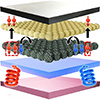
| Schematic illustration of a quantum-dot photodetector with a chiral charge transport layer. The device stack comprises an ITO substrate, a PEDOT:PSS hole transport layer, a quantum dot absorber, a chiral zinc oxide (ZnO) electron transport layer functionalized with L-cysteine or D-cysteine, and a silver top electrode. Right-handed (RCP) and left-handed (LCP) circularly polarized light generate spin-polarized electrons that are selectively transmitted through the chiral ZnO layer depending on the handedness of the cysteine ligand, enabling direct detection of the light’s rotational direction. (Image: DGIST)
|
|
Because chirality resides in the transport layer, the quantum dots can be selected purely for their spectral absorption properties. This decoupling allowed the team to construct a device covering ultraviolet, visible, near-infrared, and short-wave infrared wavelengths — a breadth of coverage that has been difficult to achieve with conventional designs relying on chiral absorbers. The sensor also reached a specific detectivity of 10¹² Jones, a standard measure of photodetector sensitivity that places its performance on par with commercial silicon-based sensors.
|
|
“This research is significant in that it presents a new principle for optical sensors capable of detecting the spin information of photons,” stated Professor Jiwoong Yang. “It is highly likely to serve as a core sensor technology driving diverse fields of quantum optoelectronics, including quantum communication, quantum sensing, next-generation image sensors, and secure optical communication.”
|
|
Capturing photon spin information across such a broad wavelength range with a compact, single-device architecture could simplify sensor design for quantum optoelectronics applications that currently require multiple detectors or bulky external optics.
|