| Mar 05, 2026 |
Densely packed polymer chains can spontaneously start moving in one direction, even without being pushed, a finding that could explain DNA behavior and inspire new smart materials.
|
|
(Nanowerk News) Researchers at the University of Vienna have discovered that densely packed polymer chains can develop spontaneous directional motion without any external guidance. The effect emerges when different segments of the same chain fluctuate at different intensities, creating what the team describes as an entropic tug of war.
|
|
Published in Physical Review X (“Entropic Tug of War: Topological Constraints Spontaneously Rectify the Dynamics of a Polymer with Heterogeneous Fluctuations”), the study offers new insight into how active polymer systems generate directed transport and has direct implications for understanding chromatin dynamics inside living cells.
|
Key Findings
- Polymer chains composed of segments with differing fluctuation magnitudes spontaneously develop persistent, directed motion when concentrated, despite having no built-in directional forces.
- The mechanism depends on topological constraints between entangled chains, which convert asymmetric fluctuations into net forward movement along the chain contour.
- At higher chain densities, the directed motion intensifies, and individual segments display superdiffusive behavior on intermediate timescales.
|
|
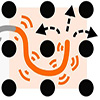
The research team, consisting of Adam Höfler, Iurii Chubak, Christos Likos, and Jan Smrek, combined computer simulations with analytical theory to identify how this motion arises. In a concentrated polymer solution, long chains become entangled and cannot pass through one another. These topological constraints act like a dense forest of obstacles. When one portion of a chain fluctuates more vigorously than another, the more active segment generates a larger entropic force. That imbalance propels the entire chain forward along its own contour, with the more active segment functioning as the leading end.
|
 |
| Chain in the forest of obstacles. The tip of orange segment (stronger fluctuations than acting on the grey segment) has three options to move forward (dashed arrows) and only one to move backwards (along the chain). More options (higher entropy) and hence higher probability to move forwards. The resulting driving force is proportional to the fluctuations magnitude, hence as the orange segment fluctuations dominate, the chain starts to “crawl” through the forest like a worm. If the grey segment, had the same amplitude of fluctuations, the chains would be at equilibrium, diffusing back and forth in the forest. (Image: Jan Smre)
|
|
“Think of a chain threaded through a dense forest of trees, which represent obstacles posed by the other chains in the system. One end of the chain is being shaken much more vigorously than the other,” explains lead author Jan Smrek from the Faculty of Physics at the University of Vienna. “You might expect it to just wiggle randomly in place. But we found that because the chain has to find its way by going in-between the trees, the difference in shaking intensity creates an imbalance that actually propels the entire chain forward through the forest.”
|
|
What distinguishes this mechanism from earlier active polymer models is its simplicity. Previous approaches relied on building directional forces into the system to produce motion. Here, the only requirement is a difference in fluctuation magnitude between chain segments. No artificial correlations or external steering is needed. The asymmetry in thermal-like activity, combined with the topological constraint that chains cannot cross each other, is sufficient to break symmetry and generate persistent movement.
|
|
The finding carries particular significance for chromatin research. Chromatin, the complex of DNA and proteins that fills cell nuclei, is subject to localized regions of enhanced biochemical activity generated by processes such as transcription and DNA repair. The Vienna team’s results suggest that these activity variations alone could be responsible for the coherent, directed chromatin motions that biologists have observed in living cells, without requiring dedicated molecular motors or other directional machinery.
|
|
The study further reveals that the degree of chain entanglement plays a central role in determining how strongly the effect manifests. As the density of the polymer solution increases and chains become more entangled, the directed motion grows faster and more pronounced. At intermediate timescales, individual chain segments were found to exhibit superdiffusive behavior, meaning they traveled farther than random thermal diffusion would predict.
|
|
“This work bridges materials science and biology,” says Smrek. “We’re showing that the same physics that governs synthetic polymers can explain behaviors in living systems. And it suggests we could design new materials that spontaneously develop directed transport properties,” adds Smrek.
|
|
Beyond the biological implications, the findings point toward practical applications in functional active materials. The researchers note that the underlying physics could be harnessed to design smart materials capable of transporting cargo autonomously or exhibiting self-healing properties. Future work will examine how these entropic transport effects interact with other active processes in biological systems and explore their potential in engineered materials.
|
|
The study builds on Adam Höfler’s Master’s thesis, completed under the supervision of Jan Smrek at the University of Vienna.
|