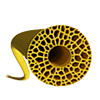
Hollow graphene aerogel fibers mimicking polar bear hair achieve record-low thermal conductivity and high electrical conductivity for multifunctional smart textiles.
(Nanowerk Spotlight) Polar bears survive Arctic winters that plunge below −70 °C, and a key reason lies not in their bulk but in the architecture of their fur. Each hair is hollow, threaded with tiny pores that trap air and block heat loss with remarkable efficiency. That biological design principle has now been translated into an advanced material that could reshape wearable technology.
Depending on their intended purpose, smart textiles may need to sense motion, block heat, conduct electricity, or harvest energy. Ideally, a single fiber would handle several of these tasks at once, but no existing material does.
The closest candidates for thermal insulation are aerogel fibers. These structures consist of a thin solid scaffold surrounding pores filled almost entirely with air, and because trapped air conducts heat poorly, they make excellent thermal barriers. What they cannot do is conduct electricity, which rules out any sensing or energy-harvesting function.
Graphene fills that gap with exceptional electrical conductivity. The problem lies in shaping it. Conventional methods for building three-dimensional graphene structures are constrained by the geometry of the reaction vessel and typically require lengthy processing, making it impractical to form the long, continuous fibers that textiles demand. A fiber that pairs graphene’s conductivity with an aerogel’s insulating architecture has therefore remained elusive.
The fibers conduct electricity at levels rivaling the best-performing aerogels on record, block heat under vacuum conditions more effectively than any previously documented graphene-based aerogel and bounce back after being squeezed nearly flat.
The schematic illustration of conceptual design, controllable fabrication, and multifunctional integration of biomimetic hollow graphene aerogel fibers and flexible smart textiles. (Image: Reproduced with permission from Wiley-VCH Verlag)
The fabrication relies on a spinning process in which two materials are pushed simultaneously through a nozzle with one channel nested inside another. A graphene oxide ink, a liquid suspension with a consistency suitable for extrusion, flows through the outer channel, while a lightweight clay fills the inner channel. Shear forces in the outer channel cause the graphene oxide nanoplates to self-organize into an ordered, arch-like pattern along the fiber’s length.
A subsequent freezing step creates a pore network aligned radially from the fiber’s center outward. The clay core is then dissolved during a hydrothermal reaction, a high-temperature treatment in a water bath, leaving behind the hollow, porous tube that mirrors polar bear fur.
Two independent processing controls allow the researchers to tune the fiber’s properties without one improvement degrading another. Thermal annealing, which involves heating the fibers to temperatures between 250 °C and 2000 °C, progressively strips oxygen-containing chemical groups from the graphene sheets, restoring the regular, repeating arrangement of carbon atoms needed for electrical conduction.
Separately, the amount of oxidizing agent used during graphene oxide synthesis controls how many oxygen groups remain attached, adjusting the spacing between graphene layers. By turning these two knobs independently, the team pushes electrical conductivity upward while keeping thermal conductivity low.
At 2000 °C annealing with an ink concentration of 20 mg/mL, the fibers reach an electrical conductivity of 1457.09 S/m, among the highest values on record for any conductive aerogel. Under vacuum conditions, the thermal conductivity drops to just 1.28 mW/(m·K), which the paper identifies as the lowest value reported for graphene-based aerogels.
The vacuum qualifier matters: in open air, gas conduction through the pores adds to the total, but heat conduction through the solid material itself is exceptionally suppressed. Four mechanisms work in concert across different length scales. Oxygen groups and defects in the carbon structure restrict phonons, the atomic-scale vibrations that carry heat through a solid, within individual graphene sheets. Interfaces between stacked sheets scatter phonons further.
The hierarchical pore network forces heat along winding, indirect paths. And the hollow core limits air circulation that would otherwise carry warmth by convection.
Mechanically, the arch-like internal structure acts like a series of tiny springs. The fibers recover their shape after being compressed to 90 % strain, meaning they return to their original form even after being squeezed to one tenth of their thickness. They withstand repeated compression cycles at 80 % strain without visible damage. Tensile strength, compressive resistance, and bending toughness can each be adjusted independently through the same processing parameters that control electrical and thermal behavior.
These combined properties open a range of applications that the study demonstrates in woven textile prototypes. Attached to the body at joints such as the shoulder, knee, and elbow, the fibers detect motion through the piezoresistive effect: bending shifts the contact points where graphene sheets touch inside the fiber, changing its electrical resistance. The shoulder joint, which undergoes the largest bending angle, produces a resistance change of about 18 %, while the knee generates a more complex signal reflecting its combination of bending, tension, and twisting.
The same fibers convert temperature differences into voltage. The Seebeck coefficient, a measure of how much voltage a material generates per degree of temperature difference, ranges from 16.7 to 20.0 µV/K depending on ink concentration and remains stable over both 20 heating-and-cooling cycles and 24 hours of continuous operation. This thermoelectric sensitivity enables an early fire-warning sensor that detects rapid temperature spikes and a small energy harvester capable of powering an electronic wristband or LED strips from body heat.
When voltage is applied in the opposite direction, the textiles become personal heaters. At just 7 V, the surface temperature reaches 175 °C, with a precise linear relationship between temperature and the square of applied voltage. The required voltage falls below what the paper describes as the human safety threshold for body contact, making the textiles suitable for battery-powered operation in cold environments. The heating response remains stable over 24 hours at 5 V.
The thermal insulation performance ties directly back to the polar bear inspiration. Placed on a heated surface alongside polystyrene, asbestos board, silica aerogel blanket, and wool felt, the graphene aerogel textile consistently registered the lowest surface temperature, with insulation efficiency gains exceeding 20 %. Draped over a running engine, it substantially concealed the thermal signature in infrared imaging, suggesting applications in military camouflage.
At the opposite extreme, it protected bare skin from direct contact with liquid nitrogen at −196 °C and kept a lithium battery operating within its safe temperature window under both extreme heat and extreme cold.
Atomic-scale simulations reported in the paper help explain why one fiber can do so many things at once. Introducing defects and oxygen groups into the graphene structure disrupts the even distribution of electrons, which enhances thermoelectric voltage generation. The same defects scatter phonons, suppressing heat flow without proportionally reducing electrical conduction.
Because these atomic-level modifications and the fiber’s microscopic pore structure operate through different physical mechanisms, the various properties respond to different processing levers and can be optimized without mutual interference.
Translating these laboratory fibers into commercial smart clothing will require answers to questions the paper does not address: manufacturing cost at scale, durability through repeated washing, and long-term reliability under real-world wear. But the demonstration that a single biologically inspired fiber can set simultaneous records in electrical conductivity and thermal insulation while also sensing movement, generating power, and providing camouflage establishes a material platform on which those engineering challenges can now be pursued.
For authors and communications departmentsclick to open
Lay summary
Prefilled posts
Nanowerk Newsletter
Get our Nanotechnology Spotlight updates to your inbox!
Thank you!
You have successfully joined our subscriber list.
Become a Spotlight guest author! Join our large and growing group of guest contributors. Have you just published a scientific paper or have other exciting developments to share with the nanotechnology community? Here is how to publish on nanowerk.com.