| Feb 09, 2026 |
Researchers have developed a breakthrough technique that quantifies energy dissipation in complex, small systems, offering insights into energy use, efficiency, and speed in computers and other devices.
(Nanowerk News) In order to build the computers and devices of tomorrow, we have to understand how they use energy today. That’s harder than it sounds. Memory storage, information processing, and energy use in these technologies involve constant energy flow – systems never settle into thermodynamic balance. To complicate things further, one of the most precise ways to study these processes starts at the smallest scale: the quantum domain.
|
|
New Stanford research published in Nature Physics (“Non-equilibrium entropy production and information dissipation in a non-Markovian quantum dot”) combines theory, experimentation, and machine learning to quantify energy costs during a non-equilibrium process with ultrahigh sensitivity.
|
|
The researchers used extremely small nanocrystals called quantum dots, which have unique light-emitting properties that arise from quantum effects at the nanoscale. They measured the entropy production of quantum dots – a quantity that describes how reversible a microscopic process is, and encodes information about memory, information loss, and energy costs. Such measurements can determine the ultimate speed limits for a device or how efficient it can be.
|
|
“When I first saw this work, they really had to convince me that they were measuring the thing that they said they were measuring because it’s an incredibly hard thing to do,” said Grant Rotskoff, assistant professor of chemistry in the School of Humanities and Sciences and co-author of the paper.
|
|
Many materials and devices switch between different structural phases, involving atomic-scale motions at very fast timescales. Improved measurements of the interplay between memory, information, and energy dissipation in a complex system could reveal new limits for computers and similar devices in terms of energy, efficiency, stability, and speed.
|
|
“The world we live in is intrinsically non-equilibrium in nature – weather patterns, living things, and materials and devices, for example, are driven by non-equilibrium processes,” said the paper’s senior author, Aaron Lindenberg, professor of materials science and engineering in the School of Engineering and of photon science at SLAC National Accelerator Laboratory. “No one has ever been able to measure things like entropy production in one of these real material systems. That’s the fundamental thing that our paper achieves.”
|
|
By starting with a very complex and small system, the researchers hope this lays the foundations for devices across different scales and complexity to evolve in ways that use less energy and operate faster.
|
|
“There is a lot of work in this area, mainly dominated by theory,” said Yuejun Shen, graduate student in the Lindenberg lab and lead author of the paper. “But it’s very hard to do a proper experiment to measure these scenarios because some parameter in the theory is too ideal, or there’s too much noise in the real experiment. What we did splits the difference between experiment and theory.”
|
 |
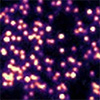
| Video showing the blinking quantum dots from the experiment. The researchers turned a laser field on and off to drive them far from equilibrium and modulate their blinking. (Image: Shen, Y., Chen, C., Ma, H., et al.)
|
How to measure a complex nanoscale system
|
|
In classical thermodynamics, like an engine, we know how to measure efficiency. But when you shrink that down to the nanoscale, the tools we have don’t work anymore.
|
|
“There is a lot of work thinking about what happens when you shrink systems down. How do fluctuations play a role? How should we define all of the quantities? There’s a big gap between what we can do theoretically and what can be done experimentally,” said Rotskoff. “This work is a significant step toward closing that gap for a specific class of systems, and for understanding efficiency in particular.”
|
|
“When the field is off, the blinking of a quantum dot follows a certain statistical blinking pattern. When the field is on, there’s another statistical pattern,” said Shen. “This is how we induce the non-equilibrium state and it is how we make the experiment represent information dissipation.”
|
|
After obtaining experimental data, the researchers use machine learning to optimize the parameters for a physics-based model. With the aid of the optimized model, they were then able to calculate the entropy production for the quantum dots.
|
New possibilities in measurement and innovation
|
|
This work aims to inform future computers and other devices and builds on recent advances in computation, measurement, data analysis, and theory. Years ago, the computer vision techniques required to track the quantum dot blinking, the machine learning algorithms, and the computing power needed to do these analyses would have been prohibitively challenging or time-intensive. The theory is contemporary, too.
|
|
“Conceptually, I’m not sure that the question could have been formulated as clearly 10 years ago. We’re very much at the beginning of starting to think about how to measure dissipation and energy efficiency in systems that are externally controlled,” said Rotskoff.
|
|
The researchers anticipate their technique can become even more precise and realistic, given that it combines insights from fields that are experiencing an abundance of innovation. They are also excited to see how their work could inform the future of devices.
|
|
“If you can measure energy dissipation within driven, non-equilibrium systems directly, you can start to explore different pathways to search for optimal ways to improve the process, like searching for a device that operates using less energy or is faster,” said Lindenberg. “It is a problem of important technological relevance.”
|