| Mar 25, 2026 |
Fluorinated donor-acceptor self-assembled molecules achieve 25.02% efficiency in inverted perovskite solar cells while improving film quality and ambient stability.
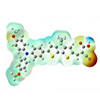
(Nanowerk News) Perovskite solar cells built with a new class of donor-acceptor self-assembled molecules show measurable gains in both efficiency and durability. Researchers at National Taiwan University designed two molecules, LYS-H and LYS-F, as replacements for Me-4PACz, a widely used but limited hole-selective material in inverted device architectures. The fluorinated variant, LYS-F, reached a power conversion efficiency of 25.02% and a fill factor of 83.64%. The results were published in Small (“Co‐Assembly with Donor‐Acceptor Self‐Assembled Monolayers to Enhance Interfacial Hole Extraction, Wettability, and Crystallization in Inverted Perovskite Solar Cells”).
|
Key Findings
- Two newly designed donor–acceptor SAMs, LYS-H and LYS-F, reduce molecular aggregation and improve perovskite precursor wetting compared to the conventional Me-4PACz hole-selective layer.
- The fluorinated LYS-F molecule produced solar cells with a power conversion efficiency of 25.02% and a fill factor of 83.64%.
- Unencapsulated devices using the new SAMs showed improved stability under ambient conditions, an important step toward commercial viability.
|
|
Me-4PACz is one of the most common SAMs used as a hole-selective layer in inverted perovskite solar cells. However, the molecule tends to aggregate on the substrate, producing an uneven coating. It also has poor wettability toward perovskite precursor solutions, which prevents uniform spreading. These factors degrade the buried interface, the junction where the perovskite film meets the charge-transporting surface underneath.
|
|
LYS-H and LYS-F were designed with a donor–acceptor architecture specifically to suppress this aggregation behavior. When co-assembled on the substrate, they form a more uniform interfacial layer than Me-4PACz alone. The improved surface coverage allows the perovskite precursor to wet the substrate more evenly, establishing better conditions for the subsequent film deposition step.
|
|
Perovskite films grown on the new SAM layers crystallized with higher structural quality and fewer subsurface defects. Charge extraction improved and recombination losses dropped, both reflected in the device metrics. LYS-F, which carries a fluorine substituent, outperformed LYS-H. Its 25.02% power conversion efficiency and 83.64% fill factor represent clear improvements over cells fabricated with conventional Me-4PACz.
|
|
Stability testing provided a second practical result. Unencapsulated devices made with the new SAMs retained their performance more effectively during ambient air storage. Commercial solar technologies must sustain their output over long periods without elaborate packaging, so buried-interface quality matters for durability as well as initial efficiency.
|
|
“This work shows how molecular design can overcome buried-interface limitations and unlock more efficient, stable perovskite solar cells,” said co-corresponding author Chu-Chen Chueh, professor of chemical engineering at National Taiwan University.
|
|
By suppressing SAM aggregation, improving precursor wetting, and raising perovskite crystallinity through a single molecular design strategy, the LYS-H and LYS-F molecules address multiple fabrication bottlenecks at once. The co-assembly approach offers a practical route toward inverted perovskite solar cells that pair high efficiency with the long-term stability needed for real-world deployment.
|