
Home > Press > Beyond silicon: Electronics at the scale of a single molecule
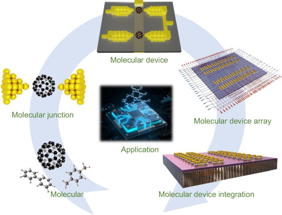 |
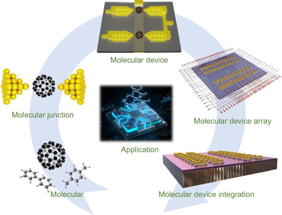
| Fabrication-Functionalization-Integration-Application process schematic of molecular electronic devices.
Credit Microsystems & Nanoengineering |
Abstract:
As silicon-based electronics approach fundamental limits, researchers are turning to molecules as the smallest possible functional devices. Molecular electronics replaces conventional transistors with individual molecules that control current through quantum effects rather than classical charge flow. Recent progress shows that molecular switches, diodes, and transistors can now be built more reliably and measured more reproducibly than ever before. Advances in fabrication and interface control have reduced long-standing instability and variability issues. Together, these developments suggest that molecular electronics is moving beyond proof-of-concept experiments and toward practical architectures capable of supporting ultra-dense, low-power electronic systems beyond today’s semiconductor technologies.
Beyond silicon: Electronics at the scale of a single molecule
Beijing, China | Posted on January 30th, 2026
For more than half a century, shrinking transistors has driven faster and cheaper electronics. That strategy is now running out of room. At nanometer scales, quantum effects disrupt conventional device behavior, while fabrication costs continue to rise sharply. These pressures have pushed researchers to search for alternatives that do not rely on further silicon scaling. Molecular electronics offers such an option by using single molecules as active electronic elements whose properties can be tuned by chemical design. Yet the field has faced persistent obstacles, including unstable device performance, poor reproducibility, and difficulties in large-scale integration. Based on these challenges, deeper exploration of new molecular fabrication strategies has become essential.
In a 2025 review published (DOI: 10.1038/s41378-025-01037-8) in Microsystems & Nanoengineering, researchers from Xiamen University analyze how atomic-scale manufacturing is reshaping molecular electronics. The article, released in early 2025, summarizes recent advances in building, stabilizing, and measuring single-molecule electronic devices. It also outlines emerging strategies that combine molecular self-assembly with established micro- and nanofabrication techniques. Together, these approaches point to a possible path toward integrated molecular circuits capable of logic and computing functions at dimensions far smaller than today’s silicon technologies.
At the core of molecular electronics lies the molecular junction, where a single molecule bridges two electrodes. At this scale, electrons move by tunneling rather than flowing like classical currents. This behavior allows molecules to act as switches, rectifiers, or transistorsif they can be assembled and contacted reliably.
The review highlights how recent fabrication methods are addressing this challenge. Static junctions created by controlled nanogaps or self-assembled molecular layers offer improved mechanical stability. Dynamic techniques, which repeatedly form and break molecular contacts, provide statistically robust measurements that reveal intrinsic molecular behavior rather than experimental noise.
Researchers have also expanded beyond traditional metal electrodes. Carbon-based materials such as graphene and carbon nanotubes reduce unwanted signal interference and improve control over moleculeelectrode coupling. Meanwhile, DNA-based positioning methods allow molecules and nanoparticles to be placed with near-atomic precision, opening new routes to ordered molecular arrays.
Importantly, these technical advances are no longer just demonstrations of feasibility. The review shows that molecular devices can now be engineered to respond predictably to light, electric fields, redox states, or mechanical forceskey requirements for real electronic functions.
“The field is shifting from asking whether molecular devices work to understanding how they can work reliably,” the authors explain. They note that improved control over interfaces and fabrication conditions has significantly narrowed performance variations between devices. According to the review, this progress marks a turning point: molecular electronics is no longer limited by fundamental physics, but by engineering challenges that may be solved by integrating atomic-scale precision with existing manufacturing technologies.
If these trends continue, molecular electronics could reshape the future of computing and sensing. Devices built from single molecules promise extreme miniaturization and ultra-low energy consumption, making them attractive for next-generation logic circuits, memory technologies, and neuromorphic systems. Molecular junctions could also enable sensors capable of detecting chemical or biological signals with single-molecule sensitivity. The review emphasizes that three-dimensional integrationalready used in advanced semiconductor packagingmay be critical for turning molecular components into functional circuits. While practical deployment remains a long-term goal, molecular electronics is increasingly viewed as a credible post-silicon technology.
####
About Aerospace Information Research Institute, Chinese Academy of Sciences
About Microsystems & Nanoengineering
Microsystems & Nanoengineering is an online-only, open access international journal devoted to publishing original research results and reviews on all aspects of Micro and Nano Electro Mechanical Systems from fundamental to applied research. The journal is published by Springer Nature in partnership with the Aerospace Information Research Institute, Chinese Academy of Sciences, supported by the State Key Laboratory of Transducer Technology.
For more information, please click here
Contacts:
Na Li
Microsystems & Nanoengineering
Copyright © Aerospace Information Research Institute, Chinese Academy of Sciences
If you have a comment, please Contact us.
Issuers of news releases, not 7th Wave, Inc. or Nanotechnology Now, are solely responsible for the accuracy of the content.
Bookmark:


News and information

Decoding hydrogen‑bond network of electrolyte for cryogenic durable aqueous zinc‑ion batteries January 30th, 2026
COF scaffold membrane with gate‑lane nanostructure for efficient Li+/Mg2+ separation January 30th, 2026
Quantum Physics
MXene nanomaterials enter a new dimension Multilayer nanomaterial: MXene flakes created at Drexel University show new promise as 1D scrolls January 30th, 2026
ICFO researchers overcome long-standing bottleneck in single photon detection with twisted 2D materials August 8th, 2025
Quantum computers simulate fundamental physics: shedding light on the building blocks of nature June 6th, 2025
A 1960s idea inspires NBI researchers to study hitherto inaccessible quantum states June 6th, 2025
Possible Futures
Decoding hydrogen‑bond network of electrolyte for cryogenic durable aqueous zinc‑ion batteries January 30th, 2026
COF scaffold membrane with gate‑lane nanostructure for efficient Li+/Mg2+ separation January 30th, 2026
Chip Technology
Metasurfaces smooth light to boost magnetic sensing precision January 30th, 2026
Lab to industry: InSe wafer-scale breakthrough for future electronics August 8th, 2025
A 1960s idea inspires NBI researchers to study hitherto inaccessible quantum states June 6th, 2025
Discoveries
From sensors to smart systems: the rise of AI-driven photonic noses January 30th, 2026
Decoding hydrogen‑bond network of electrolyte for cryogenic durable aqueous zinc‑ion batteries January 30th, 2026
COF scaffold membrane with gate‑lane nanostructure for efficient Li+/Mg2+ separation January 30th, 2026
Announcements
Decoding hydrogen‑bond network of electrolyte for cryogenic durable aqueous zinc‑ion batteries January 30th, 2026
COF scaffold membrane with gate‑lane nanostructure for efficient Li+/Mg2+ separation January 30th, 2026
Interviews/Book Reviews/Essays/Reports/Podcasts/Journals/White papers/Posters
Metasurfaces smooth light to boost magnetic sensing precision January 30th, 2026
COF scaffold membrane with gate‑lane nanostructure for efficient Li+/Mg2+ separation January 30th, 2026
Quantum nanoscience
MXene nanomaterials enter a new dimension Multilayer nanomaterial: MXene flakes created at Drexel University show new promise as 1D scrolls January 30th, 2026
ICFO researchers overcome long-standing bottleneck in single photon detection with twisted 2D materials August 8th, 2025
