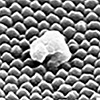
Flexible plastic films stamped with dense nanopillar arrays mechanically rupture viral particles, reducing infectivity by 94% in one hour with no chemical agents involved.
(Nanowerk Spotlight) Viruses that linger on surfaces pose a persistent public health problem. Common respiratory pathogens, including influenza and SARS-CoV-2, can remain infectious on everyday materials for hours, turning shared objects into transmission routes. The conventional response has relied on chemical interventions: coatings laced with silver or copper nanoparticles, surfaces treated with industrial disinfectants, films embedded with zinc oxide.
These approaches can neutralize pathogens, but they come with trade-offs. The active agents gradually leach out, diminishing effectiveness over time. Many raise concerns about toxicity to human cells and environmental contamination. And the constant low-level chemical exposure they create may drive the emergence of resistant strains.
An alternative strategy, rooted in physics rather than chemistry, emerged from an unexpected source: insect wings. The wings of cicadas and dragonflies are covered in nanoscale spikes that physically destroy bacteria on contact. When a bacterium settles onto these natural nanostructures, its cell membrane stretches across the spike tips and ruptures under mechanical stress.
Scientists have since replicated this “mechano-bactericidal” effect on engineered surfaces made from silicon, titanium, and other hard materials. If the surface geometry is right, no chemical agent is needed. The topography itself does the work.
Applying this principle to viruses presents a harder problem. Most viruses measure between 30 and 200 nanometers (nm) in diameter, far smaller than bacteria. The nanostructures required to physically engage viral particles must be extraordinarily fine and precisely arranged.
Early experiments on rigid substrates like nanospike silicon showed that physical disruption of viruses was possible, but those materials were expensive, brittle, and unsuitable for large-scale production.
A multinational research team based primarily at RMIT University in Melbourne, working with collaborators in Spain and Japan, fabricated flexible acrylic films covered in dense arrays of nanopillars that physically rupture the envelopes of viral particles. These surfaces reduced the infectivity of human parainfluenza virus type 3 (hPIV-3), a serious respiratory pathogen with no approved vaccine or antiviral treatment, by up to 94% within one hour, without any chemical additives.
Characterization of nanofabricated acrylic surfaces with varying nanopillar pitch and height. (a) Schematic illustration of the fabrication process for nanostructured antiviral surfaces using anodized AAO molds. (b) Representative SEM images of acrylic surfaces with 60 nm pitch and height of 60, 85, 110, 170, and 185 nm. (c) Representative SEM images of 100 nm pitch and (d) 200 nm pitch with heights indicated. The upper panel of these SEM images shows the top view, while the bottom panel shows tilted views. Inset images show the corresponding water contact angle for each surface, indicating all surfaces are moderately hydrophilic. (e) Image demonstrating the bending flexibility of a nanofabricated acrylic surface. All scale bars in SEM images represent 100 nm. (Image: Reproduced from DOI:style=”color:#0000FF” target=”_blank”, CC BY) (click on image to enlarge)
The manufacturing method matters as much as the result. The team used ultraviolet nanoimprint lithography, a process that stamps nanoscale patterns into photocurable acrylic resin using molds made from anodized aluminum oxide. This technique produces highly ordered pillar arrays with precise geometric control and is already compatible with roll-to-roll production, the same continuous process used to make plastic packaging films. The resulting material is transparent, flexible, and chemically identical to flat acrylic, as infrared spectroscopy confirmed.
The researchers systematically varied two geometric parameters: the pitch (center-to-center distance between pillars) and the pillar height. They produced surfaces with pitches of 60, 100, and 200 nm, each at multiple heights, then exposed them to hPIV-3. This virus, which has a diameter of roughly 150 to 250 nm, causes significant illness and death, particularly among children, elderly people, and immunocompromised patients.
The densest arrays, with a 60 nm pitch, proved most effective. Across all pillar heights tested, from 60 to 185 nm, these surfaces reduced viral infectivity by an average of 0.7-log, roughly a five-fold drop. The best-performing configurations, at pillar heights of 85 and 170 nm, achieved a maximum 1.2-log reduction, or approximately a 16-fold decrease in infectious particles.
Surfaces with a 100 nm pitch showed weaker, height-dependent activity: short pillars at 45 nm had no measurable antiviral effect, while taller ones at 200 nm produced a 0.5-log, or roughly three-fold, reduction. At a 200 nm pitch, antiviral activity vanished entirely regardless of pillar height.
Statistical analysis using Type II ANOVA confirmed that interpillar spacing, not pillar height, drove antiviral performance. Height mattered only at intermediate spacing, where taller pillars could partially compensate for reduced density.
Electron microscopy revealed the physical mechanism at work. On the 60 nm pitch surfaces, viral particles appeared deflated, deformed, and clamped between multiple pillar tips, showing clear loss of structural integrity. Focused ion beam cross-sections of taller pillars, particularly at 110 nm height, showed them penetrating deeply into the viral particle, suggesting extensive structural compromise. On the 200 nm surfaces, by contrast, viruses lodged between widely spaced pillars without significant damage, often contacting only a single pillar.
Finite element method simulations clarified why spacing matters so much. When a virus settles onto a dense pillar array, its lipid envelope drapes over several pillar tips and stretches across the gaps between them. This stretching concentrates mechanical stress at the points where the envelope lifts away from each tip.
On 60 nm pitch surfaces, these localized stresses exceeded 10 megapascals (MPa), a threshold the researchers estimate is sufficient to rupture the viral envelope. On wider-pitched surfaces, the virus contacted too few pillars to generate adequate deformation.
The mechanism is not simple piercing by individual spikes. Instead, multiple closely spaced pillars collectively induce tensile stress across the viral membrane as it settles between them. The simulations also identified an optimal ratio of pillar pitch to virus diameter, between 0.2 and 0.5, for maximum virucidal efficiency.
This ratio functions as a generalizable design rule: for any target virus of known size, it specifies the pillar spacing most likely to achieve mechanical rupture, offering a framework for engineering surfaces against a range of enveloped pathogens.
Genetic analysis confirmed that viral RNA remained intact on the nanostructured surfaces, ruling out chemical degradation. The inactivation was purely mechanical, a rupture of the lipid envelope that eliminates infectivity while leaving the genetic material untouched.
The acrylic nanopillar surfaces also outperformed previously reported nanospike silicon, which achieved only a 0.8-log reduction over three hours. The researchers attribute this improvement partly to the greater elasticity of the polymer pillars, which flex and store mechanical energy upon viral contact, amplifying the stress delivered to the envelope.
The team further demonstrated that the most effective surface, at 60 nm pitch, also killed the common bacterial strains Staphylococcus aureus and Pseudomonas aeruginosa, confirming dual antimicrobial capability.
These films introduce no new chemicals, degrade nothing, and present nothing that pathogens could evolve resistance against. They are flexible enough to wrap around curved objects, transparent enough for screens and packaging, and produced by a process the team has already scaled to roll-to-roll mold production. Unlike every chemical coating on the market, they cannot run out. The antiviral agent is the surface itself, a fixed arrangement of nanoscale pillars that works the same way on day one thousand as on day one. For hospitals, consumer electronics, food packaging, and other settings where contaminated surfaces continue to spread disease, that permanence may matter more than potency.
For authors and communications departmentsclick to open
Lay summary
Prefilled posts
Nanowerk Newsletter
Get our Nanotechnology Spotlight updates to your inbox!
Thank you!
You have successfully joined our subscriber list.
Become a Spotlight guest author! Join our large and growing group of guest contributors. Have you just published a scientific paper or have other exciting developments to share with the nanotechnology community? Here is how to publish on nanowerk.com.