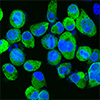
A vanadium MXene nanoparticle uses gene editing to strip tumors of heat resistance, then kills them with laser-triggered free radicals while activating immunity.
(Nanowerk Spotlight) When doctors heat a tumor with laser light, the precision is remarkable. The energy concentrates at the tumor site, sparing surrounding tissue in ways that chemotherapy and radiation cannot. Photothermal therapy exploits this advantage to ablate cancerous tissue with minimal collateral damage.
But cancer cells mount a defense. They flood themselves with heat shock proteins, molecular chaperones that stabilize damaged structures and buy time for repair. Heat shock protein 90 is particularly effective, blunting the very temperatures designed to kill the cell. Past efforts to overcome this shield have relied on small-molecule inhibitors, but these spread throughout the body and carry significant side effects. A more radical idea would be to edit the defense out of the tumor’s genome entirely. Silence the gene before the laser fires, so the cell has no shield when the heat arrives.
Four therapeutic modes are packed into a single particle and activated in sequence by the tumor’s own chemistry and a near-infrared laser.
Synthesis and mechanism of VARH. (Image: Reproduced from DOI:10.1002/advs.202522535, CC BY) (click on image to enlarge)
The foundation of VARH is V₄C₃, a two-dimensional MXene material with strong absorption at 1064 nm, a near-infrared-II wavelength that penetrates tissue more deeply than the near-infrared-I range used in conventional photothermal agents. Under laser irradiation, VARH converted 44.21% of absorbed light energy into heat.
To assemble the full therapeutic payload, the researchers grafted amino groups onto V₄C₃, then used a crosslinker containing disulfide bonds to attach two components. The first is a thermosensitive compound that decomposes at elevated temperatures to generate alkyl radicals. The second is a gene-editing complex consisting of Cas9 protein paired with a guide RNA targeting the gene for heat shock protein 90.
A final coating of hyaluronic acid gave the nanoparticle a negative surface charge for stability in the bloodstream and enabled active targeting of receptors overexpressed on many cancer cells. In uptake experiments, the coated particles were internalized significantly faster and more completely than uncoated ones.
Once inside a tumor cell, the high glutathione concentration characteristic of the tumor microenvironment breaks the disulfide bonds, releasing both the thermosensitive compound and the gene-editing cargo. The editing complex escapes the lysosome, the cell’s digestive compartment, by building up positive charge inside it until the membrane swells and ruptures. It then enters the nucleus and cuts the HSP90 gene, stripping the tumor cell of its primary heat defense.
When the external laser is switched on, a cascade of cell-killing events follows. The V₄C₃ nanosheets convert light to heat, raising local temperature to levels that would normally trigger thermotolerance, except HSP90 has already been silenced. Simultaneously, the heat decomposes the thermosensitive compound, flooding the cell with alkyl radicals. Because this radical generation does not require oxygen, it remains effective even in the oxygen-starved core of solid tumors.
In parallel, vanadium ions in the V⁴⁺ state catalyze a chemical chain reaction that converts the tumor’s own hydrogen peroxide into hydroxyl radicals, a highly reactive oxygen species. This further amplifies oxidative damage. Together, photothermal ablation, two types of free radicals, and gene-mediated removal of heat resistance all act on the same cell simultaneously.
In HepG2 liver cancer cells, VARH plus laser irradiation drove the apoptosis rate to 66.4%. Without laser activation, the nanoparticles showed no significant toxicity to normal cells, confirming that the system depends entirely on the laser trigger.
In H22 tumor-bearing mice, intravenous VARH followed by five cycles of laser irradiation over 14 days achieved a tumor inhibition rate of 83.21%. The deeper tissue penetration of the 1064 nm wavelength contributed to effective heating at the tumor site. Photothermal therapy alone reached only 44.10% inhibition, and adding alkyl radicals without gene editing yielded 57.96%. Each added component delivered a measurable gain. Biosafety assessments found no significant organ toxicity, and off-target gene editing was undetectable in the five major organs examined.
Beyond direct tumor killing, the platform activated a strong immune response. The combined thermal and radical damage induced immunogenic cell death, causing tumor cells to display calreticulin on their surfaces and release HMGB1 protein. These molecular danger signals recruited dendritic cells, immune sentinels that present tumor fragments to T cells, and promoted their maturation. CD8⁺ killer T cells increased 7.72-fold over untreated controls, while regulatory T cells, which dampen immune activity, dropped sharply.
This coupling of gene editing with immune activation echoes recent work on nanovaccines that combine CRISPR with targeted immune responses, though VARH achieves it through photothermal and radical-driven immunogenic cell death rather than direct immune programming.
By silencing the gene that enables heat resistance, generating oxygen-independent free radicals, and catalyzing additional reactive species, VARH converts a moderate photothermal treatment into a multimodal antitumor system that also recruits the immune system. Clinical translation will require long-term toxicological studies and manufacturing standardization. But the approach demonstrates that layering gene editing onto photothermal and radical-based therapies can overcome resistance mechanisms that have limited each strategy individually.
For authors and communications departmentsclick to open
Lay summary
Prefilled posts
Nanowerk Newsletter
Get our Nanotechnology Spotlight updates to your inbox!
Thank you!
You have successfully joined our subscriber list.
Become a Spotlight guest author! Join our large and growing group of guest contributors. Have you just published a scientific paper or have other exciting developments to share with the nanotechnology community? Here is how to publish on nanowerk.com.