| Dec 12, 2025 |
With targeted molecularly designed contacts, researchers reach an efficiency of perovskite-silicon tandem cells of 31.4 percent.
|
|
(Nanowerk News) Perovskite-silicon tandem solar cells are considered a key technology for photovoltaics. Because of their design, they use sunlight more efficiently than conventional silicon cells. While the upper perovskite layer absorbs the high-energy blue part of the spectrum, the silicon layer underneath captures the red part. The interplay of the two materials allows significantly more solar energy to be harvested.
|
|
An international team led by LMU-chemist Dr. Erkan Aydin, research group leader at LMU, has now made an important breakthrough with this approach. In the journal Joule (“Enhanced charge extraction in textured perovskite-silicon tandem solar cells via molecular contact functionalization”), the researchers report on the first perovskite-silicon tandem cell to be wholly produced in the Munich region. LMU’s collaborators in this work are the Southern University of Science and Technology (SUSTech) in Shenzhen, China, the City University of Hong Kong, and the King Abdullah University of Science and Technology (KAUST) in Saudi Arabia.
|
 |
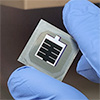
| Perovskite-silicon tandem solar cells fabricated at LMU. (Image: Aydin Group)
|
A new approach to molecular design
|
|
A key element of tandem cells is the self-assembled monolayer (SAM). Just a few nanometers thick, this molecular layer ensures that electrical charges are transported efficiently to the charge collection layers. On pyramidally textured silicon surfaces, however, conventional SAMs with simple alkyl chains tend to aggregate unevenly. This limits the performance of the cells.
|
|
To solve this problem, the researchers developed a special molecule. Its particular structure improves charge transport even on rough surfaces and thus creates the basis for a stable interface.
|
|
During analyses, the team made a surprising observation: A commercially available SAM precursor possessed tiny impurities containing bromine. These proved to be extremely useful, as they neutralized defects at the interface and so increased the efficiency of the solar cells.
|
|
“That such a small chemical change can have such a large effect surprised even us,” explains project leader Aydin. “This discovery shows how decisive the precise interplay of materials at the molecular level is for the energy yield of emerging solar cells.”
|
|
The researchers combined brominated and non-brominated molecules in order to exploit the positive effects of bromine without impairing chemical stability. Their newly designed SAM structure permits denser molecular packing and better passivation of the interface – which in turn leads to higher efficiencies, increased stability, and more efficient charge extraction.
|
31.4 percent efficiency
|
|
Through this targeted fine-tuning at the molecular level, the team obtained an efficiency of 31.4 percent. This places the team among the leading laboratories developing high-performance perovskite-silicon tandem cells worldwide. Even more remarkably, these values were achieved on industrially relevant crystalline silicon bottom cells. In addition to the increased efficiency, the stability of the cells was shown to improve over longer times. The denser molecular packing of the new SAMs protects the sensitive interface from damage at the molecular level.
|
|
“As the next step, we want to show that our tandem cells can prove their worth not just in the lab, but also in accelerated aging tests, which gives insight about real environmental condition behavior,” says Aydin. “At the same time, we’re testing how the technology can be adapted for space applications – particularly for satellites in low Earth orbits.” This is a field with a burgeoning interest in very light, radiation-resistant, and high-performance solar cells.
|