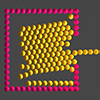
Microrobot swarms self-assemble into artificial microtubules under confinement, moving cargo through tight channels and biological fluids using controlled magnetic fields that enable reversible transport.
(Nanowerk Spotlight) Cells are cramped. They are filled with membranes, proteins and droplets of fluid that leave almost no open space. Yet within that crowded environment, essential cargo travels efficiently. Vesicles carrying nutrients or signaling molecules are not left to drift. They are hauled across the cell along rigid filaments called microtubules, using protein motors that convert chemical energy into motion. This system works not because the environment is easy to navigate, but because cells impose order on chaos by creating directional transport pathways.
Attempts to engineer similar transport systems for use in microfluidic environments and biological tissues have fallen short. Microscopic cargo usually moves by diffusion, a process dominated by viscous drag and random motion. In narrow vascular channels or tissue cavities, this slow drift becomes even less effective.
Magnetic microrobot swarms were proposed as a more controllable solution. These microrobot systems can be assembled from magnetic particles and pushed through fluids using external fields. Yet when swarms enter confined spaces, they lose coherence, jam or deform into irregular clusters. Their control requires constant intervention, and their performance deteriorates in exactly the environments where precise cargo transport would matter most.
Under a specific magnetic field, a moving swarm of superparamagnetic microspheres spontaneously unravels into a one-dimensional filament that resembles a biological microtubule. This filament, described as an artificial microtubule, becomes a conveyor that transports passive cargo along confined paths. Once transport is complete, the magnetic field can be reversed, and the chain re-forms into a compact microrobot swarm.
Artificial microtubule (AMT) assisted cargo transport into a cavity (right) inspired from intracellular cargo transport along its natural
counterpart (left). (Image: Reproduced with permission from Wiley-VCH Verlag)
The microrobots consist of monodisperse superparamagnetic microspheres with diameter 2a = 4.5 μm. Superparamagnetic materials magnetize only under an external magnetic field, avoiding permanent clumping. The microspheres are positioned near a substrate and are driven by an elliptical precessing magnetic field. Under this field, each microsphere rotates and interacts magnetically with its neighbors. The rotation couples to translation through wall-induced hydrodynamics, assembling the particles into two-dimensional microrobot swarms that propel themselves across the surface.
Artificial microtubule formation begins when part of the swarm becomes pinned. This can happen when a single microsphere sticks to a surface or when the swarm reaches a corner or channel neck. The pinned region anchors the moving cluster. Instead of collapsing, the boundary of the swarm begins to unravel. Beads detach one by one and form an elongated chain that advances along the surface. The rotating microspheres generate tangential fluid flows that collectively move the chain forward. Reversing the propulsion direction causes the chain to rebraid, converting back into a stable swarm.
Two magnetic field parameters govern this transformation: the ellipticity of the rotating field and the ratio between the rotating field component and the static field component. When the rotating and static components are balanced at an intermediate ratio, microrobot swarms remain stable but capable of unraveling upon pinning. If rotation dominates, swarms fracture into small spinning clusters. If the static component dominates, microspheres align and remain largely immobile. Increasing field ellipticity reduces the magnetic energy difference between swarm and chain states, allowing the system to reorganize efficiently.
The unraveling of artificial microtubules follows discrete steps rather than forming instantly. Boundary microspheres experience asymmetric interactions that pull them away from the bulk, forming the front of the chain. The authors examined the local bond orientational order to quantify how closely particles resemble a hexagonal packing. In simple unraveling cycles, a boundary particle detaches, order temporarily decreases and then recovers when the new chain front slides around the next microsphere. In more complex cycles, several particles form transient lattice patterns that break later, producing irregular drops in order.
Velocity of artificial microtubule formation scales with the rotating magnetic component. The rotational speed of each bead is proportional to the square of the rotating amplitude. Because rotation near a surface drives translation, both the unraveling frequency and artificial microtubule velocity increase accordingly. This provides a practical control mechanism. By adjusting only the rotating amplitude, engineers can tune how rapidly artificial microtubules form and how fast they transport cargo.
This behavior becomes most valuable in microfluidic confinement. When microrobot swarms attempt to squeeze through narrow channels, translational velocity falls sharply. In contrast, microrobot chains pass through the same constrictions with nearly constant speed, unless the channel becomes too narrow for a single microsphere. Artificial microtubules formed successfully using particles of approximately 1 μm, a size compatible with biological capillaries roughly 5 μm wide.
Artificial microtubules also form in dead-end cavities. Instead of jamming, swarms trapped in cavity necks unravel outward. Rotational freedom around the neck allows dipoles to realign, improving stability and producing chains that grow longer before breaking. The researchers report artificial microtubules with lengths near 250 particle diameters and simultaneous formation from multiple cavities.
Cargo transport along artificial microtubules arises from fluid mechanics rather than chemical motors. Each microsphere creates a local flow pattern near the substrate, and a string of rotating beads generates a conveyor-like stream. Nonmagnetic cargo such as 5 μm polystyrene beads can ride this flow.
Experiments show cargo moving above artificial microtubules at speeds exceeding 10 μm s⁻¹, sometimes faster than the chain itself. Cargo beside the chain is less stable because velocity decreases rapidly with distance. Larger cargos travel more slowly due to increased drag. Ferromagnetic cargos move more reliably than polystyrene despite not forming the chains themselves.
The researchers tested artificial microtubules in biologically relevant conditions. The system transported red blood cells in saline and continued to unravel in whole porcine blood and simulated intestinal fluid. A magnetic gradient helped overcome viscous drag, and the system tolerated shear stresses similar to those found in venules and arterioles.
Hemolysis and co-culture assays supported short-term biocompatibility of the superparamagnetic microspheres. In an in vitro tumor model, drug-loaded microspheres were guided across a barrier along artificial microtubules and induced substantial cancer cell death within 6 hours, approaching near-complete death at 12 hours.
This study distinguishes artificial microtubules from conventional microrobot swarms, fixed magnetic fibers and diffusion-based delivery. The method uses confinement as a design element. Microrobot swarms reorganize themselves into artificial transport filaments precisely where navigation is most difficult. They then carry cargo through constrained spaces and reassemble when transport is complete.
The work shows how magnetic microrobots can leverage their interactions with boundaries to create adaptable pathways that resemble a biological transport strategy while operating in engineered environments.
For authors and communications departmentsclick to open
Lay summary
Prefilled posts
Nanowerk Newsletter
Get our Nanotechnology Spotlight updates to your inbox!
Thank you!
You have successfully joined our subscriber list.
Become a Spotlight guest author! Join our large and growing group of guest contributors. Have you just published a scientific paper or have other exciting developments to share with the nanotechnology community? Here is how to publish on nanowerk.com.