| Mar 04, 2026 |
A machine learning pipeline identifies low-frequency Raman signatures as reliable indicators of liquid-like ionic conduction in solid electrolytes for batteries.
|
|
(Nanowerk News) A research team has developed a machine learning pipeline that connects low-frequency Raman scattering signatures to liquid-like ionic conduction in solid electrolytes, offering a faster route to identifying materials suitable for all-solid-state batteries.
|
|
The study, published in AI for Science (“Revealing fast ionic conduction in solid electrolytes through machine learning accelerated Raman calculations”), combines ML force fields with tensorial ML models to simulate Raman spectra at near-ab initio accuracy while dramatically reducing the computational expense traditionally required for modeling dynamically disordered systems at finite temperatures.
|
Key Findings
- Pronounced low-frequency Raman intensity serves as a reliable spectroscopic marker for liquid-like ionic conduction in crystalline solid electrolytes.
- The ML-accelerated pipeline reproduces Raman spectra at near-ab initio accuracy while substantially lowering computational costs compared to conventional methods.
- Validation on sodium-ion conductors such as Na3SbS4 confirmed that strong low-frequency Raman features correlate directly with high ionic diffusivity.
|
|
All-solid-state batteries are considered a safer and potentially higher-energy-density successor to conventional lithium-ion technology. Their viability depends on finding solid electrolyte materials that support fast ionic conduction. However, discovering such materials has historically required labor-intensive synthesis and characterization, compounded by the difficulty of computationally modeling ionic behavior in disordered, high-temperature environments.
|
|
Standard computational approaches for calculating material properties in these dynamically disordered systems demand prohibitively large resources, making large-scale screening impractical.
|
 |
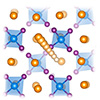
| Mobile ions (in orange) move through the atomic structure of a sodium solid electrolyte material. (Image: Dr. Manuel Grumet, Dr. Waldemar Kaiser, Technical University of Munich)
|
|
The newly reported method addresses this bottleneck by pairing ML force fields with tensorial ML models capable of predicting Raman spectra for complex, disordered materials. The physical basis of the approach rests on a specific mechanism: when ions move through a crystal lattice in a liquid-like fashion, they dynamically disrupt the lattice symmetry.
|
|
This disruption relaxes Raman selection rules, producing characteristic low-frequency scattering that can be measured experimentally and linked quantitatively to high ionic mobility. The pipeline captures these effects computationally without resorting to the full cost of conventional ab initio molecular dynamics simulations.
|
|
The researchers validated their workflow using sodium-ion conducting materials, including Na3SbS4. In materials where strong low-frequency Raman features appeared, the team observed a direct correlation with high ionic diffusivity and relaxational dynamics in the host lattice. By contrast, materials in which ion transport proceeded primarily through discrete hopping mechanisms did not exhibit these low-frequency signatures, establishing a clear spectroscopic distinction between conduction regimes.
|
|
Manuel Grumet, Takeru Miyagawa, Olivier Pittet, Paolo Pegolo, Karin S. Thalmann, Waldemar Kaiser, and David A. Egger authored the study. Their framework extends the interpretation of Raman selection rule breakdown beyond well-known superionic conductors, generalizing the relationship between diffusive Raman scattering and fast ion transport across diverse material classes. This generalization provides a unifying physical picture for understanding how lattice dynamics and ionic mobility interact in solid electrolytes.
|
|
By bridging the gap between atomistic simulation and experimentally accessible Raman observables, the ML-accelerated pipeline rationalizes previously unexplained experimental observations while simultaneously enabling high-throughput computational screening. Rather than synthesizing and characterizing candidate materials one by one, researchers can now use the pipeline to evaluate large numbers of structures computationally and prioritize the most promising candidates for experimental follow-up.
|
|
The work establishes a practical, data-driven tool for accelerating the identification and development of superionic materials for next-generation solid-state battery technologies.
|