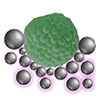
Liquid metal embedded with dormant bacterial spores forms a living conductor that heals itself, resists oxidation, and boosts conductivity when the microbes awaken.
(Nanowerk Spotlight) The idea of a material that can think, heal, and power itself has long belonged to science fiction. Materials science and microbiology are now approaching that possibility, not through artificial intelligence but through the literal integration of living organisms into matter. Imagine a circuit that conducts electricity, repairs its own breaks, resists corrosion through biological chemistry, and can awaken from dormancy to produce power.
Liquid metals are unusual substances. They flow like water yet conduct electricity almost as well as solid copper. This combination makes them appealing for flexible electronics, soft robotics, and wearable devices.
Their weakness lies in the oxide film that instantly forms when the metal meets air or water. The thin oxide stabilizes droplets but prevents them from fusing, interrupting electrical flow. Previous attempts to control this oxide used agitation, chemical etching, or complex coatings. Each method added cost or created new problems such as brittleness or instability. A stable, self-repairing conductor that worked without those steps remained out of reach.
The new research offers a biological route forward. The team created a living liquid metal composite by embedding bacterial endospores within a gallium and indium alloy. The spores come from Bacillus subtilis, a microbe known for surviving heat, dryness, and chemical stress. In the dormant spore state, the cells are metabolically inactive and remarkably durable. When exposed to nutrients, they germinate and return to life. Within the metal, these spores act as both structural and electrical agents. They modify the oxide layer and, once active, move electrons directly into the metallic network.
Conceptual illustrations of the living liquid metal composite embedded with electrogenic bacterial endospores. a) Circuit conductivity: i) Liquid metal droplets with native oxide layers, exhibiting low conductivity. ii) Endospore-mediated oxide rupture between droplets, enabling conductive bridging, and high conductivity. b) Biological functionality: i) Dormant endospores embedded in liquid metal, supporting long-term preservation, and stable conductivity. ii) Germination of endospores, reactivating metabolic activity and extracellular electron transfer (EET). c) Self-healing behavior enabled by the intrinsic fluidity and oxide dynamics of liquid metal. d) Enhanced patternability on paper substrates due to improved wettability and interfacial compatibility provided by endospores. (Image: Reprinted from DOI:10.1002/adfm.202521818, CC BY) (click on image to enlarge)
The mechanism depends on how the spores interact with the metal surface. Each spore carries a rough outer shell covered with chemical groups that bond strongly to metal oxides. These include amino, carboxyl, phosphate, and hydroxyl groups. When mixed with the gallium–indium alloy, the spores attach to the oxide skin and disturb its uniformity. This weakens the barrier and allows neighboring droplets to merge, restoring electrical continuity without external pressure or heating. Spectroscopic analysis confirms reduced oxygen signals and greater exposure of gallium, evidence of thinner oxide layers and stronger metal connectivity.
This microscopic change produces significant electrical improvements. The composite conducts at about 1.1×10⁴ siemens per centimeter even without sintering. After a week of air exposure, it retains over 90 percent of that conductivity, while pure liquid metal loses much more. When the spores are activated with a nutrient solution containing amino acids and sugars, the conductivity increases to about 5.1×10⁶ siemens per centimeter. The gain comes from both mechanical disruption of the oxide and electron transfer by the living cells. Imaging shows that the spores germinate and spread within the metallic matrix, confirming that biological activity enhances performance.
Electrochemical tests reinforce this finding. Cyclic voltammetry shows that oxidized metal without spores produces unstable current profiles that weaken over time. With spores, the current remains steady, showing stable charge transfer. Impedance measurements reveal higher resistance while the spores are dormant, followed by a marked drop after germination, consistent with active electron movement through the living network.
Mechanical performance also improves. Liquid metals already heal by flowing into cracks, but the composite heals faster. After being cut, it recovers more than 90 percent of its conductivity within about 30 seconds, while the unmodified alloy needs about 90 seconds. During 500 bending cycles at 10 percent strain, the composite retains over 90 percent of its conductivity, while the pure alloy loses nearly half. Microscopy shows continuous bridges forming across cracks and suggests that the spores reinforce the oxide layer and spread stress more evenly.
The spores also change how the metal behaves on surfaces. Gallium–indium alloys usually bead up on paper or plastic because of high surface tension. The spores reduce this effect, lowering the contact angle to around 30 degrees. The composite therefore spreads smoothly across paper, polymers, and glass, enabling simple patterning of circuits. On wax-patterned paper, it fills channels cleanly, forming confined conductive traces. Within silicone channels, it remains continuous when stretched to twice its length. This adaptability supports low-cost printing of flexible devices.
The researchers showed that the material can serve as a functional element in a microbial fuel cell. The cell used a paper substrate with a wax separator and a silver oxide cathode. The spore–metal composite formed the anode. Power generation began only after the spores germinated, confirming that metabolism was responsible. The output reached about 10 microwatts per square centimeter. Devices without spores or without liquid metal produced far less power. The composite thus functions both as a conductor and as a living electrode capable of producing current from biological activity.
Durability tests show that the spores remain viable for extended periods. Embedded spores germinated successfully after twenty weeks of storage. Culture tests confirmed colony growth, and imaging verified metabolic activity after long storage. This longevity allows the material to be stored dry and activated when needed, which could simplify transport and deployment.
Safety and environmental compatibility are favorable. Bacillus subtilis is recognized as safe for human and environmental contact. Gallium-based metals are less toxic than many other conductive alloys. Although medical use will require complete biocompatibility testing, applications in sensors, flexible circuits, and soft robotics can proceed under existing safety data.
The study identifies remaining challenges. Activation still relies on adding nutrients, which limits spatial control. Scaling the process will need automated printing techniques suited to fluid conductors. Long-term performance in physiological or environmental conditions also requires further testing.
This work shows that living systems can strengthen and regulate metallic conductors. The composite resists oxidation, heals damage rapidly, and becomes more conductive when the biological component awakens. Once active, the cells exchange electrons with the metal and enable small but measurable power generation. The result is a self-repairing, adaptive conductor that uses biology as an essential part of its function.
This research marks a shift in how bioelectronics can be built. Rather than linking living and nonliving materials through fragile interfaces, it combines them into one system. The living liquid metal behaves as a single material in which biological and metallic properties reinforce each other. Such systems could enable flexible sensors, self-healing circuits, and soft machines that draw energy from biological reactions. They demonstrate how living chemistry can serve as the organizing principle for the next generation of adaptive materials.
For authors and communications departmentsclick to open
Lay summary
Prefilled posts
ORCID information
Seokheun Choi (State University of New York at Binghamton)
, 0000-0003-1097-2391 corresponding author
Nanowerk Newsletter
Get our Nanotechnology Spotlight updates to your inbox!
Thank you!
You have successfully joined our subscriber list.
Become a Spotlight guest author! Join our large and growing group of guest contributors. Have you just published a scientific paper or have other exciting developments to share with the nanotechnology community? Here is how to publish on nanowerk.com.