| Mar 03, 2026 |
Researchers developed a lignin derived hard carbon anode for sodium ion batteries with 90.6 percent initial Coulombic efficiency and 401.5 mAh per gram reversible capacity.
|
|
(Nanowerk News) Researchers have developed a hard carbon anode material from an industrial paper waste byproduct that delivers both high initial Coulombic efficiency and high reversible capacity in sodium ion batteries. The team, based in China, used sodium lignosulfonate, a sulfonated polymer recovered from papermaking sludge, as the carbon precursor and applied a combined strategy of ultramicropore engineering and nitrogen sulfur co-doping to overcome longstanding performance tradeoffs in hard carbon anodes. The findings (Research, “Synergistic Ultramicropore-Confined and Electronic-State Modulation Strategies in Sustainable Lignin-Derived Hard Carbon for Robust Sodium-Ion Batteries”) offer a pathway toward more practical and cost effective sodium ion energy storage.
|
Key findings
|
- The optimized material reached a reversible capacity of 401.5 mAh per gram with an initial Coulombic efficiency of 90.6 percent during the first cycle.
- At a high current density of 5 A per gram, the material retained 265 mAh per gram, corresponding to 68.7 percent of its low rate capacity.
- After 500 charge discharge cycles at 300 mA per gram, the anode maintained 307.3 mAh per gram with 95.0 percent capacity retention.
|
|
Sodium ion batteries have attracted growing attention as potential alternatives to lithium ion technology, driven by the natural abundance and low cost of sodium. Among candidate anode materials, hard carbons stand out for their disordered atomic structure, wide interlayer spacing, and ability to store sodium through a three stage mechanism described as adsorption, intercalation, and pore filling. Despite these advantages, hard carbon anodes have been limited by two persistent problems. Initial Coulombic efficiency, which measures how much stored charge is recoverable during the first cycle, typically falls between 50 and 80 percent. Reversible capacity, meanwhile, has generally remained below 300 mAh per gram.
|
|
Earlier efforts to improve hard carbon performance focused on tuning precursor chemistry and carbonization conditions, but these approaches often produced materials with high surface areas that promoted unwanted side reactions with the electrolyte. During initial cycling, solvent molecules from the electrolyte penetrate open pores in the carbon structure, decomposing on internal surfaces and forming an excessively thick solid electrolyte interphase layer. This parasitic consumption of sodium ions is a primary reason why initial Coulombic efficiency remains low in many hard carbon designs.
|
|
More recent strategies have targeted this problem by engineering closed ultramicropores, internal voids smaller than 0.7 nanometers whose narrow openings physically exclude bulky solvent molecules while still permitting the passage of smaller, desolvated sodium ions. Because the electrolyte cannot infiltrate these confined spaces, decomposition reactions and interphase overgrowth are significantly suppressed, raising initial efficiency. However, sealing off pore openings simultaneously reduces the external surface area available for sodium ion adsorption during the higher voltage stage of charge storage, limiting total reversible capacity. This creates a fundamental design tension: tightening the pore structure improves efficiency but sacrifices capacity.
|
|
Doping carbon frameworks with heteroatoms such as nitrogen and sulfur offers a complementary route, introducing additional active sites and widening interlayer distances to boost charge storage. Yet doping processes frequently generate mesopores, voids larger than two nanometers, that reintroduce the same electrolyte access problems that ultramicropore confinement is meant to solve. Achieving both high initial Coulombic efficiency above 80 percent and reversible capacity above 350 mAh per gram from biomass derived hard carbon has therefore remained rare. The central materials design challenge is to construct a pore architecture dominated by closed ultramicropores while simultaneously modifying surface chemistry to compensate for the adsorption capacity that confinement removes.
|
|
The research team, led by Professors Caichao Wan and Yiqiang Wu at Central South University of Forestry and Technology, addressed this challenge by combining pore architecture control with electronic state modulation in a single material system. Their precursor, sodium lignosulfonate, was chosen for several structural advantages. Its intrinsic sulfur containing functional groups serve as a built in doping source for defect engineering. Critically for ultramicropore construction, its highly cross linkable molecular framework enables pre-oxidation treatments that lock the carbon skeleton into a rigid, disordered configuration. During subsequent high temperature carbonization, this rigidity prevents graphitic layer alignment and promotes the collapse of open pores into closed ultramicropore cavities with expanded interlayer spacing, precisely the architecture needed to block solvent penetration while preserving internal sodium storage volume. And as an industrial waste stream, sodium lignosulfonate is both inexpensive and widely available.
|
|
The fabrication process began with a thermal pre-oxidation step applied to the sodium lignosulfonate powder. Using thermogravimetry coupled with mass spectrometry, X-ray photoelectron spectroscopy, Fourier transform infrared spectroscopy, and solid state carbon 13 nuclear magnetic resonance, the team tracked the structural evolution through three temperature stages. Between 30 and 180 degrees Celsius, adsorbed and bound water were driven off alongside demethylation reactions. From 180 to 325 degrees Celsius, esterification and cross linking reactions restructured the polymer chains. Above 325 degrees Celsius, aromatization converted the material into a stabilized carbon precursor. This pre-oxidation step prevented the formation of ordered graphitic domains during later high temperature treatment, promoting the disordered structure essential for sodium storage. By stabilizing the cross linked framework before pyrolysis, the treatment also governed the evolution of the pore network, favoring the retention of closed ultramicropores rather than the open mesoporous channels that would expose internal surfaces to electrolyte attack.
|
|
The pre-oxidized material was then pyrolyzed at high temperature together with urea, a dual purpose additive that simultaneously introduced nitrogen and sulfur into the carbon lattice and drove the formation of ultramicropores. Gas evolution during urea decomposition created internal voids, while the rigid, pre-crosslinked matrix constrained these voids to the sub 0.7 nanometer scale, producing the closed ultramicropore architecture required to exclude solvent molecules. The combination of confinement and co-doping is the core of the team’s synergistic strategy: the ultramicropores raise initial efficiency by blocking parasitic electrolyte reactions, while the nitrogen and sulfur heteroatoms compensate for the loss of surface adsorption sites by creating new electrochemically active centers and enhancing sodium ion affinity throughout the carbon framework. The resulting material, designated N-S at HDM-1300 for its 1300 degree Celsius pyrolysis temperature, was analyzed using density functional theory to understand how co-doping altered its electronic properties. Replacing carbon atoms with nitrogen and sulfur changes the local charge and spin density distributions, which in turn affects how strongly the material interacts with sodium ions.
|
|
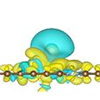
The calculations revealed that the sodium ion adsorption energy in the co-doped material reached negative 0.96 electron volts, substantially stronger than the negative 0.54 electron volts calculated for undoped carbon. Charge density mapping showed broader electron delocalization across the doped framework, which lowers the energy barrier for sodium ion migration. Work function analysis indicated a reduced value, meaning electrons transfer more readily between the material and sodium ions. The electronic density of states profile showed that the co-doped carbon exhibits metallic character, in contrast to the semiconducting behavior of the pristine carbon, further supporting efficient charge transfer during battery operation.
|
|
Electrochemical testing confirmed the computational predictions. During the first charge discharge cycle, the material delivered a reversible capacity of 401.5 mAh per gram with an initial Coulombic efficiency of 90.6 percent. Of the total capacity, 41.9 percent originated from the low voltage plateau region associated with pore filling. Rate performance tests showed the material could sustain 265 mAh per gram even at a current density of 5 A per gram, retaining 68.7 percent of the capacity measured at 0.03 A per gram. Over 500 cycles at 300 mA per gram, the discharge capacity stabilized at 307.3 mAh per gram with 95.0 percent retention, demonstrating strong long term durability.
|
|
Looking ahead, the research team has identified several directions for translating this material into practical devices. They plan to investigate how the anode performs and degrades under extreme temperature conditions to establish guidelines for broad temperature operation. Scaling up electrode fabrication and optimizing full cell integration, particularly in pouch cell configurations, will be critical for validating long term cycling stability and safety outside the laboratory. The team also intends to evaluate performance limits across different use scenarios, including grid scale renewable energy storage and portable electronics. This dual modulation approach, simultaneously tuning pore structure and electronic properties in waste derived carbon, represents a step toward closing the gap between laboratory results and commercially viable sodium ion batteries.
|