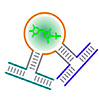
Fluorogenic DNA aptamers produce light only in the correct structural state, enabling programmable molecular logic, biosensing, DNA origami integrity reporting, and reusable mRNA detection through allosteric control.
(Nanowerk Spotlight) Allosteric regulation is one of biology’s most elegant forms of control. In these systems, a protein or RNA changes its behavior when a second molecule binds at a different location on the same structure. The binding site and the functional site are separate. They may be only nanometers apart, but that separation is enough for a shift in shape to reorganize the molecule’s active region.
Enzymes modulate activity this way, receptors adjust how they respond to signals and RNA elements alter how genes are expressed. Engineers have worked to reproduce these behaviors in designed molecular systems, but protein-based attempts often fall short. Protein folding is difficult to control, and small rearrangements can produce unexpected consequences across an intricate three-dimensional structure.
DNA offers a more programmable foundation. Its base pairing rules are explicit, and computational models can predict its geometries with high reliability. These characteristics helped DNA nanotechnology expand from basic structural motifs to complex assemblies, mechanical devices and molecular logic circuits.
Techniques such as DNA origami allow researchers to fold a long strand into nanostructures using many shorter staples. Other systems use strand displacement reactions to execute logic operations. Yet most DNA biosensors still suffer from a fundamental limitation. They rely on fluorescent dyes attached to strands. These dyes emit light whether the device is correctly folded or structurally compromised. They reveal where DNA is located, not whether the molecule is working as designed.
A study published in Advanced Materials (“Light‐Up Nanostructures with Allosterically Controlled Fluorogenic DNA Aptamers”) introduces a way to tie fluorescence directly to molecular structure. The work centers on a fluorogenic DNA aptamer called Lettuce. The name refers to its green fluorescence and is not biologically related to the plant. Fluorogenic aptamers differ from conventional fluorescent tags because they remain dark until they bind a specific dye. Lettuce binds DFHBI-1T, a small molecule derived from the chromophore of green fluorescent protein. When the aptamer folds, it creates a compact pocket that stabilizes the dye and produces visible green light. When the structure collapses, the dye cannot bind and the system remains dark. In this design, fluorescence becomes an indicator of structural integrity, not simple attachment.
Allosteric nano-switches based on fluorogenic DNA aptamer. A) Strand diagram and 3D structure (PDB ID: 8FHX) of DNA Lettuce aptamer, sequence in orange depicts the binding pocket of aptamer ligand—DFHBI-1T. B) Schematics of allosteric regulation. The conformation switching from the blocked state (OFF state) to the open state (ON state) is triggered upon allosteric modulator binding. C) DNA-based allosteric nano-switches regulated by DNA modulators. (Image: Reproduced with permission from Wiley-VCH Verlag) (click on image to enlarge)
The Lettuce aptamer forms its functional pocket using two short double helices known as P1 and P2. Between them is a guanine-rich region that assembles into a two-layer antiparallel G-quadruplex. This configuration supports the dye and allows fluorescence. If either helix is unstable, the pocket cannot maintain its shape and the dye remains nonfluorescent.
The researchers take advantage of this vulnerability. They redesign the aptamer so that one of the helices forms only when an external DNA strand binds to it. That external strand becomes an allosteric modulator. Without it, the aptamer remains OFF. With it, the helix stabilizes, the G-quadruplex forms and the aptamer switches ON.
To make this behavior reliable, the authors screen a series of aptamer variants with different helix lengths. They first hold the P2 stem at 10 base pairs and vary the P1 stem from 0 to 10 base pairs. Fluorescence intensity is normalized on a zero-to-one scale. Designs with P1 lengths of 1 to 4 base pairs remain below 0.5 without the modulator and rise above 0.5 when the modulator is present.
These variants show true switching behavior. Designs with stems of 5 base pairs or more remain permanently ON because the helix is stable without a modulator. Designs with 0 base pairs fail to assemble. A second scan focused on P2 identifies viable lengths from 1 to 5 base pairs. In both cases, configurations that function correctly show distinct OFF and ON states supported by thermodynamic models.
With switching established, the study demonstrates reversibility. The authors add a short single-stranded region called a toehold to support a strand displacement reaction. In one design, both stems are intact and the aptamer begins ON. A displacement strand attaches to the toehold, invades the helix and destabilizes the dye-binding pocket. The aptamer turns OFF.
When a complementary anti-displacement strand removes the invader, the helix reforms and fluorescence returns within about 20 min. This cycle shows that the aptamer does not just toggle once. It can operate in repeated switching regimes, making it suitable for programmable DNA nanotechnology.
The researchers treat DNA strands as inputs and fluorescence as output to construct molecular logic gates. AND, OR and XOR gates begin OFF and activate only when input strands stabilize specific helices. NAND, NOR and XNOR gates begin ON and deactivate when input strands disrupt their stems through displacement.
The AND gate illustrates the concept clearly. It uses a deliberately unstable stem flanked by two 15-nucleotide binding regions. Each input strand binds to one side. Only when both are present do the inputs assemble a four-way junction that stabilizes the stem and triggers fluorescence. The authors verify modularity by building ten distinct aptamer-modulator pairs and showing that each responds only to its matching partner.
These molecular logic elements scale to three-input systems. A BUFFER design uses three different aptamers. Its fluorescent output rises in four discrete levels as zero, one, two or three modulators are added. A MAJORITY design uses three AND-style elements arranged so that fluorescence appears only when at least two inputs are active.
Because the aptamer itself is the output mechanism, the system does not require external fluorophores to communicate its internal state. In computational DNA circuits, this allows logic and readout to occur within the same molecular layer.
The authors then show how fluorogenic aptamers can monitor structural integrity in DNA origami. They modify a 10-helix bundle by replacing selected staple strands with versions that carry aptamers. In one design sixteen pairs of staples on a single helix are replaced. When the origami folds correctly and DFHBI-1T is present, the aptamers form their pockets and the structure lights up. When the origami is degraded by DNase I at 20 Unit mL⁻¹ or heated between 40 °C and 80 °C, fluorescence drops sharply. A control origami labeled with FAM probes stays fluorescent despite structural damage. This contrast demonstrates that fluorogenic aptamers sense molecular function, not just scaffold presence.
The approach extends to imaging nanoscale arrangements. By giving origami units complementary sticky-end sequences, the researchers assemble monomers, extended polymers and alternating oligomers. Monomers appear as individual fluorescent dots. Polymers form bright micrometer-scale chains.
Alternating oligomers produce evenly spaced fluorescent points separated by about 250 nm, wide enough to distinguish as separate units. The light pattern reflects the structural design, allowing researchers to read nanoscale organization through direct optical output.
The study also uses aptamer-decorated origami as an mRNA biosensor. The authors place sixteen distinct aptamers along one helix of the bundle, each targeting a 20-nucleotide region of a messenger RNA. One RNA molecule can bind across all sites, creating a single recognition event. Because real RNA forms secondary structures, initial signals are weak. After heating to 80 °C and rapid cooling, two of the tested RNAs generate strong fluorescence.
A shorter RNA of about five hundred nucleotides produces weaker signals, likely because it cannot stretch across all binding sites. Increasing the RNA concentration compensates. The detection process is reusable. Introducing RNase H1 at 50 U mL⁻¹ degrades RNA in DNA-RNA hybrids and extinguishes fluorescence. After enzyme removal and dye replenishment, the origami can detect new RNA samples.
This work shows how fluorogenic DNA aptamers can connect molecular shape, computation and biosensing. These aptamers do not simply label DNA. They act as structural reporters, logic elements and RNA sensors. They enable DNA nanotechnology to communicate through its own conformation, producing signals only when designs operate as intended. In molecular engineering, where reliability and transparency are critical, this type of direct structural readout is valuable.
For authors and communications departmentsclick to open
Lay summary
Prefilled posts
Nanowerk Newsletter
Get our Nanotechnology Spotlight updates to your inbox!
Thank you!
You have successfully joined our subscriber list.
Become a Spotlight guest author! Join our large and growing group of guest contributors. Have you just published a scientific paper or have other exciting developments to share with the nanotechnology community? Here is how to publish on nanowerk.com.