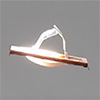
A 301 mg soft robot jumps continuously under constant light without batteries or electronics, using snap-through buckling and self-shadowing to create an autonomous feedback loop.
(Nanowerk Spotlight) A soft robot smaller than a paper clip and lighter than a few grains of rice has achieved something few machines its size have managed: continuous, self-sustaining jumps powered only by light. Weighing just 301 mg, the device completed 188 consecutive jumps in a single session and accumulated more than 800 jumps over a year without any decline in performance. It carries no battery, no motor, and no control electronics. Instead, the robot harvests energy directly from visible light and resets itself automatically after each landing through the physics of its own structure.
Building a robot at insect scale, typically defined as weighing less than one gram, demands solving three interconnected problems simultaneously: harvesting enough energy to sustain movement, actuating with sufficient power to launch the body into the air, and resetting the mechanism automatically for the next jump. Most miniature jumping robots built to date manage only a handful of leaps before requiring manual intervention or running out of stored power.
Batteries add prohibitive weight at this scale. Motors become inefficient. Control electronics consume precious energy and occupy valuable space. Researchers have explored alternatives including combustion-powered systems, shape-memory alloys, and piezoelectric actuators, yet none has delivered continuous operation, autonomous resetting, and true energy independence together.
Progress in stimuli-responsive materials, particularly those that change shape when exposed to light or heat, has opened new possibilities, but translating laboratory demonstrations into practical robotic locomotion has not yet succeeded.
The study, published in Advanced Materials (“Self‐Sustained, Continuous Jumping of a Light‐Driven Electronics‐Free Insect‐Scale Soft Robot”) by researchers at the University of California Los Angeles and the University of California Davis, addresses this stubborn problem. Such machines could navigate collapsed buildings after earthquakes, inspect pipelines too narrow for human access, or monitor remote ecosystems.
Insects accomplish such feats routinely, extracting energy from their surroundings and converting it into agile, repetitive movement. Grasshoppers, click beetles, and springtails jump continuously to traverse uneven terrain and escape predators. Replicating this capability in artificial systems has not succeeded because it requires integrating energy harvesting, high-power actuation, and automatic resetting into a structure that weighs a fraction of a gram.
Self-sustained insect-scale robots capable of continuous jumping based on self-sustained, repeated snapping (SSRS). A) As an example, grasshoppers use repeated jumps to locomote and overcome obstacles with energy scavenged from the environment. B) Analogously, our robots are capable of continuous jumps with energy harvested from constant light. C) A SSRS is mainly composed of a liquid crystal elastomer (LCE) strip, a curved elastomer beam (with its two ends fixed on a wood frame), and two shutters. The geometry of the curved beam is defined in Equation 1. D) LCE undergoes reversible photothermal actuation. E) Schematic force-displacement diagram for a monostable LCE/curved beam composite. When the (photo)thermal-induced force of the LCE (along the contraction direction) reaches a critical value Fst, the beam snaps to the downward position, which leads to a sudden release of energy ΔE (highlighted in green). When the force decreases below the snap-back force (Fsb), the beam snaps back to the upward position. F) Working principle of the SSRS mechanism. The shutters control the exposure of the LCE to irradiation, which, when combined with the monostable composite, generates a self-shadowing-enabled built-in feedback loop for cyclic snapping. G) Representative displacement and temperature of the apex of the composite curved beam during multiple cycles of a SSRS device. H) Zoom-in on the displacement curve highlighting the dynamics of one snapping event in (G). The maximum speed of the apex can reach about 680 mm s−1. Vibration of the beam was observed after a snapping event. (click on image to enlarge)
The key innovation enabling this behavior is what the researchers call self-sustained repeated snapping, or SSRS. The mechanism exploits two phenomena working in concert: snap-through buckling, a rapid geometric transition familiar from children’s toys like popper domes, and self-shadowing, whereby the robot’s own movements control its exposure to the light source powering it.
At the heart of the device lies a curved elastomer beam made from a silicone rubber called Dragon Skin 30. Bonded to its upper surface is a thin strip of liquid crystal elastomer, or LCE, a material that contracts when heated and relaxes when cooled. The researchers doped the LCE with candle soot, a highly effective photothermal agent that absorbs visible light and converts it efficiently into heat.
When a solar simulator shines on the device from above, the LCE heats rapidly, shrinking along its length and bending the composite beam. Once the bending force exceeds a critical threshold, the beam snaps abruptly into an inverted configuration, releasing stored elastic energy within roughly 11 ms. This snap-through transition propels the apex of the beam at speeds reaching approximately 680 mm s⁻¹.
The critical step is what happens next. Attached to the robot are two small shutters made of aluminum-coated plastic that reflect light. When the beam snaps downward, these shutters close over the LCE, blocking the incoming illumination. Shielded from light, the LCE cools, relaxes, and the beam gradually unbends. When it crosses another critical point, it snaps back to its original upward curvature, reopening the shutters and exposing the LCE to light once more. The cycle repeats indefinitely, creating a feedback loop embedded entirely in the physical structure.
The team measured specific released energy during snap-through events at approximately 232 to 480 mJ kg⁻¹ depending on beam geometry, with peak specific power reaching roughly 99 W kg⁻¹. This power density compares favorably to biological jumpers like the desert locust, which generates approximately 18 W kg⁻¹ normalized against whole body mass.
The energy release depends on the beam’s height-to-span ratio and thickness. Shallow beams bend smoothly without snapping. Deeper beams enter a monostable regime, meaning they naturally return to one resting shape, allowing them to snap through when heated and snap back when cooled. If the beam becomes too deep, it turns bistable and fails to return automatically.
To transform the snapping mechanism into a functional jumping robot, the team added two carbon fiber filaments as balancers extending outward from the wooden frame. These simple appendages serve a passive self-righting function. After launching, the robot naturally orients with the heavier beam facing downward, and the balancers widen the landing base to prevent tipping. This design keeps total weight below one gram while ensuring the beam comprises about 70% of the robot’s mass.
The researchers also demonstrated directional jumping. When they used a deeper beam with slightly different dimensions, the snap-through transition followed an asymmetric S-shaped path rather than a symmetric U-shape. This asymmetry imparts a horizontal impulse component, causing the robot to travel sideways with each jump. Attaching a small reflective strip to cover part of the LCE forced one side to heat preferentially, further controlling the direction and angle of launch.
Durability tests confirmed robustness. The robot survived a load of 500 g, roughly 1700 times its own body weight, and resumed jumping with no performance loss once the load was removed. The rapid snapping motion ejected contaminants sprinkled on the LCE surface, demonstrating a self-cleaning capability. The team also operated the robot outdoors under concentrated natural sunlight focused by a Fresnel lens, achieving sustained jumping powered entirely by the sun.
To illustrate potential applications, the researchers mounted a pH sensor weighing approximately 8 mg onto the robot and positioned it 138 mm from a simulated ammonia leak. Under constant simulated sunlight at 1020 mW cm⁻², the robot hopped directionally toward the leak, traversing 185 mm over four jumps in 208 s. As it approached the source, the sensor strip changed color, successfully detecting the hazardous gas without any onboard electronics.
The significance of this work lies in its integration strategy. Rather than attempting to miniaturize conventional robotic components, the researchers embedded sensing, actuation, energy harvesting, and control into the material behavior itself. The LCE serves simultaneously as a solar collector, a thermal actuator, and part of the structural spring. The shutters function as both light shields and mechanical triggers. The curved beam stores energy and acts as a geometric latch.
This approach sidesteps the scaling problems that have hindered prior efforts and demonstrates the feasibility of robots that operate more like living organisms, drawing sustenance from their environment and responding through embodied physical intelligence rather than computed commands. Future refinements could reduce the required light intensity to operate under unconcentrated sunlight, incorporate humidity-driven materials, or add legs with LCE tendons for active trajectory control. The work represents a meaningful step toward fully self-sufficient micro-robots capable of operating independently in environments inaccessible to humans or conventional machines.
For authors and communications departmentsclick to open
Lay summary
Prefilled posts
Nanowerk Newsletter
Get our Nanotechnology Spotlight updates to your inbox!
Thank you!
You have successfully joined our subscriber list.
Become a Spotlight guest author! Join our large and growing group of guest contributors. Have you just published a scientific paper or have other exciting developments to share with the nanotechnology community? Here is how to publish on nanowerk.com.