A levitating magnetic microrobot autonomously sorts sub-millimeter particles by weight in 3D environments, enabling precise, contamination-free handling in biomedical and manufacturing applications.
(Nanowerk Spotlight) Sorting objects in the sub-millimeter to millimeter range is a critical task in biomedical research and precision manufacturing. At this scale, precise separation can determine whether a medical test yields accurate results or whether a miniature device functions as intended.
In biomedicine, sorting can involve isolating clusters of cells for cancer diagnostics, separating viable embryos from non-viable ones in fertility treatments, or removing diseased tissue samples from healthy ones to prevent contamination. In manufacturing, it can mean selecting defect-free micro-spheres for ball bearings in miniature instruments or organizing optical beads for high-precision sensors. These objects are delicate, easily damaged, and often located in environments where they cannot be touched directly.
In many laboratories, sorting at this scale is still performed manually by trained operators using microscopes and fine tools, a process that is slow, repetitive, and difficult to expand to higher volumes.
Automated systems have been developed to reduce reliance on manual work, but most are designed for batch processing, where large numbers of particles pass through the sorting device at once. While this approach can be efficient, it is not suitable when only a few items need to be separated from a larger group, especially when contact with the rest must be avoided.
Individual particle sorting systems handle one object at a time, offering greater selectivity but usually at the cost of speed. Untethered microrobots, which can be controlled remotely inside enclosed spaces, address some of these issues but still depend heavily on human operators. The lack of fully autonomous control has limited their broader application in research and manufacturing.
Researchers from the University of Twente, the University of Naples Federico II, and the University of Groningen have developed an approach that closes much of this automation gap. In Advanced Intelligent Systems (“Autonomous Sorting of Beads in a 3D Environment Using Levitating Magnetic Microrobots”), they describe a fully autonomous system for three-dimensional sorting of small passive beads using a levitating magnetic microrobot.
A key element of the design is untethered magnetic weighing, a method that determines the weight of a carried object by measuring the magnetic force required to keep the microrobot and its load levitating in a fluid. This allows the robot to classify particles without visual inspection or physical contact sensors.
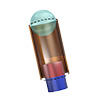
The microrobot is a rigid cup-shaped body containing a cylindrical neodymium magnet. The cup can hold spherical beads securely during transport. Motion is controlled by an array of eight electromagnetic coils positioned at the corners of a cube surrounding the workspace. By adjusting coil currents, the system generates both a magnetic field and a gradient that control the robot’s position and orientation in three dimensions.
Magnetic actuation system and microrobot. A) Water-cooled nine-coil magnetic actuation system and cube workspace. B) Magnetic microrobot levitating while holding a passive green bead. C) Composition of the microrobot. (Image: Reprinted from DOI:10.1002/aisy.202500200, CC BY) (click on image to enlarge)
The sorting process follows a planned trajectory between four points: a home position, a deposit containing unsorted beads, and two targets for sorted particles. To collect a bead, the robot moves from home to the deposit and slides along the surface, trapping a bead in the cup when contact occurs. Collection is inherently random, so not every attempt succeeds. After attempting pickup, the robot returns to the home position and measures the magnetic force needed to hold its vertical position in the fluid. Because buoyancy reduces the apparent weight of the bead, the required force directly reveals its effective weight. The system achieves a measurement resolution of about one micronewton, enough to detect bead size differences of about 0.05 millimeters.
In experiments, silica beads between 0.75 and 1.00 millimeters in diameter were sorted into light and heavy categories. Beads larger than 0.90 millimeters were classified as heavy, while those smaller than 0.85 millimeters were classified as light. This classification was consistent across tests. The microrobot followed its planned paths with an average positioning error of 0.1 millimeters and a maximum error of 0.4 millimeters. After classification, the robot transported the bead to the appropriate target. If the weight measurement indicated no bead was collected, the robot returned to try again without human intervention.
The researchers also tested the system in a non-Newtonian fluid made from a sodium carboxymethyl cellulose solution, which has a viscosity of about one pascal-second and elastic flow behavior. The robot successfully collected, weighed, and released beads in this medium, although releasing them required a longer pause due to the fluid’s resistance. The ability to operate in such fluids is important for biomedical applications, where particles are often suspended in viscous or biocompatible liquids.
Compared to batch sorting methods, the system’s throughput is low, with each bead requiring about 200 seconds to process. However, this is comparable to other untethered three-dimensional microrobotic systems, which prioritize access to enclosed or sterile environments over speed. Unlike most of those systems, the one presented here operates without human supervision once initiated.
The authors note that weighing resolution could be improved by making the levitating magnetic field more uniform, for example by adding a Maxwell coil dedicated to generating vertical lift while other coils manage horizontal stability. Reducing the microrobot’s own effective weight, such as by incorporating buoyant elements, could improve sensitivity and allow operation in less viscous fluids. Collection efficiency could be increased by mapping bead positions in advance and planning optimal approach paths. Adaptive control methods could also help the system maintain performance in changing fluid conditions.
The choice of a rigid microrobot over a soft design provides higher magnetic responsiveness and the ability to handle heavier particles, although it limits adaptability to irregularly shaped objects. For spherical beads, the rigid cup design proved effective, offering stability during levitation and predictable handling.
By combining magnetic levitation, precise trajectory planning, and direct weight-based classification, this system demonstrates how fully autonomous microrobotic sorting can be achieved in three-dimensional environments. While the current speed is modest, the underlying method opens opportunities for applications where precision and sterility are more important than throughput.
Potential uses include selective removal of defective biological samples, handling of components in the sub-millimeter to millimeter range, and operations in sealed microfabrication systems.
For authors and communications departmentsclick to open
Lay summary
Prefilled posts
ORCID information
Franco N. Pinan Basualdo (University of Twente)
, 0000-0002-9117-4860 corresponding author, first author
Nanowerk Newsletter
Get our Nanotechnology Spotlight updates to your inbox!
Thank you!
You have successfully joined our subscriber list.
Become a Spotlight guest author! Join our large and growing group of guest contributors. Have you just published a scientific paper or have other exciting developments to share with the nanotechnology community? Here is how to publish on nanowerk.com.