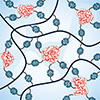
A new hydrogel stiffens 27,000-fold upon heating by transforming weak internal bonds into strong permanent ones, then gradually softens at room temperature.
(Nanowerk Spotlight) Most synthetic polymers cannot change their mechanical properties after manufacturing. A rubber band stays stretchy; a hard plastic stays rigid. Biological tissues, by contrast, constantly reconfigure themselves. Proteins undergo liquid-liquid phase separation, forming droplets that can evolve from liquid to gel to solid under the right stimulus.
Replicating this adaptability in synthetic materials would open the door to devices that shift between soft and rigid on command, from medical implants that match changing tissue conditions to soft robots that stiffen when they need to bear a load. Achieving that in practice, however, has proved difficult. Although researchers have made progress developing stimuli-responsive hydrogels with adaptive mechanical behavior, most of these materials remain limited in how dramatically they can change.
Thermal-hardening hydrogels offer one route toward this goal. These water-rich polymer networks stiffen when heated, reversing the usual expectation that materials soften at elevated temperatures. Previous versions relied on physical mechanisms: hydrophobic association, thermally induced phase separation, or ion coordination between polymer chains. These strategies produced measurable stiffening, but the reinforcement was reversible and purely physical.
A study published in Advanced Materials (“Disulfide‐Mediated Confinement Assembly Enabling Thermal‐Hyperhardening Hydrogels via Phase Evolution”) reports a hydrogel that surpasses this performance limit using what the researchers term disulfide-mediated confinement assembly. The team incorporated thioctate into poly(acrylic acid) networks crosslinked with calcium ions. Thioctate derives from thioctic acid, a naturally occurring sulfur-containing compound also known as lipoic acid. Its key feature is a five-membered ring containing a disulfide bond, a sulfur-sulfur linkage whose inherent ring strain makes it reactive under the right conditions.
The resulting hydrogel transitions from a soft, moldable gel to a rigid, glassy material upon heating, with a 27,000-fold increase in stiffness. Its elastic modulus, a measure of how strongly a material resists deformation, rises from 800 pascals to 22 million pascals.
In practical terms, a half-gram sample that initially collapsed under a 200 g weight could support 2 kg after thermal treatment. No previously reported thermal-hardening hydrogel has approached this magnitude of mechanical change.
Schematic diagram of disulfide-mediate confinement polymerization of amphiphilic 1,2-dithiolane, and the hardening and relaxation mechanism of the PAA-TA hydrogel networks. (Image: Reproduced with permission from Wiley-VCH Verlag) (click on image to enlarge)
The hardening unfolds through a multi-step phase evolution. At room temperature, the dithiolane units sit dispersed within calcium thioctate clusters that act as weak physical crosslinks, and the hydrogel stretches more than 14-fold without fracture. Heating drives hydrophobic aggregation of these units, concentrating them into dense domains with dramatically increased local monomer density.
At these elevated concentrations, the strained five-membered rings break open and link together through ring-opening polymerization, a process in which cyclic monomers join end-to-end into long chains. This converts the physically associated clusters into covalently crosslinked poly(disulfide) microspheres.
At the same time, the coordination bonds between calcium ions and carboxyl groups on the polymer chains reconstruct into a tighter arrangement. These metal-mediated bridges shift from a weak, dispersed state to a strong, compact one. Together, these processes transform the hydrogel into a glass-like solid in under 30 seconds at 90 °C.
The critical question was whether the dithiolane rings actually opened and polymerized, or whether the stiffening arose from physical compaction alone. The evidence pointed clearly to chemical transformation. After heating, spectral signatures of linear disulfide bonds appeared where only cyclic monomers had existed before. The characteristic vibration of the intact dithiolane ring vanished within the 50 to 60 °C hardening window, replaced by broadened signals consistent with poly(disulfide) chains locked in confined states.
Tracking the temporal order of molecular events revealed that weak coordination bonds broke first, freeing the dithiolane units to aggregate and polymerize, after which stronger coordination bonds formed in the densified network. This sequence held consistently across multiple analytical methods.
An equally important question was the role of water. Hydrogels are, by definition, water-rich, so heating might simply boil the water away, leaving behind a dry, rigid residue. That turned out not to be the case. Total water content dropped only slightly after thermal treatment, from 47.5 % to 44.1 %.
What changed was not the amount of water but where it sat. The initially continuous water phase fractured into isolated pockets trapped within micron-sized cavities, while the surrounding polymer matrix tightened and densified. The water remained in the material but lost its ability to soften the network.
Composition tuning proved essential for maximizing performance. Too little thioctate failed to reach the aggregation threshold needed for a full glassy transition. Too much introduced excess hydrophilic sodium thioctate that retained water in the network, diminishing the hardening effect. The optimal formulation delivered the maximum 27,000-fold stiffness increase, with nanoscale measurements confirming a local modulus of approximately 2.4 gigapascals on the hardened surface.
The decisive test came from a control experiment: a hydrogel using carbonate instead of thioctate, whose hardening depended solely on hydrophobic phase separation, achieved only half the modulus elevation. Energy analysis further supported this conclusion, as the activation energy for hardening rose with increasing thioctate content, the signature of a process driven by disulfide-mediated polymerization rather than physical rearrangement alone.
The system also exhibits time-programmable reversibility. After brief heating, the hardened hydrogel softens back to a gel state at room temperature within about 80 minutes as water re-penetrates the polymer matrix. Extending the heating time progressively densifies the poly(disulfide) microspheres, slowing water diffusion and delaying this relaxation.
After 20 minutes at 90 °C, the material holds its high modulus for more than 300 minutes, substantially longer than previously reported thermal-hardening hydrogels. Because the poly(disulfide) network stays chemically intact through these cycles, each round of heating permanently raises the material’s baseline stiffness.
To test practical applications, the researchers built bilayer hydrogel actuators by pairing the PAA-TA hydrogel with a poly(N-isopropylacrylamide) layer. The design exploits a mismatch: when heated, the upper layer shrinks while the lower layer hardens and holds its shape, and the resulting asymmetric stress causes the structure to bend. Dynamic disulfide exchange at the interface ensured robust bonding between the two materials.
A flower-shaped actuator closed its petals within 20 seconds in hot water at 60 °C and reopened within 40 seconds when cooled. A four-jaw gripper grabbed, lifted, and transferred a 2 g object underwater in roughly 30 seconds. The PAA-TA hydrogel maintained stable mechanical recovery over 50 consecutive heating-cooling cycles, confirming its fatigue resistance. These demonstrations add to a growing body of work improving the performance of hydrogel actuators for soft robotics.
Hydrophobic aggregation concentrates monomers; confinement triggers polymerization; new covalent crosslinks lock in the mechanical gain. This three-part sequence, physical assembly followed by chemical reconfiguration followed by structural stabilization, mirrors the phase evolution seen in biological condensates but is achieved here entirely through synthetic dynamic covalent chemistry. Pairing stimuli-responsive assembly with confinement-triggered bond formation could extend to other polymer systems, with potential applications in soft robotics, biomedical devices, and reconfigurable structural materials.
For authors and communications departmentsclick to open
Lay summary
Prefilled posts
ORCID information
Da-Hui Qu (East China University of Science and Technology)
, 0000-0002-2039-3564 corresponding author
Nanowerk Newsletter
Get our Nanotechnology Spotlight updates to your inbox!
Thank you!
You have successfully joined our subscriber list.
Become a Spotlight guest author! Join our large and growing group of guest contributors. Have you just published a scientific paper or have other exciting developments to share with the nanotechnology community? Here is how to publish on nanowerk.com.