| Dec 15, 2025 |
Physicists show how microscopic particles can harness fluctuations and external forces to minimize transport energy and even extract usable work.
(Nanowerk News) Conditions can get rough in the micro- and nanoworld. To ensure that e.g. nutrients can still be optimally transported within cells, the minuscule transporters involved need to respond to the fluctuating environment. Physicists at Heinrich Heine University Düsseldorf (HHU) and Tel Aviv University in Israel have used model calculations to examine how this can succeed. They have now published their results – which could also be relevant for future microscopic machines – in the scientific journal Nature Communications (“Harnessing non-equilibrium forces to optimize work extraction”).
|
 |
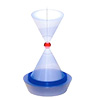
| A particle (red sphere) is guided from left to its destination (right) using a laser trap (double-cone) by means of a protocol developed in the study, which is described by the parameter λ. A known time-dependent external force field F (t) acts on this environment. The optimised protocol exploits this force field in a way that extracts the maximum amount of work. This can be applied to various external fields, to active particles and to micro-robot transport problems. (Image: Kristian S. Olsen, HHU)
|
|
When planning an ocean crossing, sailors seek a course, which makes optimum use of favourable wind and ocean currents, and manoeuvre in order to save time and energy. They also react to random fluctuations in wind and currents, and take advantage of fair winds and waves. Such considerations with regard to energy costs are also important for transport processes at the micro- and nanoscale. For example, molecular motors should use as little energy as possible when transporting nutrients from A to B between and within biological cells.
|
|
However, the conditions are much rougher in the highly dynamic environment of a living organism and the fluctuations to which the microtransporters need to respond are significantly larger. Large deterministic forces such as the periodicity of the heartbeat can however be harvested to realise optimum movement strategies; particles can surf on the waves of the microcosm, so to speak.
|
|
A German-Israeli team of physicists headed by Professor Dr Hartmut Löwen from the Institute for Theoretical Physics II at HHU and Professor Dr Yael Roichman from Tel Aviv University have now examined how to minimise the amount of work required to guide a particle to a specified destination within a specified time in a microscopic environment.
|
|
Professor Löwen, senior author of the study: “In the best case scenario, this control problem can even be used to extract work, i.e. the fluctuations and external time-dependent forces are cleverly used to optimise the energy costs of the transport.”
|
|
Such nanomachines, which extract energy from fluctuations, are of great interest in the nanosciences and biology, while the underlying question is of fundamental physical importance as it relates to central aspects of thermodynamics. Dr Kristian Stølevik Olsen, Humboldt postdoctoral fellow at HHU and lead author: “The second law of thermodynamics defines how heat is converted into work in the macroscopic world. In the microscopic world, however, things can look very different and therefore cannot be described properly by the macroscopic theory.”
|
|
The authors investigated this control problem using model calculations in which colloidal particles – nano- to micrometre-sized particles in a medium – are transported using “optical tweezers” – structures, which can be used to manipulate microscopic objects by means of light. Olsen: “We have identified the maximum amount of work that can be extracted from such an optically driven non-equilibrium system. This is, so to speak, a generalisation of the second law of thermodynamics under the given constraints for very small fluctuating systems.”
|
|
“Given a known external force field, we developed an optimised protocol for guiding such a colloidal particle with optical tweezers in order to extract maximum work. This allows external forces to be cleverly used to perform work exactly when it is needed,” says Löwen. Olsen adds: “We need to know the acting external forces in advance, but our results are stable against small inaccuracies and are therefore practically relevant.”
|
|
While HHU was primarily responsible for completing the theoretical calculations, the authors from Tel Aviv University also considered application perspectives. Co-author Dr Rémi Goerlich, postdoc in Tel Aviv: “The activities we examined occur in precisely the same way in microscopic biological processes within cells. Learning optimal solutions helps understand the energetics of natural micro-systems, potentially enabling their use for synthetic systems.”
|
|
Professor Roichman: “In our laboratory, we can in principle confirm these statements on colloids in laser traps. The theory thus forms the basis for future nanomachines, which could for example be used to transport medication to the specific locations in the body where it is needed.”
|