| Mar 06, 2026 |
A gradient-thickness microbottle resonator traps nanoparticles across 195 micrometers at sub-milliwatt power by shielding peak optical fields from particle interference.
(Nanowerk News) A new optical trapping platform based on a hollow microbottle resonator with gradient wall thickness achieves stable, large-scale particle confinement across nearly 200 micrometers using less than 0.2 milliwatts of laser power. Researchers from Fudan University and The Hong Kong Polytechnic University published the results in Microsystems & Nanoengineering (“Large-scale optical trapping using a gradient-thickness protected microbottle resonator”), presenting a device that overcomes longstanding limitations in near-field optical trapping by replacing shallow evanescent field interactions with deeply penetrating optical field antinodes generated inside the resonator.
|
Key Findings
- The gradient-thickness-protected microbottle resonator traps 500-nanometer-radius polystyrene particles across an axial span exceeding 195 micrometers with a threshold power of just 0.198 milliwatts.
- Its tapered wall design confines peak optical fields within the silica structure at the resonator ends, reducing particle-induced perturbation of the intracavity field by more than fivefold compared to a uniform-wall device.
- The platform also demonstrates localized, tunable three-dimensional particle trapping by using counter-propagating whispering-gallery modes to form adjustable standing waves.
|
|
Near-field optical trapping has become an essential tool for contact-free manipulation and sensing of micro- and nanoscale objects in fields ranging from biomedical research to atomic physics. However, most existing whispering-gallery-mode (WGM) resonator platforms, including microrings, microspheres, microbubbles, and microdisks, rely on evanescent fields that extend only about 100 nanometers beyond the resonator surface. This shallow interaction depth limits trapping efficiency, restricts the working region to the immediate vicinity of the surface, and leaves the optical mode vulnerable to disruption by the very particles being trapped.
|
|
The new device addresses these problems through a carefully engineered geometry. The microbottle resonator is fabricated from a glass capillary using a fuse-and-blow technique. Hydrofluoric acid etching first thins the capillary walls to approximately 5 micrometers, after which controlled heating and internal air pressure expand the capillary into a bottle-shaped structure with an equatorial wall thickness of only 1 micrometer and an equatorial diameter of roughly 216 micrometers. The result is a smoothly tapered profile in which the wall is thinnest at the equator and progressively thickens toward both axial ends.
|
|
This gradient wall thickness fundamentally changes how the optical field distributes inside the resonator. Near the thin equatorial region, coupled light leaks through the silica wall into the liquid core, generating mode field strength antinodes, or optical hotspots, that extend several micrometers into the fluid. These hotspots create deep potential wells capable of trapping particles through strong optical gradient forces, rather than relying on the weak evanescent tail used by conventional designs.
|
|
Meanwhile, at the thicker axial ends, the peak optical field remains confined within the silica wall. This confinement shields the highest-intensity regions from interference by trapped particles, preserving the resonator’s quality factor and maintaining stable intracavity field intensities even during multi-particle trapping.
|
 |
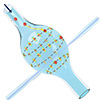
| Gradient-thickness-protected WGM microbottle resonator for large-scale particle trapping. (Image: Reproduced from DOI:10.1038/s41378-026-01167-7, CC BY)
|
|
Finite element simulations performed by the team quantify this advantage. In a uniform-thickness microbottle resonator, trapped particles at the axial field maxima cause a 5.37-fold greater attenuation of the intracavity field enhancement factor compared to the gradient-thickness-protected (GTP) design. The GTP configuration achieves this robustness because the peak electric fields at the resonator ends are embedded within the silica, where they cannot be perturbed by particles suspended in the liquid core. Since silica also absorbs less infrared light than the deuterium oxide medium used in experiments, the GTP resonator theoretically supports a higher quality factor than a uniform-wall counterpart under identical conditions.
|
|
To excite the high-order axial whispering-gallery modes needed for large-scale trapping, the researchers used an off-equatorial fiber taper coupling arrangement. Coupling strength for a particular WGM depends on the spatial overlap between the resonator mode fields and the fiber taper mode, and positioning the taper away from the equator selectively excites modes with extended axial field distributions. The fabricated device achieved an ultra-high quality factor of approximately 2.6 x 10^7.
|
|
In experiments, the team injected 500-nanometer-radius polystyrene particles diluted in deuterium oxide into the hollow resonator via a syringe pump. To prevent particle adhesion, the inner surface was functionalized with PEG-silane. Under an input power of 1.03 milliwatts, particles were trapped at multiple discrete axial antinodes and propelled along circular orbital trajectories by the scattering force of the propagating WGM.
|
|
Stable trapping was maintained across an axial range exceeding 195 micrometers, with uniform rotational velocities greater than 12 micrometers per second observed throughout. By progressively reducing input power, the researchers determined a threshold of 0.198 milliwatts for initiating particle trapping. Two additional devices fabricated and tested under the same conditions confirmed satisfactory reproducibility.
|
|
Beyond large-scale trapping, the GTP microbottle resonator also supports localized, tunable three-dimensional particle confinement. By switching laser input to an equatorial fiber taper and splitting the beam through a 3-dB optical coupler, the team generated counter-propagating WGMs that form a standing wave at the equatorial center. In this configuration, the scattering forces from opposing directions cancel out, confining particles in the axial, radial, and azimuthal directions simultaneously. Applying a controlled phase shift to one beam using a piezoelectric fiber stretcher displaced the standing-wave antinodes along the azimuthal direction, demonstrating dynamic repositioning of trapped particles within a 3-micrometer region.
|
|
“This work shows that optical trapping performance is not only about stronger lasers, but about smarter structures,” the researchers note. “By engineering the resonator geometry, we can control where optical energy resides and how it interacts with particles.”
|
|
The team emphasizes that isolating the strongest optical fields from particle-induced disturbances is central to achieving scalable and robust trapping. The approach bridges laboratory demonstrations and practical optofluidic systems capable of handling complex, real-world samples.
|
|
Yuxiang Li and Haotian Wang contributed equally as co-first authors. The team also included Zhihe Guo, Xuyang Zhao, Yi Zhou, Qi Wang, and Man Luo from Fudan University, along with Hong Cai, Lip Ket Chin, and Ai-Qun Liu from The Hong Kong Polytechnic University. The corresponding authors are Lip Ket Chin, Ai-Qun Liu, and Xiang Wu.
|
|
The gradient-thickness microbottle resonator opens several potential application pathways. Its multiple trapping orbits and extended confinement range make it suitable for high-throughput parallel single-cell analysis, where isolated orbits could enable real-time monitoring of individual microorganisms. The sensitivity of potential well depth to particle size and shape could facilitate label-free sorting of bioparticles such as yeast and E. coli.
|
|
Rapid orbital motion of trapped particles may also enhance micromixing and surface collision frequency, potentially accelerating biochemical reactions. The localized trapping capability could support targeted drug loading onto carrier particles. Advancing the design toward practical microsystems will require developing scalable fabrication strategies, with top-down micro- and nanofabrication techniques likely needed to ensure device uniformity and reproducibility.
|