| Mar 03, 2026 |
A comprehensive review examines how nanoengineered wood can serve as a renewable platform for energy storage, water treatment, and power generation applications.
(Nanowerk News) As industrial carbon emissions continue to rise, the search for renewable materials that can serve multiple technological functions has become increasingly pressing. A team of researchers from two Chinese universities has now published a comprehensive review examining how natural wood can be transformed through nanoengineering into high-performance materials for energy and environmental applications.
|
|
The review (Nano-Micro Letters, “Functionalized Wood: A Green Nanoengineering Platform for Sustainable Technologies”), led by Haibo Huang, Zhen Wen, and Yunlei Zhou, systematically maps out the design strategies, functional material options, and application pathways that position functionalized wood as a viable green platform for next-generation sustainable technologies.
|
Key findings
|
- Wood’s hierarchical, anisotropic, and porous architecture provides a structurally programmable scaffold for nanoengineering across multiple length scales.
- Targeted functionalization strategies can be combined in a modular fashion, enabling wood to be reconfigured for applications ranging from energy storage to water purification.
- Despite promising results, challenges remain in scalable fabrication, long-term environmental stability, and standardized manufacturing protocols.
|
|
Wood possesses an intrinsic structural hierarchy that makes it particularly well suited to nanoscale engineering. Its anisotropic grain patterns and interconnected pore networks create a natural scaffold that can be modified at multiple scales. As a renewable, bio-based material, wood also offers environmental advantages over synthetic alternatives, supporting closed-loop life cycle management and reducing the ecological footprint of advanced material production.
|
|
The review categorizes five principal nanoengineering strategies specific to wood. Thermal carbonization converts wood into conductive carbon frameworks. Laser-induced graphene formation creates graphitic surface layers without destroying the underlying wood structure. Targeted delignification selectively removes lignin to open up the pore network for subsequent modification. Nanomaterial integration introduces functional particles or coatings into the wood matrix. Mechanical processing reshapes the physical architecture to tune density, porosity, and alignment. Each technique can be applied independently or in combination, and the authors describe this flexibility as a modular, building block approach to material design.
|
 |
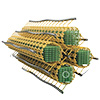
| Graphical abstract of the work. (Image: Reproduced from DOI:10.1007/s40820-025-01953-4, CC BY)
|
|
The choice of functional materials integrated into the wood scaffold determines the resulting properties. Carbon-based materials such as graphene and carbon nanotubes enhance electrical conductivity. Metal oxides contribute catalytic activity. Conductive polymers add electrochemical functionality. Single-atom catalysts provide highly efficient active sites for chemical reactions. The review discusses how each material class interacts with the wood substrate and how combinations of these components can be tailored to specific performance targets.
|
|
In energy storage, functionalized wood has demonstrated utility in metal-ion batteries, zinc-air systems, and supercapacitors. The wood-derived carbon frameworks improve electrical conductivity and cycling stability, while integrated catalysts enhance electrochemical performance. For water treatment, engineered wood structures enable efficient adsorption of heavy metals and dyes, photothermal filtration for desalination, and catalytic degradation of organic contaminants. In energy conversion, wood-based platforms have been applied to solar-thermal evaporation, ionic thermoelectric devices, hydrovoltaic generators, and triboelectric nanogenerators, all contributing to renewable power generation from ambient or waste energy sources.
|
|
The authors identify several obstacles that must be addressed before functionalized wood can transition from laboratory demonstrations to industrial use. Scalable fabrication methods are still lacking for many of the nanoengineering strategies described. Integrating multiple functional materials into a single wood substrate without compromising structural integrity remains technically demanding. Long-term environmental stability, particularly under real-world operating conditions, requires further investigation. The review calls for the development of standardized manufacturing protocols and exploration of new hybrid architectures that combine biological and synthetic design principles.
|
|
This review provides a structured roadmap for advancing functionalized wood as a sustainable material platform, drawing together research across materials science, chemistry, and environmental engineering to outline where the field stands and where it needs to go.
|