| Mar 14, 2026 |
Physicists have detected laser-assisted electron scattering using circularly polarized light for the first time, revealing new ways to probe atomic-scale chirality.
(Nanowerk News) Physicists have detected laser-assisted electron scattering using circularly polarized light for the first time, a result that could eventually help reveal how atomic-scale handedness influences the interaction between electrons, matter, and light. A team at Tokyo Metropolitan University fired synchronized femtosecond laser pulses and electron pulses at argon atoms and measured a scattering signal that matched theoretical predictions (The Journal of Chemical Physics, “Observation of laser-assisted elastic electron scattering by Ar in circularly polarized femtosecond laser fields”).
|
Key Findings
- Laser-assisted electron scattering was observed using circularly polarized femtosecond laser pulses in the near-infrared range, a first for this technique.
- Energy and angular distributions of scattered electrons showed characteristic peaks consistent with established theoretical models.
- The signal was weaker than that produced by linearly polarized light, and differences between left and right-handed circular polarization were too small to detect in this experiment.
|
|
Laser-assisted electron scattering, or LAES, is a technique that reveals how electrons interact with atoms and molecules under the influence of strong electromagnetic fields. In a typical LAES experiment, a beam of electrons is aimed at a target such as a gas of atoms. When a powerful laser field is present at the same time, the scattering process changes because the electrons exchange energy with the surrounding light field. The amount of energy exchanged follows strict quantum mechanical rules, producing characteristic shifts in the kinetic energies of the scattered electrons.
|
|
Recent LAES experiments have uncovered ways in which intense laser fields alter the behavior of matter itself. One example is a phenomenon known as light-dressing, where the strong field of a laser redistributes the electrons around an atom, effectively changing its electronic structure while the field is present.
|
|
Until now, all successful LAES measurements have relied on linearly polarized light, in which the electric field oscillates along a single direction. Circularly polarized light behaves differently. Its electric field traces a rotating helix as the wave moves forward, giving it a defined handedness, either left or right. This property makes circularly polarized light potentially sensitive to chirality, the structural handedness found in many molecules.
|
 |
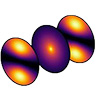
| >LAES measurement using circularly polarized light. A femtosecond laser pulse and an electron pulse were fired at an argon gas beam at the same time, giving a scattering signal whose energy and angular distributions showed the characteristic peaks of LAES. (Image: Tokyo Metropolitan University)
|
|
Comparing the scattering signal produced by left-handed and right-handed circularly polarized light also provides access to the phase of the scattered electron wave, a parameter that linear polarization cannot reveal. Despite these advantages, no one had previously performed a LAES measurement with circularly polarized light on single atoms.
|
|
The research team, led by Professor Reika Kanya, directed circularly polarized femtosecond laser pulses in the near-infrared range at a beam of argon gas while simultaneously firing electron pulses at the same target. They then measured both the energy spectrum and the angular distribution of scattered electrons, looking for the distinctive peaks that signal the LAES process.
|
|
The measurements confirmed that LAES was occurring. The positions and shapes of the peaks in the energy and angular distributions matched predictions from Kroll-Watson theory, a foundational model for describing laser-assisted scattering. The overall signal strength, however, was lower than what the same setup produces with linearly polarized light. The team was also unable to resolve any difference between left and right-handed polarization in the scattering data, a measurement that would require greater sensitivity and longer data acquisition times.
|
|
Improving detection efficiency and statistical precision remain the next practical steps. With those advances, LAES experiments using circularly polarized light could begin to extract phase information from electron scattering. Further ahead, such measurements may also clarify how structural chirality shapes the response of matter to strong fields.
|