| Mar 04, 2026 |
Scientists engineered a nanostring that cascades energy through five vibration modes from a single push, opening new paths for ultrasensitive nanoscale sensors.
(Nanowerk News) Scientists at TU Delft have designed a nanostring that, when poked, doesn’t lose its energy to the environment immediately. Instead, the energy leaks out within the string, triggering a cascade of distinct vibrational modes. For the first time, researchers have observed this cascade reaching all the way up to the fifth mode, while only actuating the first mode. This discovery offers new insights that could benefit the development of extremely sensitive sensors.
|
|
The results have been published in (Physical Review Letters, “Cascade of Modal Interactions in Nanomechanical Resonators with Soft Clamping”).
|
|
“Imagine plucking a guitar string,” associate professor Farbod Alijani begins to explain. “Eventually its energy dissipates into its surroundings, and the vibrations slowly die out.” The team engineered a nanoscale string that behaves in a very distinct manner. “When continuously plucking the string at the first mode, we observed that the energy is directed within the string to higher-order modes activating the second up to its fifth mode of vibration. In other words, five different modes are happening simultaneously within the same nanostring.”
|
 |
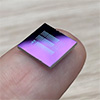
| A tiny chip carrying engineered nanostrings, showing the nanoscale devices that produced a cascade of five vibration modes from a single input. (Image: TU Delft)
|
|
It’s the first time researchers have achieved such a cascade of modal interactions. “We designed the nanostring very deliberately to make this possible,” adds postdoc Zichao Li. “The strings are extremely thin, about a hundred times thinner than human hair. We place many of them on a chip, which we attach to an actuator that vibrates at specific frequencies. Those vibrations travel into the string and excite its modes.” Instead of fixing the string rigidly at both ends, the team used a soft clamping approach, allowing the string to flex more freely and making the cascade possible.
|
What are vibrational modes?
|
|
When a nanostring vibrates, it doesn’t move in just one fixed way. Every object has multiple vibrational modes: distinct patterns of motion, each with its own frequency. The first mode is the simplest, where the entire string moves up and down in one smooth arc. In higher modes, nodes appear, which are points that remain still while the rest of the string vibrates. The higher the mode, the more complex the pattern becomes.
|
Pushing the limits of sensing devices
|
|
This cascade behavior is more than a curiosity. The researchers expect this finding to have its greatest impact in sensing applications. “Each mode that becomes active opens up a new channel to sense,” the Li explains, “which makes it very useful for developing extremely sensitive sensors.” In principle, they can now achieve with a single nanostring what traditionally requires multiple separate devices.
|
|
This was carried out in collaboration with colleagues from the Precision and Microsystems Engineering Department, including Mixing Xu, Richard Norte, Peter Steeneken and Alejandro Aragón. The team now plans to continue expanding this line of work and explore how these cascades can be applied in the design of future nanomechanical devices. “We are only at the dawn of what can be made possible when nanomechanical devices are engineered to harness cascades of interactions for new sensing applications,” concludes Alijani.
|