| Dec 12, 2025 |
A study used DNA origami to form 2D fishnet structures on silicon, testing growth conditions and advancing DNA-assisted lithography for optical materials.
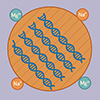
(Nanowerk News) A dissertation at the University of Jyväskylä in Finland shows how DNA can act as a nanoscale construction material on a surface used across electronics and manufacturing. The research built two dimensional fishnet style lattices from DNA origami on silicon and tested how temperature and salt conditions shape how those lattices form. The team argues that this opens practical routes for DNA assisted lithography and, ultimately, new material designs for optics.
|
|
In the doctoral thesis, Doctoral Researcher Johannes Parikka fabricated fishnet type 2D DNA origami lattices directly on silicon.
|
|
“DNA origami are nanoscale structures composed of single stranded DNA. They can interact with each other, forming larger lattice structures,” specifies Doctoral Researcher Johannes Parikka from the University of Jyväskylä.
|
|
That shift in surface matters because earlier versions of these lattices formed only on mica. The mineral is fragile and does not fit with follow on microfabrication steps such as etching. By moving assembly to silicon, the work aims to make DNA based patterns compatible with downstream processing. The thesis frames this as a way to use DNA assisted lithography to help fabricate new types of materials, including structures designed for optical applications.
|
|
Parikka also reports a size milestone for the lattice order achieved on silicon.
|
|
“The largest single crystal lattice assembled on silicon was 5.6 µm2 in area, which means around 560 individual DNA origami. For this particular design and silicon substrate, it is the largest result ever achieved,” says Parikka.
|
How the lattices assemble
|
|
The study relies on self assembly, letting many DNA origami units organize into larger 2D lattices after deposition onto silicon. Both the DNA origami and the treated silicon surface carry negative charge, so the work uses ions to mediate attachment and mobility. Divalent cations such as Mg²⁺ help bind DNA origami to the surface, while monovalent cations such as Na⁺ allow the interaction strength to be tuned. In practical terms, the thesis uses table salt, NaCl, as part of that tuning.
|
|
“The Na+ ions of added table salt replace some of the attaching Mg2+ ions, which increases the DNA origami mobility on the surface, enabling the lattice assembly,” specifies Parikka.
|
|
To map out what helps or hinders lattice formation, the research varied deposition conditions including temperature and salt concentrations. The structures were mostly imaged with atomic force microscopy, which can scan surfaces with nanoscale resolution.
|
Additional structures beyond flat lattices
|
|
While the core result centers on 2D lattices on silicon, the thesis also reports behavior in solution when conditions change.
|
|
“During the research, it was also noticed that by tuning the conditions, mainly sample solution salt concentrations, DNA origami lattices could be rolled into tubular structures in solution. In addition, the same DNA origami, with slight modifications, could be used to form controlled nanoparticle lattices,” says Parikka.
|
Why it matters for photonics and metamaterials
|
|
The thesis argues that reliable lattice fabrication on silicon matters for photonics because silicon compatibility can enable metallization using DNA assisted lithography. Metallic lattices can strengthen optical responses compared with individual DNA origami units and can support designs aimed at metamaterials.
|
|
“Metamaterials have a certain property, such as a negative refractive index, which cannot be found in materials found in nature,” explains Parikka.
|
Thesis background and public examination
|
|
Johannes Parikka completed his master’s thesis in 2020 at the Department of Chemistry and began PhD research at the Department of Physics and the Nanoscience Center. Professor Jussi Toppari supervised the doctoral thesis. Funding came from the Jane and Aatos Erkko Foundation, the Research Council of Finland, the Magnus Ehrnrooth Foundation, the University of Jyväskylä, and the Emil Aaltonen Foundation.
|
|
MSc Johannes Parikka’s thesis is titled “Nanofabrication using DNA nanotechnology”. The public examination is held on Friday, 19th of December at 12.00. The opponent is Professor Tim Liedl (Ludwig Maximilians Universität München), and the custos is Professor Jussi Toppari (University of Jyväskylä). The public examination is held in English. The public examination can also be followed as a livestream from Moniviestin at https://r.jyu.fi/dissertation-parikka191225.
|
|
The thesis “Nanofabrication using DNA nanotechnology” is available in the JYX archive at: http://urn.fi/URN:ISBN:978-952-86-1191-2.
|