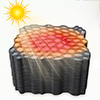
A layered coating on delignified wood enables solar heat storage and electricity generation without carbonization, while adding water, fire, and microbial resistance.
(Nanowerk Spotlight) Photothermal conversion can in principle capture more than 90% of incoming solar radiation, far exceeding the roughly 25% ceiling that bounds conventional photovoltaics. When a photothermal absorber sits atop a thermoelectric generator, the temperature difference between the heated surface and the cool side produces a voltage, a phenomenon known as the Seebeck effect. But the moment sunlight fades, the surface cools, the gradient collapses, and power output drops to zero.
Phase-change materials offer a way around this. Embedded in the absorber, they melt as the surface heats up, storing large amounts of energy as latent heat. When irradiation drops, they solidify and release that stored heat, sustaining the temperature gradient for several minutes until the phase change completes.
Achieving this in practice, however, requires the absorber, the heat store, and the protective surface to function as a tightly integrated unit. Splitting them across separate materials introduces thermal resistance at every interface, and each additional component consumes space that could otherwise hold phase change material, directly reducing storage capacity.
The ideal scaffold would therefore serve multiple roles at once: confine the phase change material, absorb sunlight across a broad spectrum, and present a surface amenable to protective modification, all without sacrificing storage volume to gain functionality.
Wood already fulfills two of these three requirements. Balsa, one of the fastest-growing tree species, contains vertically aligned microchannels roughly 20 to 50 µm across that can confine molten fatty acids and direct heat along the grain. Stripping out the lignin raises porosity above 90% and exposes cellulose surfaces rich in hydroxyl groups, a chemist’s starting point for further modification.
The standard remedy, high-temperature carbonization, solves the optical problem but incinerates the very functional groups that would enable waterproof coatings, flame-retardant anchoring, or antimicrobial surface treatments. Attempts to compensate through physical blending of nanosheets like graphene, boron nitride, or MXene have encountered weak interfacial bonding, filler migration during melting cycles, and a persistent inability to address more than one or two of these vulnerabilities at a time.
The researchers engineered the internal channel walls of delignified balsa with black phosphorene nanosheets wrapped in a tannic acid-iron metal-polyphenol network, then grew silver nanoparticles on the surface and grafted long-chain alkyl molecules as a final hydrophobic layer. Because these components build on one another chemically rather than occupying separate volumes, the system avoids the usual trade-off between added functionality and lost storage capacity.
Design of interface-engineered wood-based composite phase change materials (CPCMs) for solar-thermal energy conversion. BPNS@MPN drop-cast onto delignified wood aerogels denoted as TBW, which after Ag reduction and 18-alkyl grafting was denoted as TBAW; the final SA-loaded CPCMs were denoted as TBAWP. (Image: Reproduced with permission from Wiley-VCH Verlag) (click on image to enlarge)
The fabrication starts with delignification. An acidic sodium chlorite treatment selectively removes lignin from balsa while preserving cellulose and hemicellulose, thinning the cell walls and raising porosity above 93%. The resulting scaffold retains its aligned channel architecture but gains expanded internal surface area and a higher density of reactive hydroxyl groups.
Black phosphorene provides the solar absorption. The team synthesized bulk black phosphorus through a rapid catalytic route and exfoliated it into ultrathin nanosheets fewer than five layers thick. The material absorbs broadly across ultraviolet, visible, and near-infrared wavelengths and converts that energy to heat through nonradiative relaxation. As a phosphorus-based material, it also contributes intrinsic flame retardancy, eliminating the need for a separate fire-retardant additive.
Bare phosphorene nanosheets, however, break down rapidly under ambient conditions through oxidative degradation, a vulnerability that has hampered practical applications despite various efforts at stabilizing phosphorene against oxidation and degradation. The metal-polyphenol network in this study solves the problem differently. Tannic acid coordinates with iron ions to self-assemble a conformal protective coating around each nanosheet.
After 150 days of solar exposure, coated nanosheets retained their original structure, while unprotected phosphorene showed severe oxidation. The polyphenol network also enhances photothermal conversion through ligand-to-metal charge transfer and provides chemical anchors for subsequent modification steps.
The coated nanosheets bond to the wood’s channel walls through coordination with the cellulose hydroxyl groups, creating a rough, polyphenol-rich interior. Silver nanoparticles then nucleate directly on this coating through mild aqueous reduction, adding localized surface plasmon resonance in the visible spectrum and sharpening the nanoscale texture.
A final grafting of octadecyl chains lowers the surface energy, completing a hierarchical structure that repels water with a contact angle of 153° and maintains that performance through mechanical abrasion, ultrasonication, boiling, and immersion in aggressive organic solvents.
The hydrophobic interior also improves compatibility with stearic acid, the bio-derived fatty acid used as the phase change material. Vacuum impregnation filled the modified channels densely, and electron microscopy revealed seamless contact between the acid and the scaffold walls.
Leakage tests at 80 °C confirmed the advantage: pure stearic acid and composites made with unmodified delignified wood both leaked, while the surface-engineered composites held their shape. The bare wood framework absorbed nearly 200 times its mass in water; the fully modified composite absorbed almost none.
This encapsulation stability translates directly into thermal performance. The best composite delivered a latent heat of approximately 175 kJ/kg and a thermal conductivity 3.9 times that of pure stearic acid along the wood’s axial direction. The aligned channels act as directional pathways for phonon transport, while the phosphorene nanosheets and silver nanoparticles bridge thermal resistance at cell wall interfaces. After 100 heating-cooling cycles, enthalpies showed negligible change, and both chemical composition and crystalline structure remained intact.
Under simulated one-sun irradiation, the composite achieved a photothermal conversion and storage efficiency of 91.27%. When the lamp switched off, the stearic acid solidified and released its stored heat, maintaining a clear thermal plateau. Coupled to a thermoelectric generator, the system produced a stable open-circuit voltage of approximately 0.65 V, sufficient to power a small fan. The voltage persisted through the thermal plateau, demonstrating the composite’s ability to buffer brief solar interruptions.
Vertical combustion tests showed that unmodified composites burned continuously once ignited, while the fully treated composite self-extinguished within 120 seconds. Peak heat release rate and total heat release dropped by 27.4% and 31.2%, respectively.
The treated composite retained its aligned microstructure after burning and formed a stable, graphitized char layer; the unmodified version disintegrated into irregular fragments. Phosphorene layers and the metal-polyphenol network promote stable char formation in the condensed phase, while phosphorus-containing radicals scavenge flame-propagating species in the gas phase.
The silver nanoparticles in the coating also gave the composite clear antibacterial activity against both E. coli and S. aureus, addressing the microbial colonization that degrades bio-derived scaffolds during prolonged outdoor exposure.
The study establishes a modular interfacial engineering approach: a metal-polyphenol network that can simultaneously stabilize an oxidation-prone nanomaterial, anchor functional nanoparticles, and provide chemical handles for hydrophobic grafting, all while preserving wood’s native chemistry.
The team suggests the strategy could extend to other two-dimensional materials and biomass-derived scaffolds beyond balsa, offering a flexible template for sustainable solar thermal energy systems.
For authors and communications departmentsclick to open
Lay summary
Prefilled posts
ORCID information
Xinxin Sheng (Guangdong University of Technology)
, 0000-0001-7695-0430 corresponding author
Delong Xie (Kunming University of Science and Technology)
, 0000-0003-3587-4288 corresponding author
Nanowerk Newsletter
Get our Nanotechnology Spotlight updates to your inbox!
Thank you!
You have successfully joined our subscriber list.
Become a Spotlight guest author! Join our large and growing group of guest contributors. Have you just published a scientific paper or have other exciting developments to share with the nanotechnology community? Here is how to publish on nanowerk.com.