| Jan 15, 2026 |
Researchers tracked real-time light-induced charge on gold nanorods, modeling them as capacitors, aiding CO2 reduction, water splitting, and solar energy conversion.
(Nanowerk News) Gold nanorods are promising photocatalysts that can use light energy to drive chemical reactions—such as converting CO₂ into usable fuels or producing hydrogen from water. In this process, the nanorods act like tiny antennas that capture light and convert it into collective oscillations of their electrons. During the reaction, the particles can become electrically charged.
|
|
A research team at the University of Potsdam led by physicist Dr. Wouter Koopman has now, for the first time, directly observed how this charging process occurs and developed a model that describes the underlying mechanisms.
|
|
The results (Nature Communications, “Capacitive photocharging of gold nanorods”) pave the way for the targeted control of light-driven chemical reactions and catalytic systems. In the long term, these systems have a wide range of potential applications – from solar-powered chemical reactors to novel energy storage technologies.
|
 |
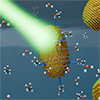
| Gold nanorods surrounded by water and ethanol molecules. Illuminating the nanorods generates a photovoltage. This allows the rods to extract electrons from the surrounding ethanol and water, resulting in electron accumulation on the rods (blue spheres). (Image: Felix Stete)
|
|
Photocharging is a central but previously elusive process in photocatalysis with nanoscale metal particles: under illumination, excess charge can accumulate, significantly influencing catalytic properties. In an in-situ study, the team was able to observe this effect directly and demonstrate that gold nanorods behave like “photochemical capacitors” under light exposure: they store electrons at their surface. Owing to the large surface-to-volume ratio, a substantial amount of charge can accumulate in an extremely small space, leading to pronounced changes in their optical and chemical properties.
|
|
“We were able to directly demonstrate that light alone is sufficient to generate electric potentials between a single nanoparticle and its environment,” explains Dr. Felix Stete, the study’s lead author.
|
|
When light is absorbed, electron–hole pairs are created. The holes are transferred to surrounding molecules – such as ethanol – while the electrons remain on the particle.
|
|
“Our particles essentially behave like nanometer-sized electrolyzers, devices that split water into H2 and O2 with the help of electricity,” says Wouter Koopman, “except that they do not require an external electric voltage source.”
|
|
In doing so, the researchers provide a new physical framework for better understanding and optimizing light-driven chemical reactions.
|