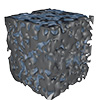
Cement infused with carbon and hydrogel can store electrical energy while remaining strong enough for construction, suggesting a future where buildings contribute directly to energy storage.
(Nanowerk Spotlight) Buildings use enormous amounts of energy but do not store any. They sit at the end of power lines, always needing to be supplied. If the grid falters, the structure goes dark. This one-way relationship defines how modern infrastructure works: the walls, floors, and foundations of a building provide strength and shelter, and everything electrical must be added on top in the form of wires, panels, boxes, and batteries.
But is that boundary really necessary? What if the material a structure is made from could also act as an electrical device? Not by turning a skyscraper into a battery farm, but by shifting a portion of everyday energy management into the very fabric of the built environment. If highways, retaining walls, or building blocks could store charge the way a supercapacitor does, using fast and reversible physical processes instead of slow chemical changes, they could buffer shifts in energy supply simply by existing. Storage would not need dedicated space. It would be embedded.
The idea has been appealing in concept but hard to achieve in practice. Materials that store electrical charge well tend to be weak or brittle. Strong materials like cement do not conduct well and tend to dry out, crack, or lose function when exposed to real weather.
Attempts to improve one property often damage another: adding conductive particles weakens strength, increasing pore volume helps ion movement but creates a fragile matrix, and common electrolytes evaporate, freeze, or degrade. These problems have kept structural energy storage at the prototype stage.
In the journal Advanced Science (“Structural Cement‐Based Supercapacitors with Multifunctional Robustness for Energy Storage”), a research team in China reports an experiment that tries to solve all three challenges at once. It presents a cement-based supercapacitor designed to store electrical charge, carry compressive load, and keep operating in heat, cold, and even open flame.
The device is made from common materials: cement, carbon black, a hydrogel that traps water, and a surfactant that makes the solid and liquid parts work together. It is shaped and strengthened using pressure and heat, two processes already used in parts of the concrete industry. The study argues that energy storage can be built directly into the structures we already need, without exotic ingredients or special environments.
Multi-scale design of CC electrode, involving a) hot-pressing preparation and building a MSHN from microscale to nanoscale via b) hydrogel impregnation and c) in situ polymerization. d) At the molecular scale, SDS acts as the bridge promoting the in situ polymerization of PAM monomers around the CB surface. (Image: Reprinted from DOI:10.1002/advs.202515769, CC BY) (click on image to enlarge)
The core begins with the electrode. Cement powder and carbon black are mixed with water. Carbon black is a fine form of carbon with a very high surface area. That surface is where ions gather during energy storage. The mixture is cast, cured, and then hot pressed at 90 degrees Celsius. The pressure ranges from 0.2 to 8 tons. Hot pressing packs particles closer and reduces voids that would otherwise weaken the material. It raises compressive strength from 3.2 megapascals to 31 megapascals. At the same time, it reduces the distance electrons must travel between carbon sites, which improves electrical conductivity. However, too much pressure closes small pores that are needed for ions to move. The study identifies a moderate pressure window that allows both strength and ionic access.
Next comes the electrolyte, which must remain stable through moisture loss and temperature swings. Here the researchers use a hydrogel made from polyacrylamide. A hydrogel is a polymer that traps water in a soft, elastic mesh. It holds liquid without letting it drain away.
To get the hydrogel inside the cement, the researchers use two steps. First, they mix a small molecule called acrylamide into the wet cement. Second, after curing and pressing, the material is placed under vacuum in a liquid that contains ions and the ingredients needed to form the hydrogel. The vacuum pulls the liquid into the pores, and the polymer forms inside them. That creates a continuous water rich network within the electrode.
The hydrogel holds 90 percent of its water even after being exposed to 60 degrees Celsius in open air for more than three hours. It also stays flexible and conductive at minus 20 degrees Celsius, which prevents the freezing that normally stops ion movement.
The last major part is the interface between carbon and hydrogel. Carbon black repels water, while the hydrogel depends on water. That contrast creates dry zones where ions cannot reach the carbon surface.
The team fixes this by adding a surfactant called sodium dodecyl sulfate during polymer formation. A surfactant has one end that likes water and one end that avoids it. Sodium dodecyl sulfate attaches to the carbon surface at one end and to the hydrogel at the other. That forms a molecular bridge so ions can reach the carbon particles more easily.
Microscopy confirms the carbon becomes wrapped in thin layers of hydrogel when the surfactant is present. Tests also show that internal resistance falls and capacitance rises, especially at higher charging speeds.
When the device is tested, it stores large amounts of charge per surface area. At a current of 2.5 milliamperes per square centimeter, a low-pressure sample stores 1551 millifarads per square centimeter. A sample pressed at 8 tons drops to 901 millifarads per square centimeter because many small pores have been squeezed shut. When the hydrogel is added without the surfactant, the internal resistance rises.
When both hydrogel and surfactant are added, resistance drops again to about 3 ohm centimeters and charge storage improves. The best result reaches 1708 millifarads per square centimeter and still holds more than 8 megapascals of compressive strength.
Cycle testing shows the material can store and release energy many times. After 1000 cycles at moderate current, a device with hydrogel keeps about 83 percent of its original charge capacity. With both hydrogel and surfactant, that figure rises to 93 percent.
The device returns over 99 percent of the charge it receives on each cycle. After 10000 cycles, it keeps over 83 percent of its starting capacity. Extended testing shows that capacity can drop after 25000 cycles, likely because salt ions cling to the carbon surface and block access. Soaking the device in fresh electrolyte restores part of the loss.
The hydrogel also increases the maximum voltage the device can tolerate. At 2 volts, it holds useful capacity after 1700 cycles. Without hydrogel, it loses most of its function after only 100 cycles at that voltage.
The material also works under realistic physical stress. It keeps more than 90 percent of its capacity when compressed close to failure. It still powers a small diode when cracked. It does not burn when held in the flame of an alcohol lamp for two hours. The hydrogel dries out during that test, but rehydration restores most of the charge capacity. The stored energy changes by less than 9 percent across temperatures from minus 20 to 80 degrees Celsius.
These results reflect the internal structure. Pressing at the right temperature and load preserves two types of pores. Tiny pores provide the surface for ion storage. Larger pores act as channels for ion motion. The hydrogel fills many of those spaces and increases strength by bonding cement hydrates. The surfactant improves how ionic liquid wets the carbon surface, which reduces resistance and increases usable area.
The authors emphasize scaling. All ingredients are common and inexpensive. The workflows are compatible with concrete casting and precast production. One constraint is device thickness. Ions cannot move far into thick electrodes during fast charging, so total capacity is better increased by using larger surface areas, not by adding depth. That means the technology fits best in panels, blocks, or slabs where area is high and thickness is modest.
This work shows a way to build energy storage into structural materials without sacrificing mechanical strength or environmental stability. It does this by combining carbon and cement in a press formed matrix, adding a water rich hydrogel for ion movement, and inserting a surfactant to improve internal contact. The result is a device that stores energy, survives load and heat, repeats cycles thousands of times, and uses materials already produced at scale.
Open questions remain about long term weathering, chemical stability, and behavior under road salt or carbonation. But the study outlines a realistic path toward structural energy storage that does not require new land, new enclosures, or new wiring systems. Instead, it uses the materials already present in the built world and gives them a second task.
For authors and communications departmentsclick to open
Lay summary
Prefilled posts
ORCID information
Yu Zhang (Shandong University of Science and Technology)
, 0000-0003-2558-0606 corresponding author
Nanowerk Newsletter
Get our Nanotechnology Spotlight updates to your inbox!
Thank you!
You have successfully joined our subscriber list.
Become a Spotlight guest author! Join our large and growing group of guest contributors. Have you just published a scientific paper or have other exciting developments to share with the nanotechnology community? Here is how to publish on nanowerk.com.