

Dec 12, 2025 A five-element ceramic aerogel compresses by 98% and recovers its shape from cryogenic to 1500 degrees C temperatures, outperforming conventional thermal insulation materials. (Nanowerk Spotlight) Ceramic aerogels occupy a peculiar niche in materials science: they are among the lightest solid materials ever created, yet they must withstand...
Blog
Functionalized graphene microrod resonator enables switchable-selectivity gas sensing
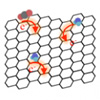
Dec 13, 2025 Graphene integrated silica microrod sensor converts gas adsorption into optical shifts, achieving parts per billion sensitivity with doping controlled selectivity at low power. (Nanowerk News) Monitoring trace gases with high sensitivity and selectivity is essential for environmental safety and smart monitoring systems. Whispering-gallery-mode (WGM) optical microcavities have...
Iron nanoparticles drive the breakdown of plastic additives

Dec 13, 2025 Iron oxide crystal phase governs how efficiently organophosphate ester pollutants hydrolyze, with lepidocrocite showing the strongest catalytic activity despite weaker adsorption. (Nanowerk News) By comparing three common iron oxide polymorphs, researchers discovered that the crystalline phase of these minerals determines how effectively they catalyze the hydrolysis of...
Webb identifies earliest supernova to date, shows host galaxy

Dec 13, 2025 The telescope captured near-infrared light from one of the earliest stars seen to explode in the history of the universe. (Nanowerk News) NASA’s James Webb Space Telescope has observed a supernova that exploded when the universe was only 730 million years old — the earliest detection of...
How femtosecond lasers push the limits of nanostructures for thermal engineering
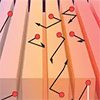
Dec 12, 2025 Researchers develop an industry-scalable method to tune thermal conductivity in thin films using femtosecond lasers. (Nanowerk News) Femtosecond laser-induced periodic surface structures can be used to control thermal conductivity in thin film solids, report researchers from Japan. Their innovative method, which leverages high-speed laser ablation, produces parallel...
Graphene membranes show promise for cheaper CO2 capture
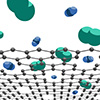
Dec 11, 2025 Researchers have modelled how a new graphene-based membrane material could cut the energy use and cost of capturing CO2 from power and industrial plants. (Nanowerk News) Carbon capture is becoming essential for industries that still depend on fossil fuels, including the cement and steel industries. Natural-gas power...
Molecular fine-tuning increases efficiency of solar cells
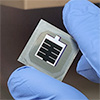
Dec 12, 2025 With targeted molecularly designed contacts, researchers reach an efficiency of perovskite-silicon tandem cells of 31.4 percent. (Nanowerk News) Perovskite-silicon tandem solar cells are considered a key technology for photovoltaics. Because of their design, they use sunlight more efficiently than conventional silicon cells. While the upper perovskite layer...
Ultracold atoms recreate Josephson junction Shapiro steps in quantum simulation

Dec 12, 2025 Researchers split two Bose-Einstein condensates with a laser barrier, simulating a Josephson junction and revealing universal Shapiro steps. (Nanowerk News) They enable high-precision measurements, define the unit of voltage, and form the heart of many quantum computers – the so-called Josephson contacts. However, the microscopic processes taking...
Researchers find that a ‘design limitation’ in transistors actually improves performance

Dec 12, 2025 What many engineers once saw as a flaw in organic electronics could actually make these devices more stable and reliable, according to new research. (Nanowerk News) A paper to be presented at the IEEE International Electron Devices Meeting (IEDM) 2025, describes how embracing small energy barriers at...
Uranus and Neptune might be rock giants

Dec 12, 2025 A team of researchers is challenging our understanding of the Solar System planets interior. The composition of Uranus and Neptune, the two outer most planets, might be more rocky and less icy than previously thought. (Nanowerk News) The planets in the Solar System are typically divided into...