

Feb 27, 2026 In a new study, researchers examined what happens when nanoplastics interact with Salmonella, potentially affecting food safety and human health. (Nanowerk News) Plastic products are ubiquitous in our food supply chain, shedding microplastics into every part of the human ecosystem. As they degrade, microplastics break down into...
Blog
Using moon dirt to build future lunar colonies

Feb 27, 2026 Laser 3D printing offers sustainable foundation for in-space manufacturing. (Nanowerk News) Simulated lunar dirt can be turned into extremely durable structures, potentially paving the way to more sustainable and cost-effective space missions, a new study suggests. Using a special laser 3D printing method, researchers melted fake lunar...
Light alone programs and reprograms a crystal surface to guide living cells
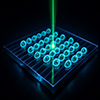
Feb 27, 2026 Erasable electric fields written by laser light onto crystal surfaces can trap, align, and release living cells without electrodes or physical contact. (Nanowerk Spotlight) All human cells possess electrical properties. Every cell maintains a voltage difference across its membrane, produced by the movement of charged ions like...
Electric eel biology inspires powerful gel battery
Feb 27, 2026 Researchers used a unique approach to develop non-toxic batteries for use in medical devices and more. (Nanowerk News) Power sources used in devices found in or around biological tissue must be flexible and non-toxic, while still powerful enough to support demanding technologies such as medical devices or...
Polar bear hair inspires graphene fibers that sense, insulate, and power smart clothing
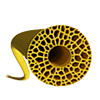
Feb 27, 2026 Hollow graphene aerogel fibers mimicking polar bear hair achieve record-low thermal conductivity and high electrical conductivity for multifunctional smart textiles. (Nanowerk Spotlight) Polar bears survive Arctic winters that plunge below −70 °C, and a key reason lies not in their bulk but in the architecture of their...
Femtosecond laser pulses enable ultrafast broadband optical switching
Feb 27, 2026 Researchers demonstrate that femtosecond laser-induced transient Pauli blocking can achieve ultrafast, broadband optical switching from visible to near-infrared. (Nanowerk News) Recent decades have witnessed rapid advancements in high-intensity laser technology. The combination of laser irradiation and novel materials is opening exciting avenues for the design of functional...
New seeding technique brings perovskite solar cells closer to large-scale production
Feb 27, 2026 A new crystal-seeding method boosts the efficiency and scalability of perovskite solar cells, advancing this promising technology toward large-scale clean energy production. (Nanowerk News) Regular perovskite solar cells (PSCs)—which place the electron-transport layer beneath the perovskite absorber and the hole-transport layer on top—have limitations with respect to...
A robust new telecom qubit in silicon
Feb 26, 2026 Researchers identified a new silicon qubit that emits telecom-band light without fragile hydrogen, potentially enabling scalable quantum devices using existing chip technology. (Nanowerk News) Quantum technologies are anticipated to transform computing, communication and sensing by harnessing the unusual behavior of matter at the atomic scale. Translating quantum’s...
Liquid metal droplets fuse themselves into stretchable circuits

Feb 26, 2026 Liquid metal droplets fuse themselves into stretchable circuits at room temperature, driven only by surface tension gradients during solvent evaporation. (Nanowerk Spotlight) Gallium-indium alloys are liquid at room temperature and conduct electricity almost as well as solid copper wire. That combination makes them attractive for stretchable electronics,...
Covalent organic frameworks assembled inside tumor cells trigger cancer cell death and immune activation
Feb 26, 2026 Crystalline polymers assembled inside tumor cell lysosomes rupture membranes, release iron, and trigger immune-activating ferroptosis that shrinks tumors in mice. (Nanowerk Spotlight) Cells produce natural polymers such as DNA, proteins, and sugars to sustain life. Synthetic polymers can offer properties they lack: customizable architecture, tunable porosity, built-in...