
Mar 06, 2026 Twisted electronic states in a molecule realized experimentally and modeled on quantum hardware. (Nanowerk News) Researchers at IBM Research, the University of Manchester, Oxford University, ETH Zürich, EPFL Lausanne and the University of Regensburg (Cluster of Excellence CCE) collaborated to realize an unprecedented molecular topology: the so-called...
Blog
Accelerating catalyst materials discovery with large artificial intelligence models

Mar 06, 2026 AI models are transforming catalyst discovery by combining databases with machine learning and language models, enabling faster design of materials for clean energy. (Nanowerk News) Artificial intelligence (AI) is transforming the way scientists discover and design new materials. In a specially invited review published in Angewandte Chemie...
Scientists control ‘free-flowing’ electric currents with light
Mar 06, 2026 Team uses light to control magnetic fields in quantum materials, steering resistance-free electric currents for energy-efficient quantum computing. (Nanowerk News) By controlling magnetic fields using light, a team of researchers led by NTU scientists has solved a long-standing challenge to precisely direct electric currents produced by quantum...
MXene smart textiles could track vitals, kill bacteria, and harvest solar energy
Mar 06, 2026 MXene materials can be coated onto fabrics to create smart textiles that track heart rate, blood pressure, and temperature while fighting bacteria and storing solar energy. (Nanowerk News) You’re probably used to the sight of smartwatches on people’s wrists. But what about smart clothes? Researchers at the...
Photonic crystal light sails could propel spacecraft without fuel
Mar 06, 2026 Researchers design scalable nanostructures that selectively reflect propulsion laser light while reducing heat and mass for fuel free interplanetary travel. (Nanowerk News) Most space missions rely on chemical rockets for propulsion. Rockets must carry fuel, which increases spacecraft mass and limits their speed and travel distance. For...
Eco-friendly cotton that repels water and separates oil
Mar 06, 2026 Hydrophobic nanoparticles create fluorine-free, water-repellent cotton with micro- and nanoscale surface textures. Stain-resistant, breathable, and eco-friendly. (Nanowerk News) Cotton is well-known for its breathability, comfort, and versatility. However, its natural tendency to absorb water (a property known as hydrophilicity), limits its use in specialised applications such as...
Gradient wall microbottle resonator enables large scale optical trapping
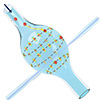
Mar 06, 2026 A gradient-thickness microbottle resonator traps nanoparticles across 195 micrometers at sub-milliwatt power by shielding peak optical fields from particle interference. (Nanowerk News) A new optical trapping platform based on a hollow microbottle resonator with gradient wall thickness achieves stable, large-scale particle confinement across nearly 200 micrometers using...
Tiny thermometers offer on-chip temperature monitoring for processors
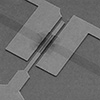
Mar 06, 2026 Researchers developed a microscopic thermometer smaller than an ant's antenna that can be integrated onto chips for highly efficient and precise temperature monitoring. (Nanowerk News) The semiconductor chips driving modern-day computer processors are covered in billions of individual transistors, each of which can overheat under stress, causing...
Wet coffee grounds turn black and that simple fact helps desalinate seawater
Mar 06, 2026 A fully biomass hydrogel made from coffee grounds and seaweed polymer turns black when wet, capturing 94% of sunlight to desalinate seawater without synthetic additives. (Nanowerk Spotlight) Spent coffee grounds darken noticeably when wet. It is an everyday observation, easy to overlook, but it reflects a real...
Novel method holds promise for smaller, tuneable machines to produce water-window X-rays
Mar 06, 2026 Discovery paves the way for smaller and more flexible machines for bioimaging. (Nanowerk News) Researchers from Nanyang Technological University, Singapore (NTU Singapore) have found a new way to produce X-rays with wavelengths in what is called the “water window”. This new method holds promise in making bioimaging...