

Mar 11, 2026 Engineers have developed an automated microfluidic platform that dramatically accelerates the formulation of lipid nanoparticles, the delivery vehicles behind mRNA vaccines and gene therapies. (Nanowerk News) AI has designed candidate drugs for antibiotic-resistant infections and genetic diseases. But efforts to incorporate AI into the design of lipid...
Blog
How to make magnets act like graphene

Mar 10, 2026 Engineers found a surprising link between graphene electrons and magnetic spin waves in magnonic crystals, offering new insights for RF technology and both fields. (Nanowerk News) The electronic and magnetic properties of two-dimensional materials both have strong potential for technological applications. Researchers have long assumed that they...
Miniature laser technology could bring lab testing into your home

Mar 10, 2026 Researchers developed a thumbnail-sized chip integrating laser and optics for portable biosensors, enabling point-of-care biomolecular testing outside labs. (Nanowerk News) By studying how various biomolecules interact with each other – for example antibodies in the immune system and xenobiotic antigens – researchers can gain valuable insights leading...
Ultrafine electroactive fibers enable textile-scale soft robotic actuators
Mar 10, 2026 Researchers developed hair-thin polymer fibers that bend and contract with electricity, enabling soft robotic actuators that can be woven into textiles. (Nanowerk News) Researchers at Tohoku University, working with international collaborators in France, have developed an ultrafine "soft yarn" actuator fiber capable of bending, contracting, and producing...
New mRNA platform maintains drug efficacy in aging and obese patients

Mar 10, 2026 Scientists developed a new mRNA platform that keeps vaccines and therapies effective in older adults and patients with obesity, where current treatments often lose potency. (Nanowerk News) Researchers have engineered a redesigned regulatory region of messenger RNA that substantially boosts protein production and immune responses in preclinical...
Chemical shifts help track molecules breaking apart in real time

Mar 10, 2026 Tracking ultrafast charge rearrangement during molecular breakup using time-resolved X-ray photoelectron spectroscopy. (Nanowerk News) When molecules fall apart, their electric charge doesn’t stay put—it rearranges as bonds stretch and break. An international team of scientists has now tracked these ultrafast changes in the small molecule fluoromethane (CH₃F)....
Solar-powered graphene membrane filters battery-grade lithium from concentrated brine
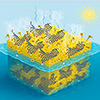
Mar 10, 2026 A graphene membrane uses sunlight to separate lithium from magnesium-rich brine, achieving 28-fold enrichment without electricity or pumps. (Nanowerk Spotlight) Beneath the salt flats of Chile and Bolivia sits a vast reserve of dissolved lithium. These deposits account for roughly 60% of the world's known supply of...
Strange cosmic burst from colliding galaxies shines light on heavy elements

Mar 10, 2026 Neutron star collision in merging galaxies reveals how cosmic destruction forges heavy elements like gold, offering clues to the universe's chemical evolution. (Nanowerk News) A recently detected flash of energy appears to have emanated from the wreckage of colliding galaxies, according to an international team of astronomers...
Atom-thin material could help solve chip manufacturing problem?

Mar 10, 2026 A 2D material called chromium oxychloride dramatically outperforms traditional hard masks in chip fabrication, resisting plasma etching far better at nanoscale thicknesses. (Nanowerk News) Making computer chips smaller is not just about better design. It also depends on a critical step in manufacturing called patterning, where nanoscale structures...
Ultrathin glass layer lets flexible solar cells survive both space radiation and corrosive chemicals

Mar 10, 2026 An ultrathin glass layer gives flexible triple-junction solar cells both chemical and radiation resistance, opening a single design to space power and solar fuel production. (Nanowerk Spotlight) Space solar arrays and solar-driven fuel production seem like unrelated technologies. Both, however, rely on III–V semiconductor photovoltaics, cells that...